Fall of the Roman Empire | World History | Khan Academy
TL;DR
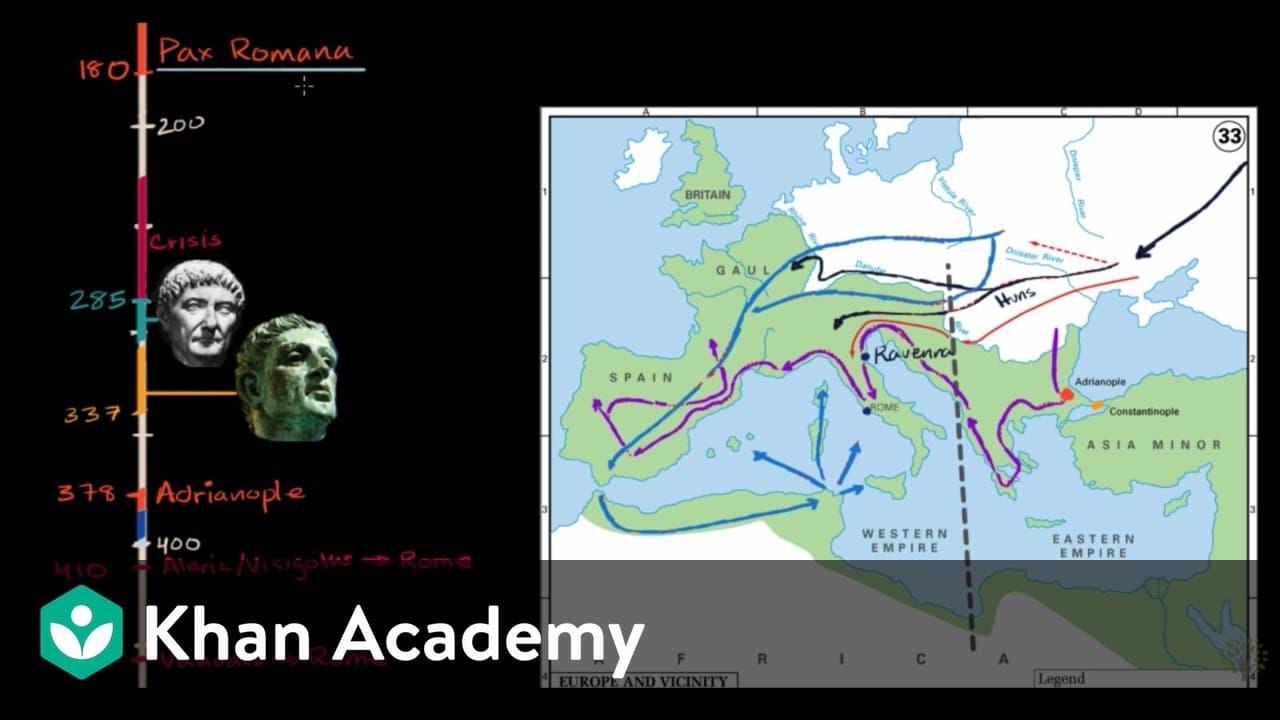
After a relatively stable period known as Pax Romana, the Roman Empire faces a succession of less competent leaders, leading to corruption and instability. The empire experiences a 50-year crisis known as the Third Century Crisis, followed by further fragmentation in the fourth and fifth centuries due to invasions from the Huns and Germanic tribes.
Transcript
- [Instructor] In the last video we talk about the first 200 years of Rome being an official empire, starting with Augustus in 27 BCE, going all the way to Marcus Aurelius, and that time period is referred to as Pax Romana, Roman Peace. It's a relatively stable, relatively peaceful time for Rome. Now all of that is relative. If you're one of the tr... Read More
Key Insights
- ✌️ The Pax Romana period provided relative stability and peace for the Roman Empire.
- 🥺 The Third Century Crisis and subsequent invasions weakened the empire and led to fragmentation.
- 🖐️ The Huns played a significant role in the fall of the Roman Empire, pushing Germanic tribes into the empire's boundaries.
- 😮 Factors such as corruption, instability, economic challenges, and the rise of Christianity also contributed to the decline of the empire.
Install to Summarize YouTube Videos and Get Transcripts
Explore YouTube Video Summarizer or Get YouTube Transcript Extractor
Questions & Answers
Q: What was the Third Century Crisis and how did it impact the Roman Empire?
The Third Century Crisis was a period of 50 years marked by political instability, multiple claimants to the emperorship, and attacks from external powers. It severely weakened the Roman Empire and led to its fragmentation.
Q: What role did the Huns play in the fall of the Roman Empire?
The Huns, fierce nomadic conquerors from Central Asia, pushed Germanic tribes into the Roman Empire, increasing instability. This migration and conflicts with the Huns contributed to the empire's decline.
Q: Why did the Roman Empire split into East and West?
Diocletian, the emperor during the Third Century Crisis, divided the empire administratively to address the challenges of governing such a vast territory. He ruled from the East, while a co-emperor ruled from the West.
Q: What were some factors that contributed to the decline of the Roman Empire?
Contributing factors include the division of the empire, breakdown of trade and military support, weakened economy, invasions from external powers, settlement of Germanic tribes within the empire, corruption, and the rise of Christianity.
Summary & Key Takeaways
-
The Roman Empire experiences relative stability during the Pax Romana period, but things worsen after the death of Marcus Aurelius and his son Commodus takes over. The empire becomes increasingly corrupt and unstable.
-
The Third Century Crisis, lasting for 50 years, further destabilizes the empire with multiple emperors and attacks from external powers.
-
The empire begins to fragment in the fourth and fifth centuries due to invasions from the Huns and Germanic tribes, leading to the end of the Western Roman Empire.
Read in Other Languages (beta)
Share This Summary 📚
Summarize YouTube Videos and Get Video Transcripts with 1-Click
Try YouTube Summary with ChatGPT & Claude or YouTube Transcript Generator
Explore More Summaries from Khan Academy 📚



Summarize YouTube Videos and Get Video Transcripts with 1-Click
Try YouTube Summary with ChatGPT & Claude or YouTube Transcript Generator