Total displacement for projectile | Two-dimensional motion | Physics | Khan Academy
TL;DR
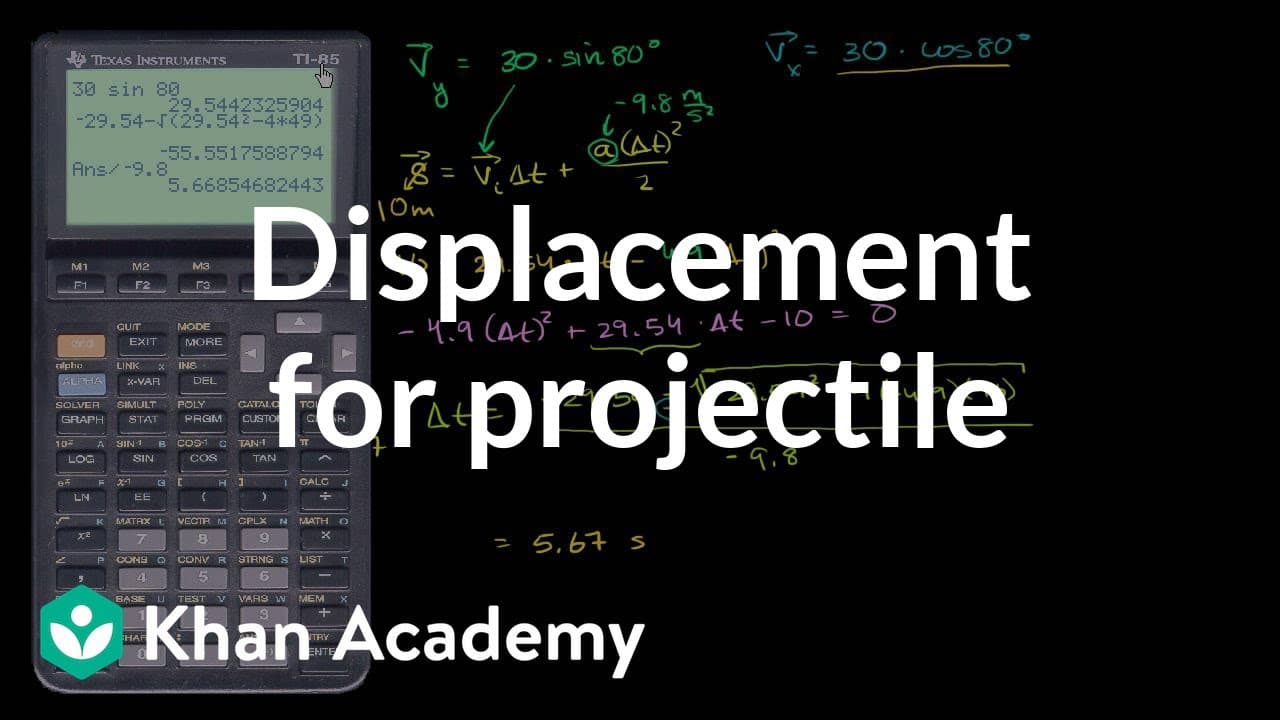
Analyzing the motion of a projectile launched at an angle of 80 degrees with a velocity of 30 meters per second and determining its landing position.
Transcript
- [Instructor] Let's do another example where we are projecting something and it lands at a different level and we'll also figure out some other interesting things. We'll figure out what the actual velocity vector is when it's landing, so both its magnitude and its direction. So let's do a situation. So let's say we are launching something from gro... Read More
Key Insights
- 🚥 Understanding how to calculate the vertical and horizontal components of velocity is crucial in analyzing projectile motion accurately.
- 👱 The quadratic formula is an essential tool when determining the time in the air of a projectile.
- 👻 Applying the Pythagorean theorem helps find the total displacement and allows consideration of both magnitude and direction.
- 🚀 Knowing the initial velocity, launch angle, and height of the landing platform enables accurate calculations in projectile motion analysis.
Install to Summarize YouTube Videos and Get Transcripts
Explore YouTube Video Summarizer or Get YouTube Transcript Extractor
Questions & Answers
Q: How do you calculate the vertical and horizontal components of velocity in projectile motion?
To calculate the vertical component, multiply the magnitude of the total velocity by the sine of the launch angle. For the horizontal component, multiply the magnitude by the cosine of the angle.
Q: How is the time in the air determined in projectile motion?
The time in the air can be found by solving a quadratic equation using the displacement, initial velocity, acceleration, and change in time. Plug in the known values to calculate the time.
Q: What is the total horizontal displacement of the projectile?
The horizontal displacement is found by multiplying the average velocity in the horizontal direction by the change in time. Using the given values, calculate the displacement.
Q: How is the total displacement of the projectile determined?
Use the Pythagorean theorem to find the square of the magnitude of the total displacement. Sum the squares of the vertical and horizontal displacements, then calculate the square root of the sum.
Summary & Key Takeaways
-
The content demonstrates the process of calculating the vertical and horizontal components of velocity, time in the air, and the horizontal displacement of a projectile.
-
The video explains how to use the quadratic formula to find the time in the air and applies the Pythagorean theorem to determine the total displacement.
-
The analysis concludes by determining the magnitude and direction of the total displacement, and provides the landing position along the platform.
Read in Other Languages (beta)
Share This Summary 📚
Summarize YouTube Videos and Get Video Transcripts with 1-Click
Try YouTube Summary with ChatGPT & Claude or YouTube Transcript Generator
Explore More Summaries from Khan Academy 📚



Summarize YouTube Videos and Get Video Transcripts with 1-Click
Try YouTube Summary with ChatGPT & Claude or YouTube Transcript Generator