Conditions for MVT: table | Existence theorems | AP Calculus AB | Khan Academy
TL;DR
The Mean Value Theorem states that if a function is differentiable and continuous over a closed interval, there exists at least one point within the interval where the derivative is equal to the average rate of change over the interval.
Transcript
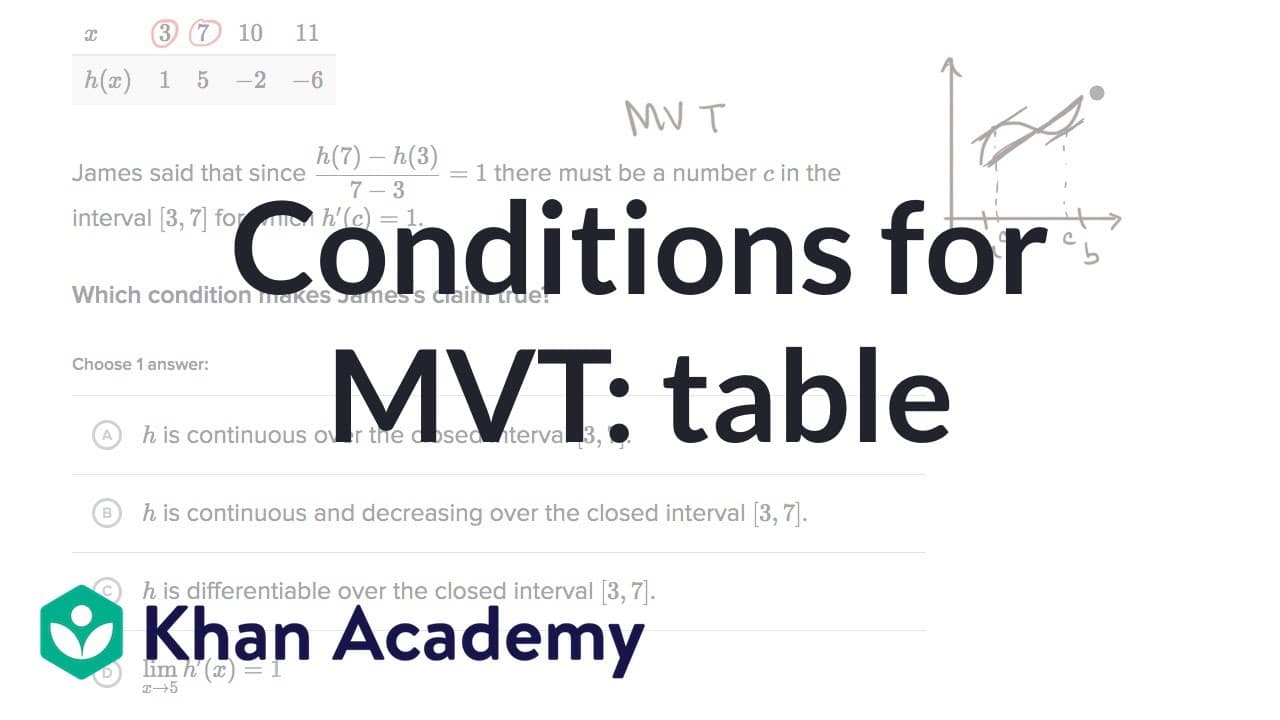
- [Instructor] So we've been given the value of h of x at a few values of x, and then we're told, James said that since h of seven minus h of three over seven minus three is equal to one. So this is really the average rate of change between x is equal to three and x is equal to seven, between that point and that point right over there. So since tha... Read More
Key Insights
- 😥 The Mean Value Theorem allows us to find specific points where the derivative matches the average rate of change over an interval.
- ❓ Functions must meet certain conditions, including differentiability and continuity, for the Mean Value Theorem to apply.
- ❓ Continuity does not guarantee differentiability, and differentiability implies continuity.
- 😥 The Mean Value Theorem is a fundamental concept in calculus, used to analyze rates of change and find specific points within intervals.
- ☠️ The theorem helps bridge the gap between average rate of change and instantaneous rate of change.
- ❓ Understanding the conditions and implications of the Mean Value Theorem is crucial in solving problems related to derivatives.
- 🏑 The Mean Value Theorem has applications in various fields, such as physics, economics, and engineering.
Install to Summarize YouTube Videos and Get Transcripts
Explore YouTube Video Summarizer or Get YouTube Transcript Extractor
Questions & Answers
Q: What is the Mean Value Theorem and how is it used in calculus?
The Mean Value Theorem states that for a differentiable and continuous function over a closed interval, there exists at least one point within the interval where the derivative is equal to the average rate of change over the interval. It is used to find specific points where the derivative matches the average rate of change.
Q: What are the conditions for the Mean Value Theorem to apply?
The function must be differentiable over the open interval (excluding the endpoints) and continuous over the closed interval (including the endpoints).
Q: Does continuity imply differentiability?
No, continuity does not necessarily imply differentiability. A function can be continuous but still have discontinuities in its derivatives, such as at sharp turns or corners.
Q: Can a function be differentiable without being continuous?
No, differentiability implies continuity. If a function is differentiable over an interval, it is also continuous over that interval.
Summary & Key Takeaways
-
The Mean Value Theorem is used to determine the existence of a point within an interval where the derivative of a function is equal to the average rate of change over the interval.
-
To apply the Mean Value Theorem, the function must be differentiable over the open interval (excluding endpoints) and continuous over the closed interval (including endpoints).
-
Differentiability implies continuity, but continuity does not necessarily imply differentiability.
Read in Other Languages (beta)
Share This Summary 📚
Summarize YouTube Videos and Get Video Transcripts with 1-Click
Try YouTube Summary with ChatGPT & Claude or YouTube Transcript Generator
Explore More Summaries from Khan Academy 📚



Summarize YouTube Videos and Get Video Transcripts with 1-Click
Try YouTube Summary with ChatGPT & Claude or YouTube Transcript Generator