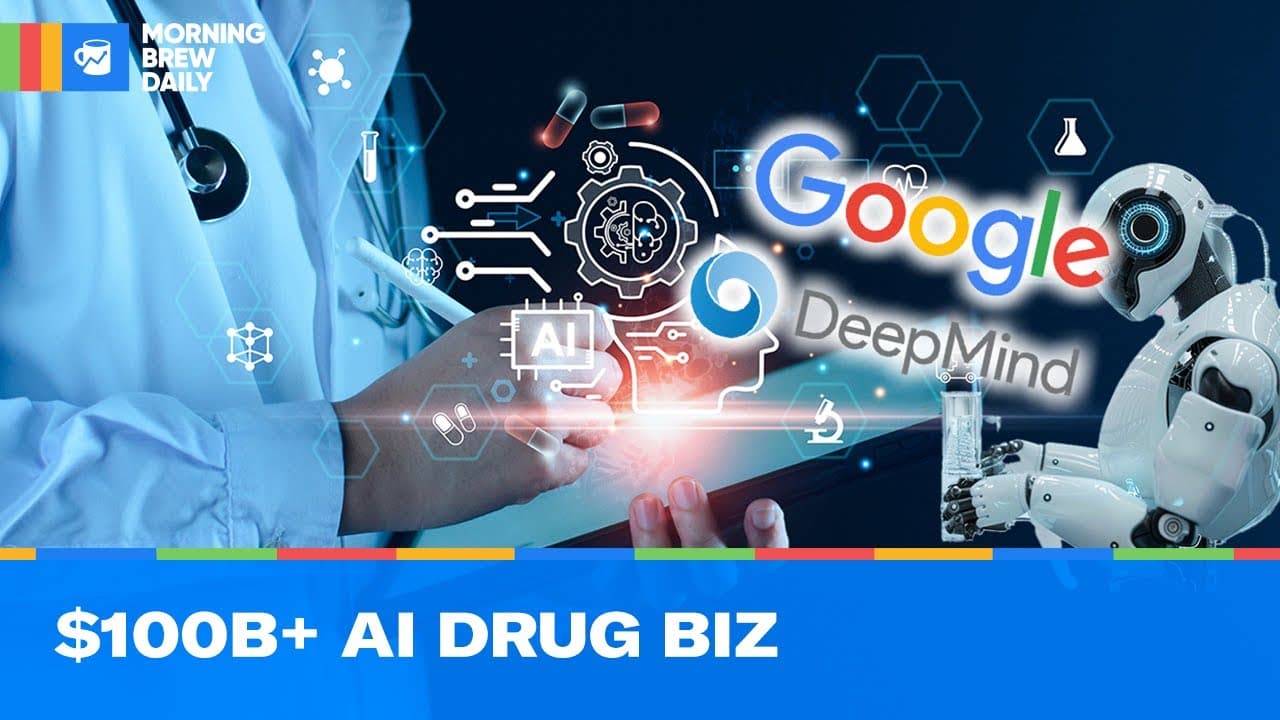
Google’s DeepMind Uses AI to Make Wonder Drugs
TL;DR
Google's DeepMind uses AI for groundbreaking drug discovery.
Transcript
Good morning, brew daily show. I'm Neal Freyman, and I’m Toby Howell Today, the FTC's saga has something no one thought possible. A happy ending. Then why are kabobs suddenly such a hot topic in the German government? It's Thursday, May 9th. Let's ride. Apple is experiencing its worst PR debacle since it forced a U2 album onto everyone to hype up t... Read More
Key Insights
- DeepMind's AlphaFold model is a breakthrough in predicting protein structures, potentially revolutionizing drug discovery with AI.
- AI can vastly expand the molecular compounds used in pharmaceuticals, increasing from 10 million to 10^160 possibilities.
- The drug development process is lengthy and costly, typically taking over ten years and billions of dollars.
- AI's application in drug discovery aims to make the process faster and cheaper, reducing the high failure rate.
- AlphaFold's accessibility allows biologists to utilize its database without needing extensive computer knowledge.
- The AI-driven drug discovery market is attracting significant investment, with $18 billion poured into biotech startups.
- AI's 'hallucinations' in generating novel proteins can inspire human researchers to explore new avenues.
- The pharmaceutical industry is on the brink of transformation, with AI-created drugs already in clinical trials.
Install to Summarize YouTube Videos and Get Transcripts
Explore YouTube Video Summarizer or Get YouTube Transcript Extractor
Questions & Answers
Q: How does AlphaFold transform drug discovery?
AlphaFold, developed by Google's DeepMind, revolutionizes drug discovery by accurately predicting protein structures. This enables researchers to explore a vastly expanded range of molecular compounds, making the discovery process faster and potentially reducing costs and failure rates associated with traditional methods.
Q: What are the potential benefits of using AI in drug development?
AI can drastically reduce the time and cost of drug development by efficiently identifying molecular targets and designing compounds. It expands the possibilities for new drugs, potentially increasing the success rate of clinical trials and accelerating the availability of innovative treatments.
Q: What challenges remain in AI-driven drug discovery?
Despite AI's potential, challenges remain, particularly in the clinical trial phase, which requires human testing to ensure safety and efficacy. AI-generated 'hallucinations' must be managed to avoid misleading results, and the integration of AI into existing pharmaceutical processes poses logistical hurdles.
Q: How does AlphaFold compare to traditional drug discovery methods?
AlphaFold offers a significant advantage over traditional methods by predicting protein structures with high accuracy, which can lead to more targeted drug design. Traditional methods are often slower and less precise, relying heavily on trial and error, whereas AI can streamline and enhance the entire process.
Q: What impact could AI have on the pharmaceutical industry?
AI has the potential to revolutionize the pharmaceutical industry by making drug discovery more efficient and cost-effective. This could lead to a surge in innovative treatments, reduce drug prices, and increase the speed at which new therapies reach the market, ultimately benefiting global health.
Q: What role does investment play in AI-driven drug discovery?
Investment is crucial for the advancement of AI in drug discovery, as it funds the development of sophisticated models and supports startups in the biotech sector. With $18 billion invested in the last decade, the financial backing reflects confidence in AI's transformative potential for the industry.
Q: How does AI handle the complexity of biological systems in drug discovery?
AI models like AlphaFold are trained on vast datasets of chemical interactions and biological structures, allowing them to predict complex protein folding patterns. This capability helps researchers design more effective drugs by understanding how molecules interact within biological systems, despite their inherent complexity.
Q: What is the significance of AI 'hallucinations' in drug discovery?
AI 'hallucinations' refer to the generation of novel, unexpected protein structures or compounds. While they may initially seem nonsensical, these hallucinations can inspire researchers to explore unconventional approaches, potentially leading to breakthroughs in understanding and treating diseases.
Summary & Key Takeaways
-
Google's DeepMind has developed AlphaFold, an AI model that predicts protein structures, potentially transforming drug discovery by making it faster and more cost-effective. This advancement could open up a vast array of new molecular compounds for pharmaceutical use.
-
The traditional drug development process is expensive and time-consuming, with a high failure rate. AI aims to streamline this process by better identifying targets and molecules, although clinical trials still pose a challenge.
-
AI-driven drug discovery is attracting significant investment, and several AI-created drugs are already in clinical trials. This development could mark a major shift in the pharmaceutical industry, with potential impacts comparable to the introduction of solar and wind energy in the power sector.
Read in Other Languages (beta)
Share This Summary 📚
Summarize YouTube Videos and Get Video Transcripts with 1-Click
Try YouTube Summary with ChatGPT & Claude or YouTube Transcript Generator
Explore More Summaries from Morning Brew Daily 📚




Summarize YouTube Videos and Get Video Transcripts with 1-Click
Try YouTube Summary with ChatGPT & Claude or YouTube Transcript Generator