How To Find The Sum of a Geometric Series
TL;DR
Learn how to find the sum of an infinite geometric series using a formula, with examples provided.
Transcript
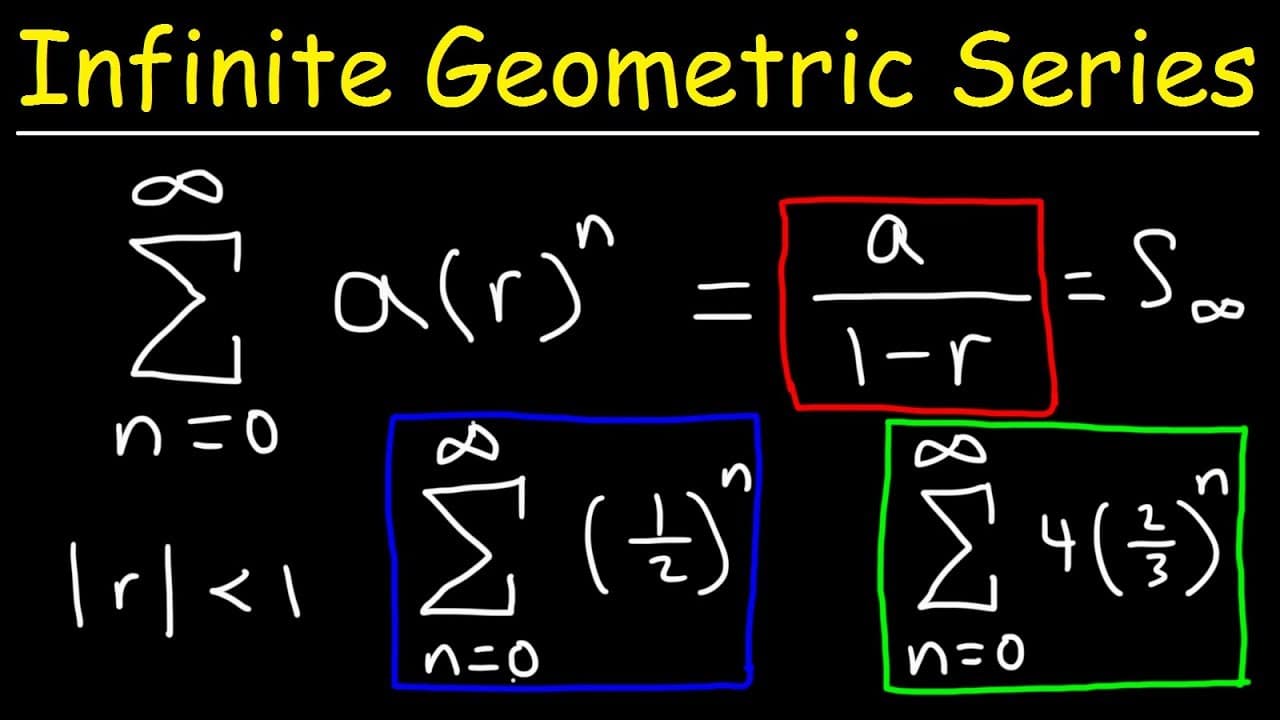
in this lesson we're going to talk about how to find the sum of an infinite geometric series so let's say if you get a problem that looks like this so you want to find the sum of this series and we have the geometric sequence one half raised to the n so if we were to write out the terms of the sequence the sequence is a n is equal to one half raise... Read More
Key Insights
- 🥳 An infinite geometric series has a common ratio and a starting term.
- 🍹 The sum of an infinite geometric series can be found using the formula: sum = a / (1 - r).
- 🍉 The terms of an infinite geometric series can be calculated by multiplying the previous term by the common ratio.
- 🍹 The sum of an infinite geometric series can only be approached but not reached.
- 🎆 The formula for finding the sum works when the common ratio is less than 1.
- 😚 Adding up the terms of the series verifies that the sum gets closer to the value obtained using the formula.
- 🥳 Example 1: The sum of a series with a starting term of 1 and a common ratio of 1/2 is 2.
Install to Summarize YouTube Videos and Get Transcripts
Explore YouTube Video Summarizer or Get YouTube Transcript Extractor
Questions & Answers
Q: How do you find the terms of an infinite geometric series?
Each term can be calculated by multiplying the previous term by the common ratio. For example, if the common ratio is 1/2, the second term would be 1/2 * 1 = 1/2, the third term would be 1/2 * 1/2 = 1/4, and so on.
Q: What is the formula for finding the sum of an infinite geometric series?
The formula is: sum = a / (1 - r), where "a" is the starting term and "r" is the common ratio. This formula works when the common ratio is less than 1.
Q: Can an infinite geometric series ever reach its sum?
No, the sum of an infinite geometric series can only be approached but not reached. It gets closer and closer to the sum as more terms are added.
Q: How can the sum of an infinite geometric series be verified?
By adding up the terms of the series, we can see that the sum gets closer and closer to the value obtained using the formula. However, it never exactly reaches the sum.
Summary & Key Takeaways
-
An infinite geometric series has a common ratio and a starting term. Each term can be calculated by multiplying the previous term by the common ratio.
-
The sum of an infinite geometric series can be found using the formula: sum = a / (1 - r), where "a" is the starting term and "r" is the common ratio.
-
Example 1: The sum of the series with a starting term of 1 and a common ratio of 1/2 is 2.
-
Example 2: The sum of the series with a starting term of 4 and a common ratio of 2/3 is 12.
Read in Other Languages (beta)
Share This Summary 📚
Summarize YouTube Videos and Get Video Transcripts with 1-Click
Try YouTube Summary with ChatGPT & Claude or YouTube Transcript Generator
Explore More Summaries from The Organic Chemistry Tutor 📚



Summarize YouTube Videos and Get Video Transcripts with 1-Click
Try YouTube Summary with ChatGPT & Claude or YouTube Transcript Generator