How Does the Levenberg-Marquardt Algorithm Work?
TL;DR
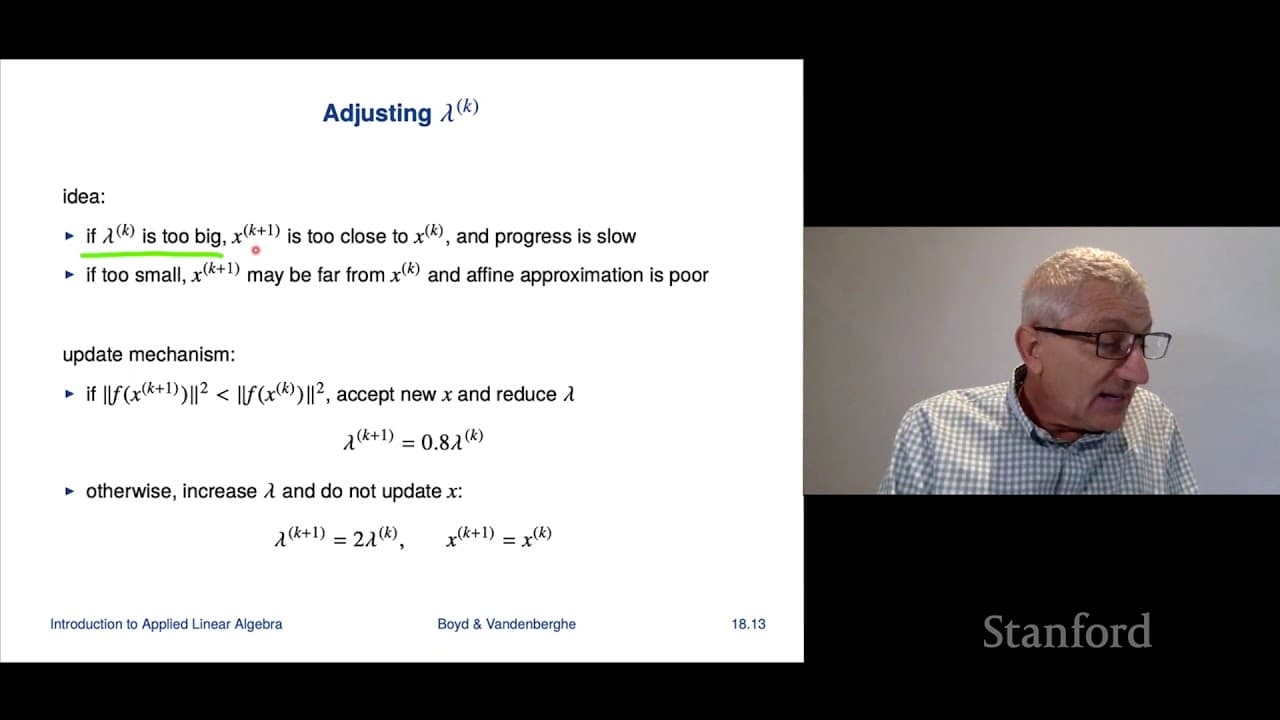
The Levenberg-Marquardt algorithm effectively approximates solutions for nonlinear least squares problems by iteratively refining estimates. It balances the goal of minimizing the objective function with maintaining proximity to the current guess, ensuring trustworthiness in approximations to navigate potential pitfalls like local minima.
Transcript
we're now going to look at a method for approximately or heuristically solving the nonlinear least squares problem there's actually many methods that can be used so that's a whole world by itself you can take whole courses on on this we're going to look at one it's called levenberg marquardt we're we actually look at this one for a couple reasons n... Read More
Key Insights
- ❎ The Levenberg Marquardt algorithm is a widely used method for solving nonlinear least squares problems.
- 💡 It combines ideas from differential calculus and linear least squares to approximate and minimize the objective function.
- 😚 Trust in the approximation is crucial, and it is balanced by staying close to the current point during iteration.
- 😥 The algorithm can find global or local minimum points depending on the starting point and the success of the objective minimization step.
- ✋ The value of lambda determines the level of trust in the affine approximation, with higher values indicating less trust.
- 😥 The algorithm requires an initial point and an initial value of lambda to start the iteration process.
- ✋ It is particularly useful in high-dimensional problems where visualization is not feasible.
Install to Summarize YouTube Videos and Get Transcripts
Explore YouTube Video Summarizer or Get YouTube Transcript Extractor
Questions & Answers
Q: What is the basic idea behind the Levenberg Marquardt algorithm?
The algorithm aims to minimize a nonlinear least squares objective function by forming an affine approximation near the current point and iteratively updating the solution.
Q: How is the affine approximation of the objective function formed?
The affine approximation is formed using differential calculus, specifically the first-order Taylor expansion or the first-order derivative matrix.
Q: How does the algorithm handle trust in the approximation?
The algorithm balances minimizing the objective function with staying close to the current point. Trust in the approximation is determined by the value of lambda, which is adjusted based on the success or failure of the objective minimization step.
Q: What happens when the objective value at the next iterate is not better than the current value?
In this case, the algorithm does not update the solution but doubles the value of lambda. This indicates that the trust in the affine approximation was too high and needs to be reduced.
Summary & Key Takeaways
-
The Levenberg Marquardt algorithm is a heuristic method for solving nonlinear least squares problems.
-
It involves forming an affine approximation of the objective function and iteratively updating the solution.
-
The algorithm balances minimizing the objective function with staying close to the current point to ensure trust in the approximation.
Read in Other Languages (beta)
Share This Summary 📚
Summarize YouTube Videos and Get Video Transcripts with 1-Click
Try YouTube Summary with ChatGPT & Claude or YouTube Transcript Generator
Explore More Summaries from Stanford Online 📚


Summarize YouTube Videos and Get Video Transcripts with 1-Click
Try YouTube Summary with ChatGPT & Claude or YouTube Transcript Generator