How Did Fei-Fei Li Transition from Physics to AI?
TL;DR
Fei-Fei Li transitioned from studying physics to becoming a prominent AI scientist by pursuing her passion for asking big questions about intelligence. She emphasizes the importance of diverse entry points into AI and the need for collaboration between AI experts and policymakers to address societal impacts, especially concerning privacy in healthcare. Education initiatives like AI for All are vital in fostering diversity within the field.
Transcript
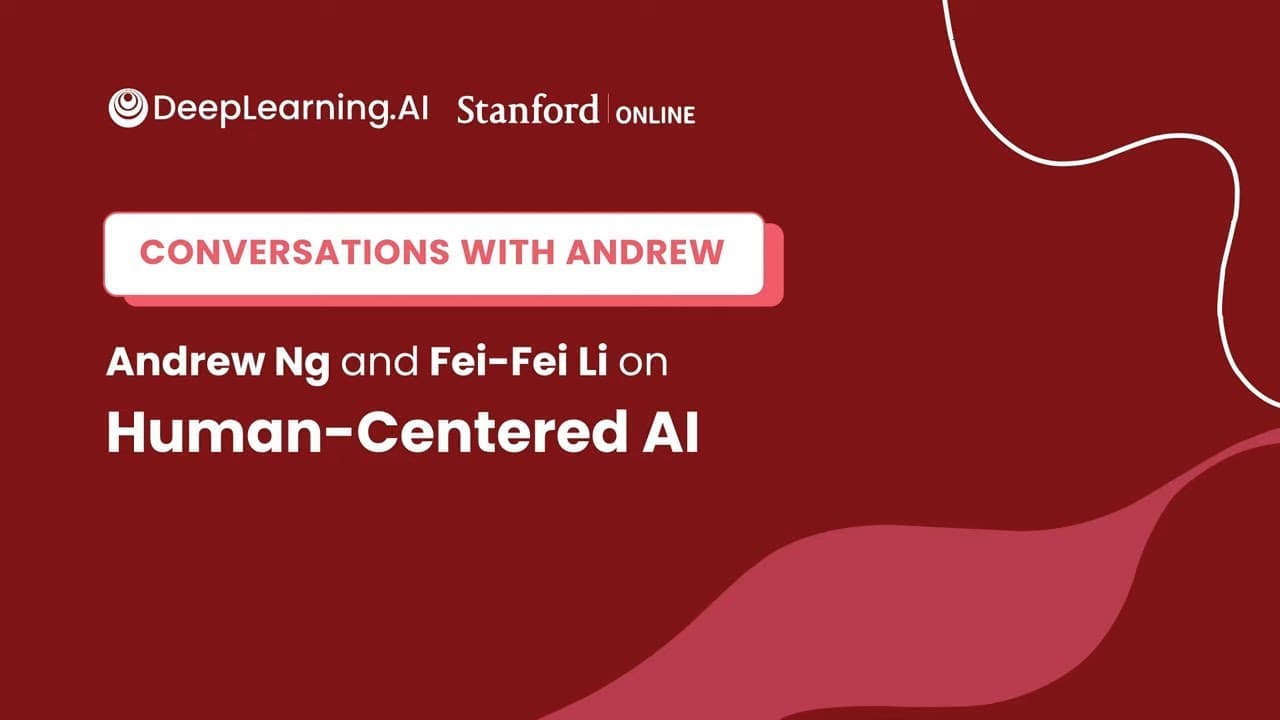
foreign delighted to have with us here today my old friend Professor Faye family feifei is a professor of computer science at Stanford University and also co-director of Hai the human centered AI Institute and previously she also was responsible for AI at Google Cloud as a chief scientist for the division it's great to have you here thank you Andre... Read More
Key Insights
- 😥 AI offers entry points for individuals from various backgrounds, not just computer science, to contribute to the field's development.
- ❓ Understanding the impact of AI on society requires collaboration between policymakers and AI experts, focusing on issues such as privacy, fairness, and concentration of data.
- 😷 AI has the potential to transform healthcare by improving patient safety, reducing medical errors, and optimizing resource allocation.
- 🫷 The audacious questions in AI, such as understanding the fundamental principles of intelligence, continue to push the field forward.
- 🖤 AI education programs, like AI for all, aim to address the lack of representation and diversity in the field, providing opportunities for underrepresented communities.
Install to Summarize YouTube Videos and Get Transcripts
Explore YouTube Video Summarizer or Get YouTube Transcript Extractor
Questions & Answers
Q: How did Faye FeiFei Li make the switch from studying physics to AI?
Li explains that her passion for asking big questions led her to transition from physics to AI during college. She became curious about intelligence and started interning at neuroscience labs focused on vision-related research.
Q: What audacious question does Li currently have in the field of AI?
Li's audacious question centers around understanding the fundamental computing principles behind intelligence, whether it be animal or machine intelligence. She believes that, just as physics has simplified complex phenomena with simple laws, AI can achieve the same level of understanding.
Q: How did Faye FeiFei Li contribute to the development of ImageNet?
Li explains that, after realizing the limitations of existing data and models in AI research, she and her advisor, Pietro Perona, decided to build the Caltech 101 dataset. This served as a foundation for the creation of ImageNet, which became instrumental in advancing deep learning and computer vision.
Q: What role does Faye FeiFei Li see for AI in healthcare?
Li highlights the need for AI in healthcare, particularly in addressing medical errors, hospital-acquired infections, and injuries/fatalities. She mentions the importance of privacy-preserving technologies, smart sensors, and on-device inference to enhance safety and efficiency in healthcare settings.
Summary & Key Takeaways
-
Faye FeiFei Li reflects on her longstanding friendship with Andrew Ng and their early discussions about recruiting her to Stanford University.
-
Li discusses her transition from studying physics to AI, noting the importance of asking big questions and being passionate about seeking knowledge.
-
Li shares her audacious question in AI: discovering the fundamental computing principles behind intelligence.
-
The conversation touches on the challenges of AI research, the need for privacy-preserving computing in healthcare, and the importance of collaboration between policymakers and AI experts.
Read in Other Languages (beta)
Share This Summary 📚
Summarize YouTube Videos and Get Video Transcripts with 1-Click
Try YouTube Summary with ChatGPT & Claude or YouTube Transcript Generator
Explore More Summaries from Stanford Online 📚
Summarize YouTube Videos and Get Video Transcripts with 1-Click
Try YouTube Summary with ChatGPT & Claude or YouTube Transcript Generator