Velocity and Position From Acceleration By Integration - Physics and Calculus
TL;DR
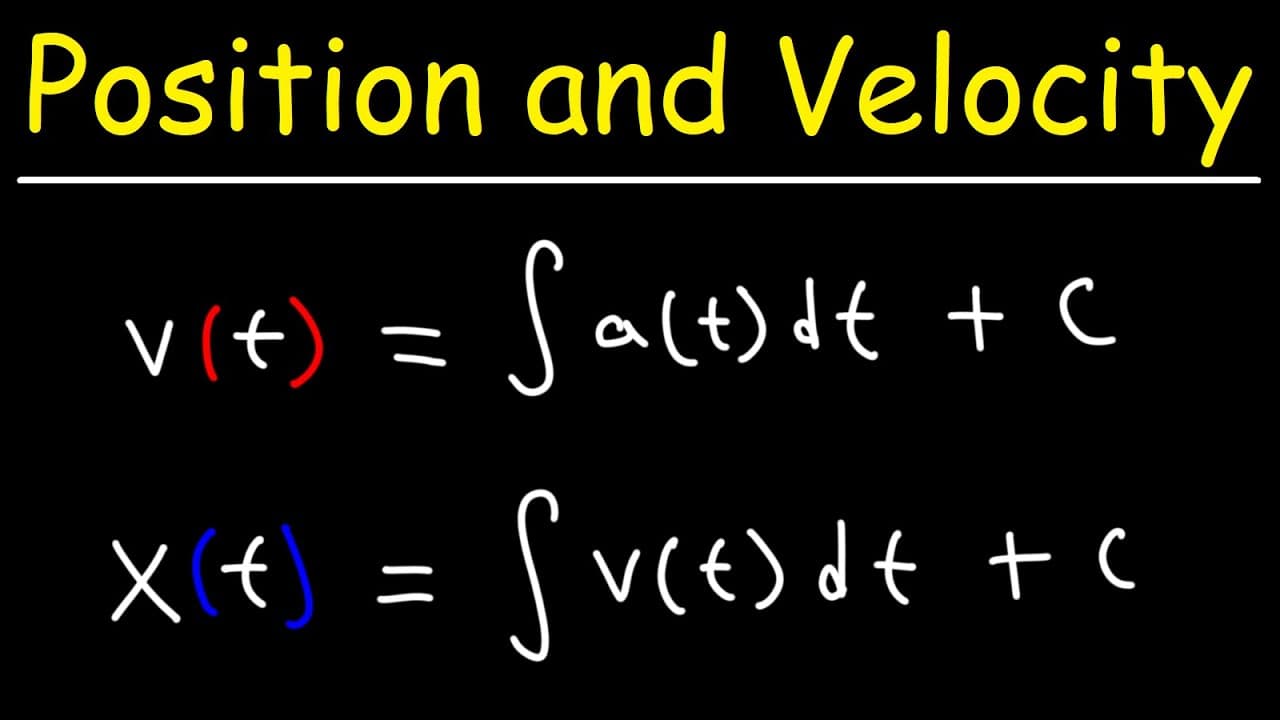
Integration can be used to find velocity and position functions from acceleration, considering constants.
Transcript
on this problem we're given the acceleration function and using these two points we want to determine velocity function and the position function how can we do this well here's some things you want to know you could find the velocity function by integrating the acceleration function and of course you need to make into account the constant C you cou... Read More
Key Insights
- 🧘 Integration can determine velocity and position functions from an acceleration function.
- ✊ The antiderivative of t to the first power is t to the second power divided by 2 using the power rule.
- ❓ Constants in the original functions affect the resulting functions after integration.
- 😥 Given points are crucial in determining the constants and obtaining accurate functions.
- 🍉 The integral of a constant in an acceleration function results in a linear term in the velocity function.
- 🧘 The integral of a constant in a velocity function results in a linear term in the position function.
- ❓ Differentiation can be used to confirm the accuracy of the obtained functions.
Install to Summarize YouTube Videos and Get Transcripts
Explore YouTube Video Summarizer or Get YouTube Transcript Extractor
Questions & Answers
Q: How can the velocity function be found from the acceleration function?
The velocity function can be obtained by integrating the acceleration function, considering the constant C. The antiderivative of t to the first power is t to the second power divided by 2. To account for the constant -6, it becomes t to the first power minus 16. Adding the constant C, the velocity function is 6t^2 - 6t + 10.
Q: How to determine the position function from the velocity function?
The position function can be found by integrating the velocity function. Integrating 6t^2 - 6t + 10, the antiderivative of t^3 is t^4 divided by 3, and the antiderivative of t^1 is t^2 divided by 2. Integrating the constant 10 gives 20t. The position function is (2/3)t^3 - 3t^2 + 10t + C.
Q: How can the constant C be determined for the velocity function?
The constant C in the velocity function can be found by using a given point, such as V(1) = 10. Substituting 1 into the velocity function equation and solving for C, we get 6 - 6 + C = 10, simplifying to C = 10. Therefore, the velocity function is 6t^2 - 6t + 10.
Q: How is the constant C determined for the position function?
To find the constant C in the position function, a given point, such as P(2) = 17, is used. Substituting 2 into the position function equation and solving for C, we get 24 + C = 17. Subtracting 24 from both sides gives C = -7. Thus, the position function is (2/3)t^3 - 3t^2 + 10t - 7.
Summary & Key Takeaways
-
The content explains how to find velocity and position functions from an acceleration function using integration.
-
The velocity function can be obtained by integrating the acceleration function and considering the constant C.
-
The position function can be determined by integrating the velocity function and solving for the constant C using given points.
Read in Other Languages (beta)
Share This Summary 📚
Summarize YouTube Videos and Get Video Transcripts with 1-Click
Try YouTube Summary with ChatGPT & Claude or YouTube Transcript Generator
Explore More Summaries from The Organic Chemistry Tutor 📚



Summarize YouTube Videos and Get Video Transcripts with 1-Click
Try YouTube Summary with ChatGPT & Claude or YouTube Transcript Generator