Photoelectric Effect (2 of 8) Example No.1 (Easy to Follow)
TL;DR
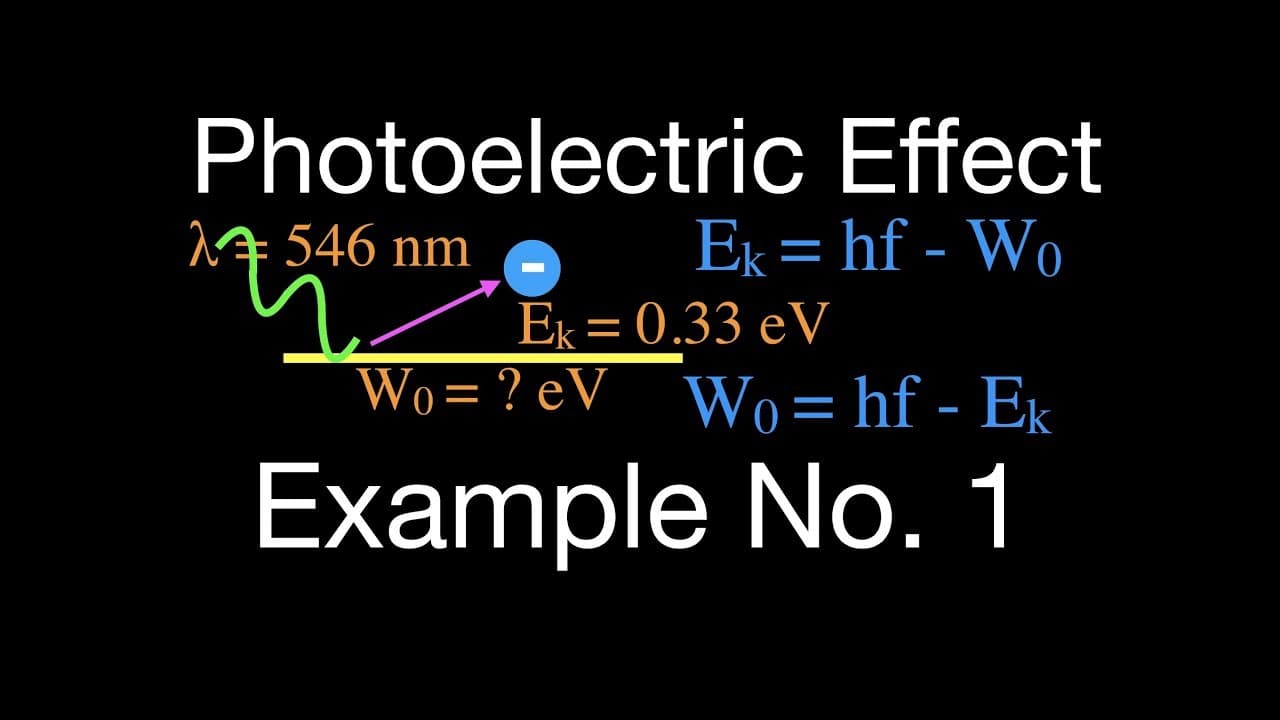
Solving a photoelectric effect equation to determine the metal plate using energy and work function calculations.
Transcript
okay in today's video I am gonna be going over an example for some calculations for the photoelectric effect please don't forget before we get started to subscribe to my channel get all my excellent physics chemistry and math videos and made some other videos for the photoelectric effect and you're gonna link to those babies in the upper right hand... Read More
Key Insights
- 💦 Understanding the photoelectric effect involves energy and work function calculations.
- ⚡ Conversion of light energy from joules to electron volts is essential in photoelectric effect analysis.
- 🇦🇪 Matching units is critical for accurate results in photoelectric effect calculations.
- 💦 The work function determines the metal plate in the photoelectric effect example.
- 💦 Different metals have varying work functions, affecting the photoelectric effect outcome.
- 💦 Calculating the work function helps identify the metal plate in the photoelectric effect scenario.
- 🦾 Physics principles of energy conservation and quantum mechanics are fundamental in analyzing the photoelectric effect.
Install to Summarize YouTube Videos and Get Transcripts
Explore YouTube Video Summarizer or Get YouTube Transcript Extractor
Questions & Answers
Q: What is the photoelectric effect example about?
The video demonstrates solving an example calculation for the photoelectric effect to determine the metal plate using energy and work function concepts.
Q: How is the work function calculated in the photoelectric effect?
The work function is calculated by subtracting the kinetic energy of the ejected electrons from the energy of the incident light, following the equation: Work Function = HF - Kinetic Energy.
Q: How is the energy of light converted to electron volts?
The energy of light, given in joules, is converted to electron volts by multiplying the energy in joules by 1.6 × 10^-19, as 1 eV is equal to this value in joules.
Q: Why is it important to match the units when performing calculations in the photoelectric effect?
Matching units is crucial to ensure accurate calculations and comparisons in the photoelectric effect, especially when converting between energy units like joules and electron volts.
Summary & Key Takeaways
-
Example calculation using the photoelectric effect.
-
Determining the metal plate from given data.
-
Explaining the energy and work function calculations.
Read in Other Languages (beta)
Share This Summary 📚
Summarize YouTube Videos and Get Video Transcripts with 1-Click
Try YouTube Summary with ChatGPT & Claude or YouTube Transcript Generator
Explore More Summaries from Step by Step Science 📚
Summarize YouTube Videos and Get Video Transcripts with 1-Click
Try YouTube Summary with ChatGPT & Claude or YouTube Transcript Generator