How To Determine The Maximum Number of Electrons Given a Set of Quantum Numbers
TL;DR
The video explains how to calculate the maximum number of electrons based on different quantum numbers.
Transcript
in this video we're going to talk about how to determine the maximum number of electrons given a certain set of quantum numbers so let's say if n is equal to 7 what is the maximum number of electrons that will have an n value of seven n is the principal quantum number by the way well there's a formula that we could use to get the answer but first l... Read More
Key Insights
- #️⃣ The maximum number of electrons can be determined using the formula 2n², where n is the principal quantum number.
- #️⃣ Each sublevel has a specific maximum number of electrons based on the number of orbitals it contains.
- #️⃣ The magnetic quantum number (ml) determines the specific orbital within a sublevel.
- #️⃣ The electron spin does not affect the maximum number of electrons.
- #️⃣ Different combinations of quantum numbers represent different electrons.
- 🎚️ The maximum number of electrons increases as the energy level increases.
- ✋ The d and f sublevels have a higher maximum number of electrons compared to the s and p sublevels.
Install to Summarize YouTube Videos and Get Transcripts
Explore YouTube Video Summarizer or Get YouTube Transcript Extractor
Questions & Answers
Q: How do you determine the maximum number of electrons when n is equal to 7?
The maximum number of electrons when n equals 7 can be determined using the formula 2n². Thus, 2(7)² = 2(49) = 98 electrons.
Q: What is the relationship between the maximum number of electrons and their respective n values?
The maximum number of electrons is always equal to 2n². For example, when n is 3, the maximum number of electrons is 2(3)² = 18.
Q: What is the maximum number of electrons with n = 4 and ms = +1/2?
The maximum number of electrons in the fourth energy level is 32. Half of them will have a spin of +1/2, so the answer is 16 electrons.
Q: How do we determine the maximum number of electrons with the quantum numbers n = 4 and l = 2?
The 4d sublevel can hold up to 10 electrons. Since the d sublevel has 5 orbitals, each can hold 2 electrons. Therefore, the maximum number is 10 electrons.
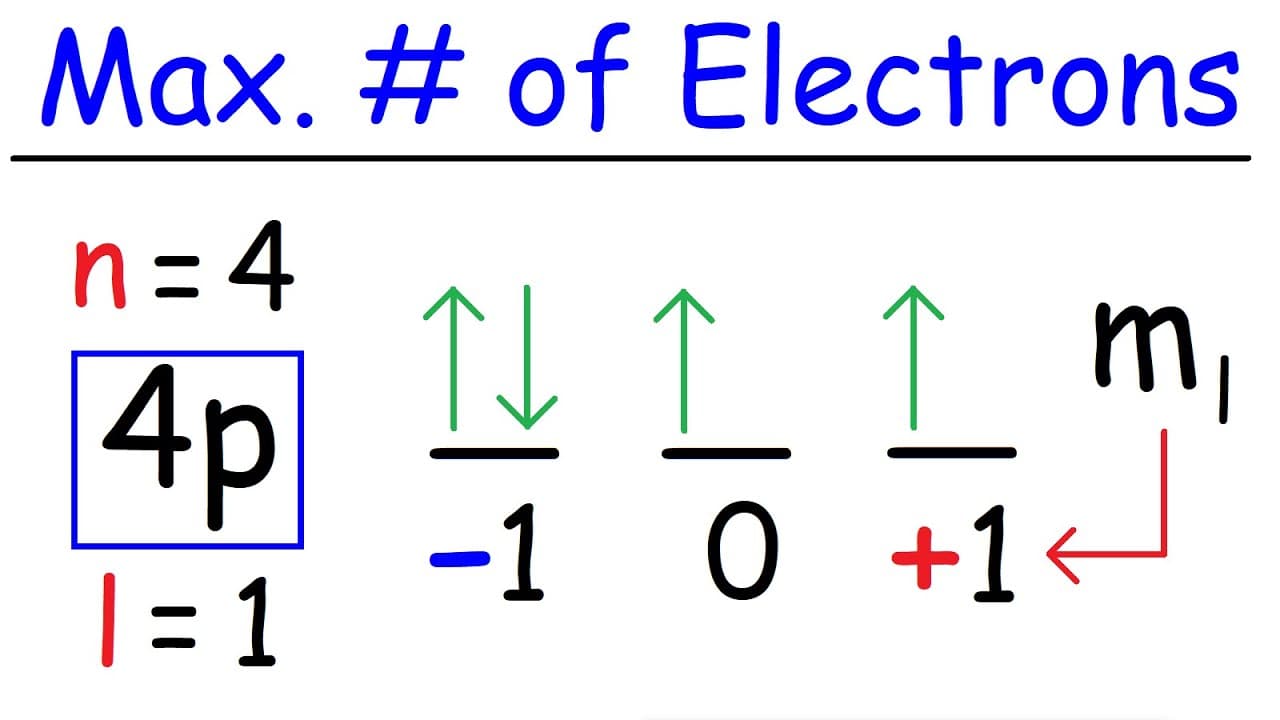
Q: How many electrons can have the quantum numbers n = 4 and ml = 1?
The 4p sublevel has 3 orbitals, each holding 2 electrons, resulting in a maximum of 6 electrons. In this case, since ml = 1, we are focusing on only one orbital, so the maximum number is 2 electrons.
Summary & Key Takeaways
-
The maximum number of electrons in an energy level n can be determined using the formula 2n².
-
The quantum number n indicates the principal energy level, with s orbital holding 2 electrons, p orbital holding 6 electrons, d orbital holding 10 electrons, and f orbital holding 14 electrons.
-
The maximum number of electrons can also be calculated by adding the maximum number of electrons in each sublevel.
Read in Other Languages (beta)
Share This Summary 📚
Summarize YouTube Videos and Get Video Transcripts with 1-Click
Try YouTube Summary with ChatGPT & Claude or YouTube Transcript Generator
Explore More Summaries from The Organic Chemistry Tutor 📚


Summarize YouTube Videos and Get Video Transcripts with 1-Click
Try YouTube Summary with ChatGPT & Claude or YouTube Transcript Generator