Beginning of the Civil War
TL;DR
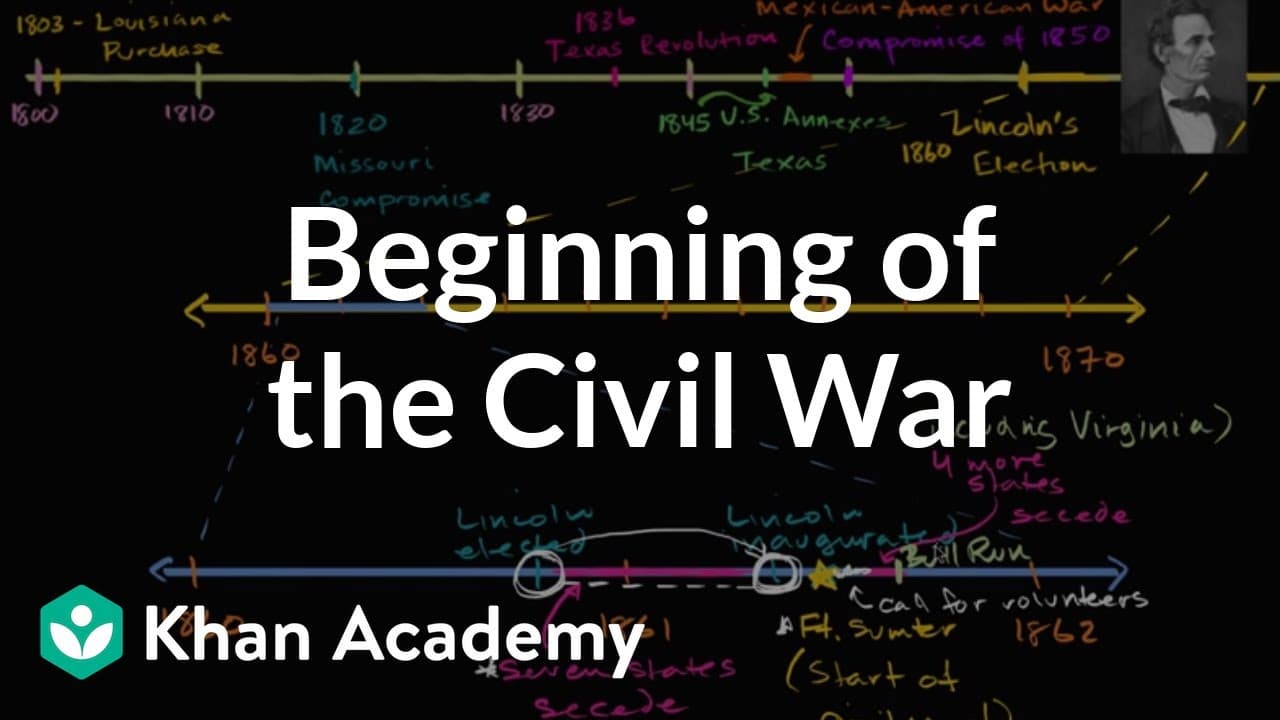
The election of Abraham Lincoln and the secession of southern states led to the outbreak of the Civil War in 1861.
Transcript
- [Voiceover] Kim, we've been doing a couple of videos where we saw how slavery became more and more of a political issue as we're going through the early 1800s. You go all the way to the Compromise of 1850, the Fugitive Slave Act, it really starts to anger, especially, definitely abolitionists, who are always very against slavery under moral argum... Read More
Key Insights
- 🇦🇬 Abraham Lincoln's election and his anti-slavery stance were the catalysts for southern states' secession.
- 🙈 The secession winter of 1860-1861 saw seven southern states secede from the Union in response to Lincoln's election.
- 💋 The firing on Fort Sumpter and President Lincoln's call for 75,000 volunteers marked the outbreak of war.
Install to Summarize YouTube Videos and Get Transcripts
Explore YouTube Video Summarizer or Get YouTube Transcript Extractor
Questions & Answers
Q: Why were southern states concerned about Abraham Lincoln's election?
Southern states knew that Lincoln was against slavery, which they viewed as a threat to their way of life. They feared his presidency would lead to the abolition of slavery in the South.
Q: What triggered the secession of southern states?
The secession winter, a period of two months from December 1860 to February 1861, saw southern states considering secession in response to Lincoln's election. Commissioners were sent to discuss and decide to secede from the Union.
Q: Why did the firing on Fort Sumpter lead to the outbreak of war?
The firing on Fort Sumpter by southern forces in April 1861 was seen as an act of rebellion against federal authority. President Lincoln called for 75,000 volunteers to suppress the rebellion, marking the beginning of the Civil War.
Q: Why did some slave states, like Maryland, remain in the Union?
Although Maryland was a slave state, it did not secede from the Union. Its proximity to Washington D.C. made it strategically important for the Northern cause, as the capital would have been surrounded by enemy territory if Maryland joined the rebellion.
Summary & Key Takeaways
-
The election of Abraham Lincoln as an anti-slavery president in 1860 sparked tensions among southern states, who believed he would challenge the institution of slavery.
-
During the secession winter of 1860-1861, seven southern states seceded from the Union.
-
The firing on Fort Sumpter by southern forces in April 1861 led to President Lincoln's call for 75,000 volunteers and marked the beginning of the Civil War.
Read in Other Languages (beta)
Share This Summary 📚
Summarize YouTube Videos and Get Video Transcripts with 1-Click
Try YouTube Summary with ChatGPT & Claude or YouTube Transcript Generator
Explore More Summaries from Khan Academy 📚



Summarize YouTube Videos and Get Video Transcripts with 1-Click
Try YouTube Summary with ChatGPT & Claude or YouTube Transcript Generator