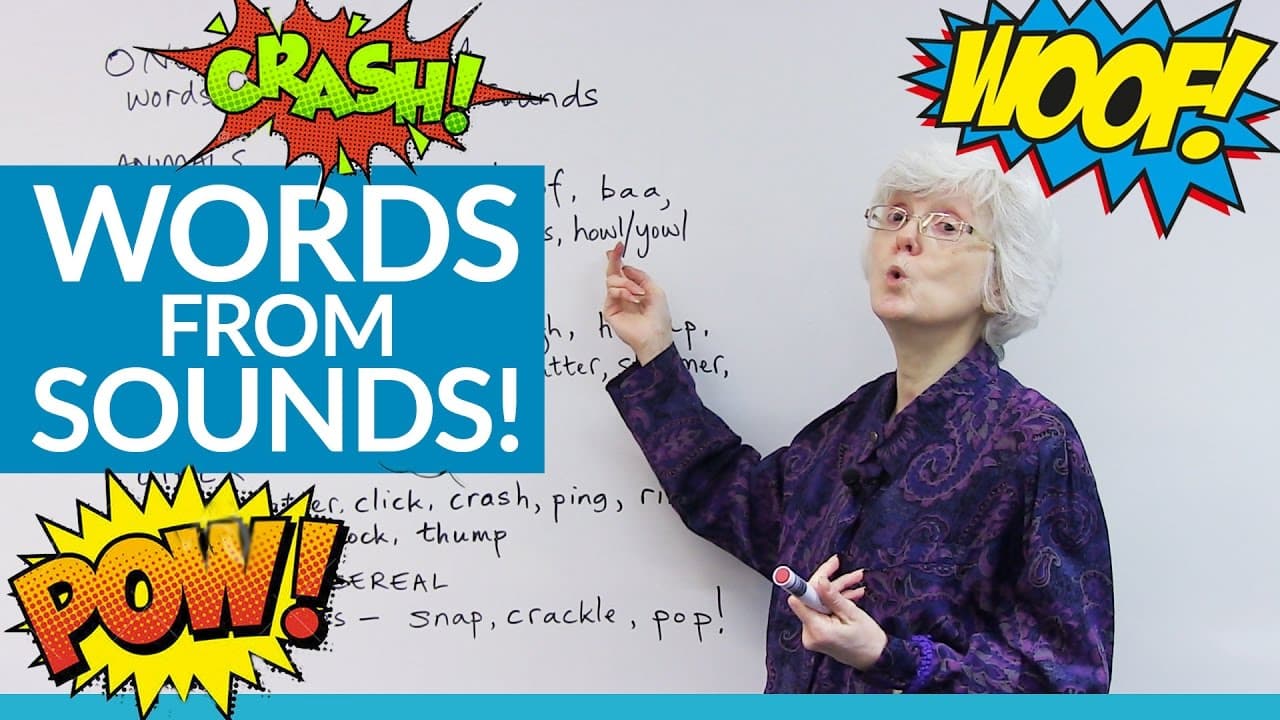
BANG! CRASH! DING DONG! Words that Imitate Sounds
TL;DR
Onomatopoeia explores words imitating sounds, from animal noises to human actions and object impacts.
Transcript
Hi. I'm Gill at www.engvid.com, and today we're going to be looking at "Onomatopoeia". Now, don't run away. It's a very long Greek word, but it means something quite simple. It means words that imitate sounds. Okay? So, like a cat that makes a sound: "Meow, meow, meow", and it's been turned into a word. Either "mew, mew, mew, mew" or "meow", "miaow... Read More
Key Insights
- 👂 Onomatopoeia encompasses words imitating various sounds from animals, humans, and objects in language.
- 👂 Children often associate animal sounds with names, merging the sound and name together as a fun learning tool.
- 💍 Onomatopoeic words can enhance communication, providing vivid descriptions and engaging the audience.
- 🦕 Using onomatopoeia in moderation is crucial to avoid being perceived as odd or excessive.
- 👶 Exploring onomatopoeia in language can make learning more interactive and memorable for students, especially children.
- 😯 Onomatopoeic words add a sensory dimension to writing and speech, creating a more immersive experience for the audience.
- 🔔 Some common examples of onomatopoeic words include "Meow" for cats, "Bark" for dogs, and "Crash" for impact sounds.
Install to Summarize YouTube Videos and Get Transcripts
Explore YouTube Video Summarizer or Get YouTube Transcript Extractor
Questions & Answers
Q: What does onomatopoeia refer to, and what are some examples provided in the content?
Onomatopoeia involves words that imitate sounds, such as animal noises like "Meow" and "Bark", human actions like "Clap" and "Yawn", and object sounds like "Click" and "Crash".
Q: How can onomatopoeic words enhance language and communication?
Onomatopoeic words can convey vivid imagery and add a sensory dimension to writing or speech, making the communication more engaging and descriptive.
Q: Why is it important to be cautious when using onomatopoeic words in conversation?
Using onomatopoeic words excessively or inappropriately in conversation may lead to being perceived as peculiar. It's essential to use them judiciously to avoid misunderstandings.
Q: How does onomatopoeia play a role in children's language development?
Children often associate animal sounds with the respective names, aiding in their early language learning and cognitive development. Onomatopoeia can make learning more fun and memorable for children.
Summary & Key Takeaways
-
Onomatopoeia refers to words that imitate sounds found in animals, human actions, and inanimate objects.
-
Examples include animal sounds like "Meow" for cats and "Bark" for dogs, as well as human actions like "Clap" and "Yawn."
-
The concept of onomatopoeia extends to objects with sounds like "Click," "Crash," and "Squeak."
Read in Other Languages (beta)
Share This Summary 📚
Summarize YouTube Videos and Get Video Transcripts with 1-Click
Try YouTube Summary with ChatGPT & Claude or YouTube Transcript Generator
Explore More Summaries from Learn English with Gill · engVid 📚



Summarize YouTube Videos and Get Video Transcripts with 1-Click
Try YouTube Summary with ChatGPT & Claude or YouTube Transcript Generator