Properties of the equilibrium constant | Equilibrium | AP Chemistry | Khan Academy
TL;DR
The equilibrium constant of a reaction can change depending on how the equation is written.
Transcript
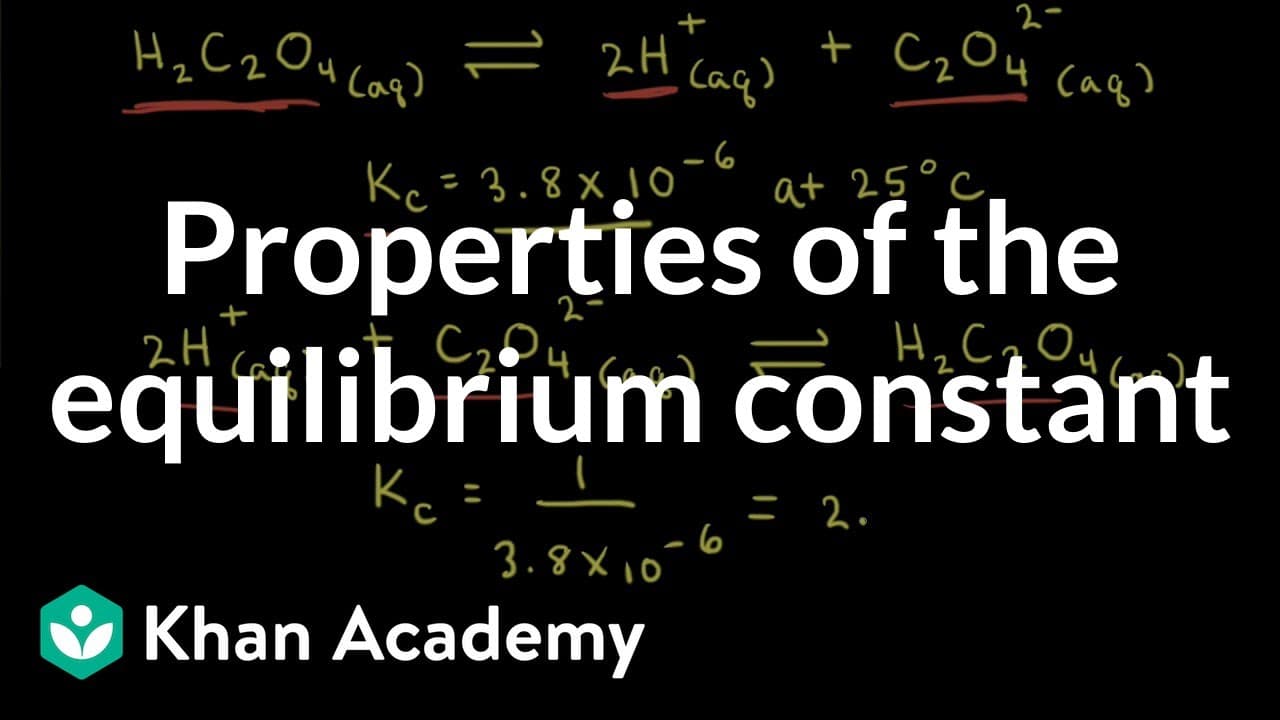
- [Instructor] An equilibrium constant has one value for a particular reaction at a certain temperature. For example, for this reaction, we have oxalic acid turning into two H plus ions and the oxalate anion. The equilibrium constant, K C, for this reaction is equal to 3.8 times 10 to the negative six at 25 degrees Celsius. However, the value of th... Read More
Key Insights
- ❓ Equilibrium constants have fixed values for reactions at a specific temperature.
- ◀️ Reversing a reaction changes the equilibrium constant, which is the inverse of the original constant.
- ✊ Multiplying a reaction by a factor changes the equilibrium constant, which is found by raising the original constant to the power of that factor.
- 👻 Combining existing reactions allows for the calculation of the equilibrium constant for a new reaction.
Install to Summarize YouTube Videos and Get Transcripts
Explore YouTube Video Summarizer or Get YouTube Transcript Extractor
Questions & Answers
Q: How does changing the way an equation is written affect the equilibrium constant?
Changing the way an equation is written, such as reversing it, results in a new equilibrium constant. For a reversed equation, the equilibrium constant is the inverse of the original constant.
Q: What happens to the equilibrium constant when a reaction is multiplied by a factor?
When a reaction is multiplied by a factor, the equilibrium constant is raised to the power of that factor. For example, if the reaction is multiplied by 2, the equilibrium constant is squared.
Q: How can we calculate the equilibrium constant for a new reaction by combining two existing reactions?
To calculate the equilibrium constant for a new reaction formed by adding two existing reactions together, multiply the equilibrium constants of the individual reactions.
Q: Is the equilibrium constant affected by temperature changes?
The equilibrium constant is temperature-dependent and will change with variations in temperature. The values provided in the content are specific to 25 degrees Celsius.
Summary & Key Takeaways
-
Equilibrium constants have specific values for reactions at a certain temperature.
-
Reversing a reaction changes the equilibrium constant, which is found by taking the inverse of the original constant.
-
Multiplying a reaction by a factor changes the equilibrium constant, which is found by raising the original constant to the power of that factor.
Read in Other Languages (beta)
Share This Summary 📚
Summarize YouTube Videos and Get Video Transcripts with 1-Click
Try YouTube Summary with ChatGPT & Claude or YouTube Transcript Generator
Explore More Summaries from Khan Academy 📚



Summarize YouTube Videos and Get Video Transcripts with 1-Click
Try YouTube Summary with ChatGPT & Claude or YouTube Transcript Generator