Numericals on Diffraction
TL;DR
This analysis focuses on solving numerical problems related to diffraction grating, covering various calculations and concepts.
Transcript
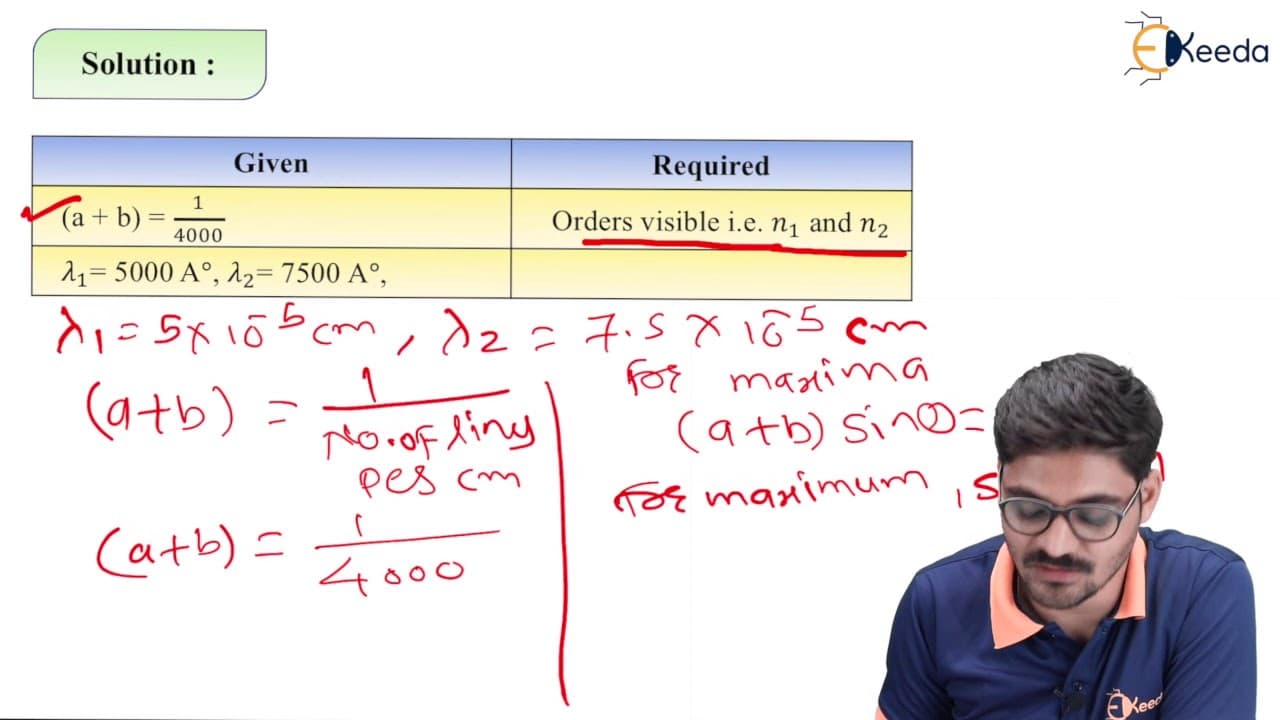
hello friends so in this part ii of numerical on diffraction we will be learning the new miracles particularly on creating so here in the numerical part to that is the numerical sanda fraction part 2 will be having two questions to discuss so here the question is how many orders will be visible how many orders will be visible if your length of inci... Read More
Key Insights
- ❓ Converting wavelength from angstroms to centimeters is an essential step in solving diffraction grating numerical problems.
- 👻 Calculating the grating element allows for determining various properties and quantities related to diffraction grating.
- 🪈 The concept of maximum diffraction order helps in understanding the number of visible orders and the resolving power of a grating.
Install to Summarize YouTube Videos and Get Transcripts
Explore YouTube Video Summarizer or Get YouTube Transcript Extractor
Questions & Answers
Q: How do you convert the wavelength from angstroms to centimeters in the numerical problems?
To convert wavelength from angstroms to centimeters, you can use the conversion factor of 1 angstrom = 10^-8 centimeters. Multiply the wavelength in angstroms by this conversion factor to obtain the wavelength in centimeters.
Q: What is the grating element and how is it calculated in the numerical problems?
The grating element is the spacing between adjacent lines on the diffraction grating. It is calculated using the formula a + B = 1/number of lines per centimeter. By substituting the given values into this formula, you can obtain the value of the grating element.
Q: How is the resolving power calculated in the numerical problems?
Resolving power is calculated using the formula resolving power = lambda/D lambda, where lambda is the wavelength and D lambda is the change in wavelength. By substituting the given values into this formula, you can calculate the resolving power.
Q: What is the condition for maximum diffraction order and how is it used in the numerical problems?
The condition for maximum diffraction order states that a + B * sin(theta) = n * lambda, where a and B are the dimensions of the grating, theta is the angle of diffraction, n is the order of the diffraction, and lambda is the wavelength. This equation is used to calculate the maximum diffraction order and other related quantities in the numerical problems.
Summary & Key Takeaways
-
Two numerical problems are discussed, involving finding the number of orders visible and resolving power of diffraction gratings.
-
The calculations involve converting wavelength from angstroms to centimeters and determining the grating element.
-
The analysis also explores the concept of maximum diffraction order and the angular breadth of a visible spectrum.
Read in Other Languages (beta)
Share This Summary 📚
Summarize YouTube Videos and Get Video Transcripts with 1-Click
Try YouTube Summary with ChatGPT & Claude or YouTube Transcript Generator
Explore More Summaries from Ekeeda 📚




Summarize YouTube Videos and Get Video Transcripts with 1-Click
Try YouTube Summary with ChatGPT & Claude or YouTube Transcript Generator