Language and notation of the circle | Introduction to Euclidean geometry | Geometry | Khan Academy
TL;DR
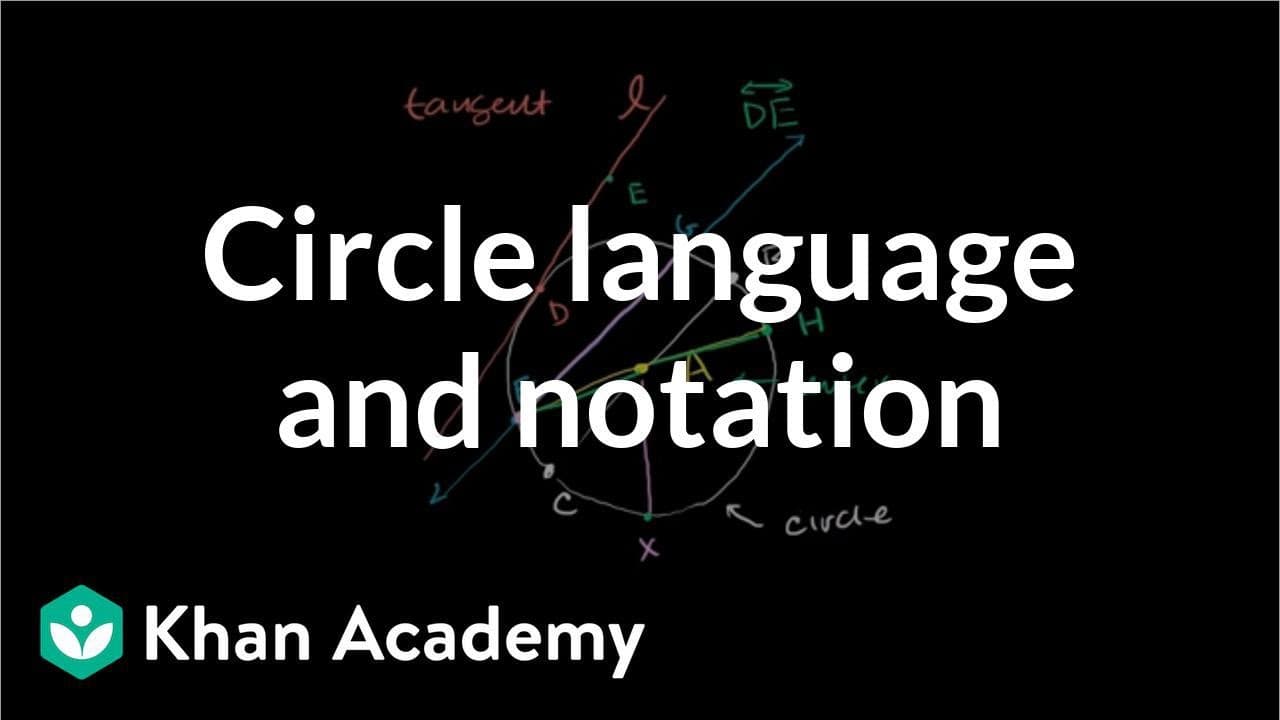
This video introduces the basic concepts of circles in geometry, including radii, tangents, secants, chords, diameters, and arcs.
Transcript
Let's start again with a point. Let's call that point point A. And what I'm curious about is all of the points on my screen right over here, that are exactly 2 centimeters away from A. So 2 centimeters on my screen is about that far. So clearly if I start at A and I go 2 centimeters in that direction, this point right over there, is 2 centimeters f... Read More
Key Insights
- 😥 A circle is the set of all points equidistant from a center point.
- 🫥 Radii are line segments that connect the center of a circle to any point on the circumference.
- 😥 Tangents intersect a circle at exactly one point, while secants intersect at two points.
- 🫥 A chord is a line segment connecting two points on a circle, and a diameter is a chord passing through the center.
Install to Summarize YouTube Videos and Get Transcripts
Explore YouTube Video Summarizer or Get YouTube Transcript Extractor
Questions & Answers
Q: What is a circle in geometry?
In geometry, a circle is defined as the set of all points that are a fixed distance, called the radius, from a central point.
Q: What is a radius in a circle?
A radius is a line segment that connects the center of a circle to any point on the circle. It represents the distance between the center and the point.
Q: What is a tangent line in relation to a circle?
A tangent line is a line that intersects the circle at exactly one point. It does not pass through the circle.
Q: How is a chord different from a radius in a circle?
A chord is a line segment that connects two points on a circle. Unlike a radius, a chord does not necessarily go through the center of the circle.
Q: What is a diameter in a circle?
A diameter is a chord that passes through the center of a circle. It is twice the length of a radius and connects two points on the circle.
Q: What is the difference between a minor arc and a major arc in a circle?
A minor arc is the shorter distance between two points on a circle, while a major arc is the longer distance. Major arcs are often specified by including an additional point on the circle's circumference.
Q: How are tangents and secants related to circles?
Tangents are lines that intersect a circle at only one point, while secants are lines that intersect a circle at two points.
Q: Can a chord be both a radius and a diameter in a circle?
No, a chord cannot be both a radius and a diameter. A radius connects the center to a point on a circle, while a diameter connects two points on the circle and passes through the center.
Summary & Key Takeaways
-
The video explains that a circle is the set of all points that are a fixed distance from a center point.
-
It discusses the terms radius, tangent, secant, chord, and diameter as they relate to circles.
-
The video also introduces the concepts of minor arcs and major arcs in a circle.
Read in Other Languages (beta)
Share This Summary 📚
Summarize YouTube Videos and Get Video Transcripts with 1-Click
Try YouTube Summary with ChatGPT & Claude or YouTube Transcript Generator
Explore More Summaries from Khan Academy 📚



Summarize YouTube Videos and Get Video Transcripts with 1-Click
Try YouTube Summary with ChatGPT & Claude or YouTube Transcript Generator