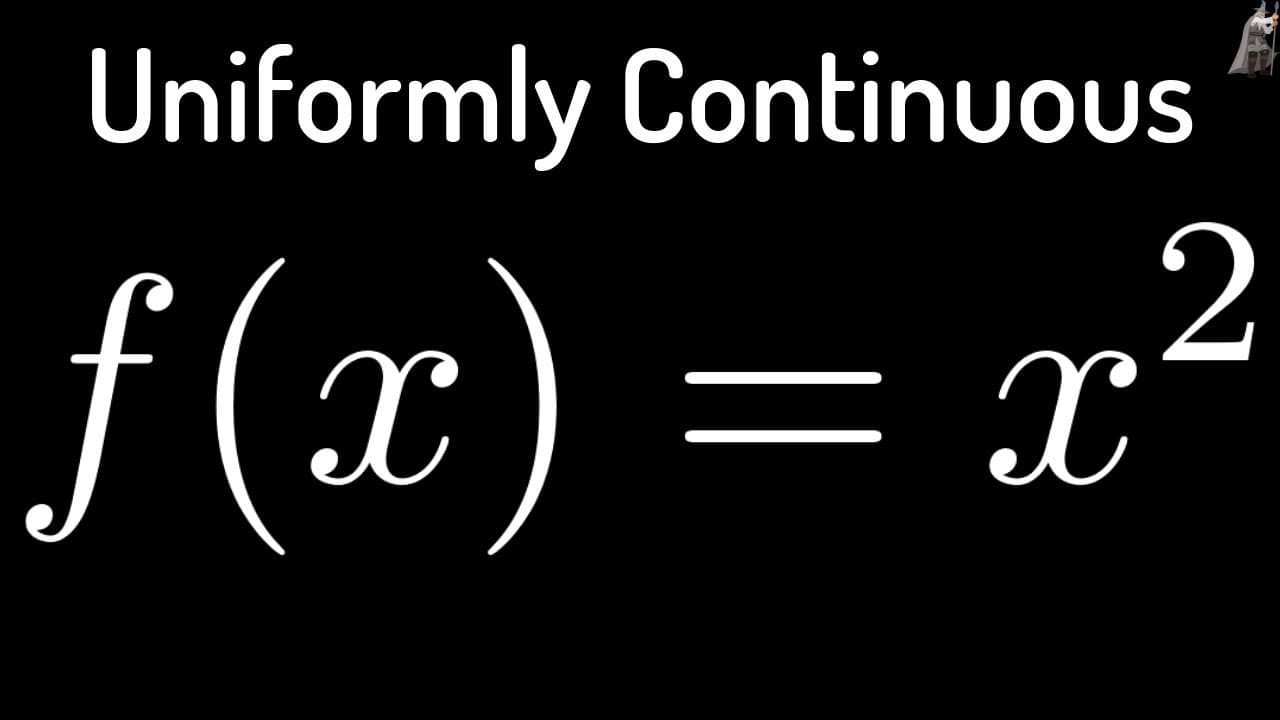
Proof that f(x) = x^2 is Uniformly Continuous on (0, 1)
TL;DR
Uniform continuity of f(x) = x² on (0,1) is proved by setting Delta = epsilon/2.
Transcript
prove f of X equals x squared is uniformly continuous on the open interval 0 1 so proof so before we can prove this we actually have to figure out how to prove it so recall that f is uniformly continuous on 0 1 if for all epsilon greater than 0 there's some delta greater than 0 such that for all x and y and the interval 0 1 with X minus y less than... Read More
Key Insights
- 👍 Understanding the epsilon-delta definition is crucial for proving uniform continuity in functions.
- 😑 By manipulating expressions and utilizing properties of absolute value, complex functions can be shown to be uniformly continuous.
- 🥋 Choosing an appropriate Delta value, such as Delta = epsilon/2, simplifies the proof process for uniform continuity.
Install to Summarize YouTube Videos and Get Transcripts
Explore YouTube Video Summarizer or Get YouTube Transcript Extractor
Questions & Answers
Q: How is uniform continuity defined for a function on an interval?
Uniform continuity means for all epsilon > 0, there exists a delta > 0 such that for all x and y in the interval, the difference between f(x) and f(y) is less than epsilon if the difference between x and y is less than delta.
Q: What strategy was used in the proof to show uniform continuity of f(x) = x²?
The proof focused on manipulating x² - y² into (x - y)(x + y), then using properties of absolute value to establish that the function is uniformly continuous by setting Delta = epsilon/2.
Q: How does setting Delta = epsilon/2 ensure uniform continuity for f(x) = x²?
By setting Delta = epsilon/2, when the distance between x and y is less than Delta, the difference between f(x) and f(y) simplifies to epsilon, satisfying the epsilon-delta definition of uniform continuity.
Q: Why is working backwards important before formally proving uniform continuity?
Working backwards allows for a clear strategy to be developed, ensuring that the proof progresses smoothly and efficiently by identifying key steps and values required to establish uniform continuity.
Summary & Key Takeaways
-
To prove uniform continuity, f(x) = x² must satisfy the epsilon-delta definition.
-
By manipulating x² - y², the proof shows that f(x) = x² is uniformly continuous on (0,1).
-
Choosing Delta = epsilon/2 demonstrates that f(x) = x² satisfies the uniform continuity condition.
Read in Other Languages (beta)
Share This Summary 📚
Summarize YouTube Videos and Get Video Transcripts with 1-Click
Try YouTube Summary with ChatGPT & Claude or YouTube Transcript Generator
Explore More Summaries from The Math Sorcerer 📚


Summarize YouTube Videos and Get Video Transcripts with 1-Click
Try YouTube Summary with ChatGPT & Claude or YouTube Transcript Generator