Prepositions of time | The parts of speech | Grammar | Khan Academy
TL;DR
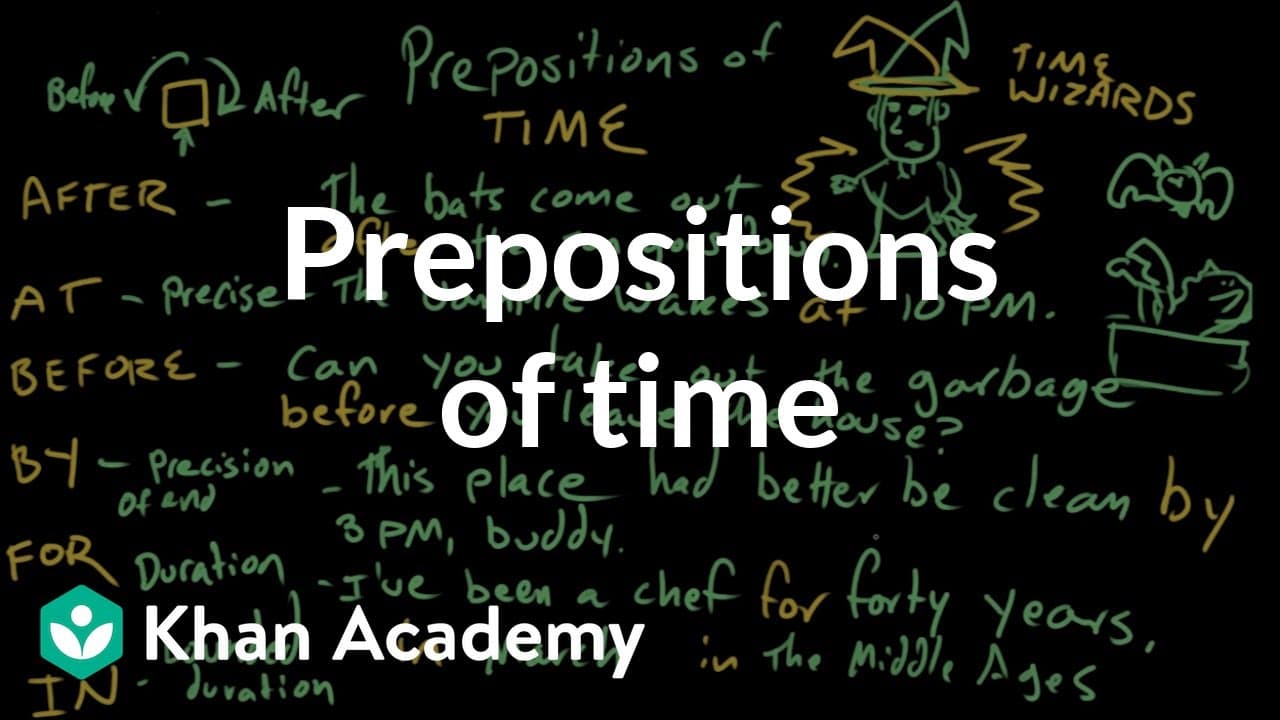
Learn about the different prepositions of time in English and how they represent time using space as a metaphor.
Transcript
- [Voiceover] Hello, Grammarians. We are once again learning how to master time and become Time Wizards, which is, of course, what you will be if you master all the tenses of English. But, if you want to become an additional Time Wizard, if you want to get, I don't know, a second hat, because everyone knows all wizards wear multiple, simultaneous h... Read More
Key Insights
- ⌛ Prepositions of time originally had physical meanings but took on representational connotations for time.
- 😥 "Before" and "after" represent something happening prior to or after a specific point in time.
- ⌛ "At" represents a single moment in time, while "by" has a precise end time and a less precise beginning time.
- 🥳 "For" denotes duration, "in" represents a bounded duration, and "on" signifies something happening on a specific day.
Install to Summarize YouTube Videos and Get Transcripts
Explore YouTube Video Summarizer or Get YouTube Transcript Extractor
Questions & Answers
Q: How did prepositions of time take on a connotation of representing time?
Prepositions like "before" and "after" originally meant behind and in front of, but over time, they started to represent time by using space as a metaphor. For example, "before" now represents something occurring prior to a point in time.
Q: What is the difference between "by" and "for"?
"By" represents a precise end time, but with a less precise beginning time. On the other hand, "for" denotes the duration of how long something has been going on. For example, "I've been a chef for 40 years."
Q: What is the difference between "in" and "on"?
"In" represents a bounded duration, meaning that it lasts for a specific amount of time, such as "in March" or "in the Middle Ages." On the other hand, "on" has a specific connotation of something happening on a specific day, like "on the 4th of July."
Q: How does "until" differ from "by"?
While both "until" and "by" represent a precise time, "until" focuses on a precise ending time. For example, if you have "until midnight" to rescue the Ambassador, you cannot complete the task after midnight.
Summary & Key Takeaways
-
Prepositions of time were originally physical prepositions but later took on a connotation of representing time.
-
"After" and "before" refer to something happening after or prior to a point in time.
-
"At" represents a single moment in time, while "by" is a precise end time with a less precise beginning time.
-
"For" denotes duration, "in" represents a bounded duration, "on" signifies something happening on a specific day, and "since" indicates a precise beginning. "Until" represents a precise ending time.
Read in Other Languages (beta)
Share This Summary 📚
Summarize YouTube Videos and Get Video Transcripts with 1-Click
Try YouTube Summary with ChatGPT & Claude or YouTube Transcript Generator
Explore More Summaries from Khan Academy 📚



Summarize YouTube Videos and Get Video Transcripts with 1-Click
Try YouTube Summary with ChatGPT & Claude or YouTube Transcript Generator