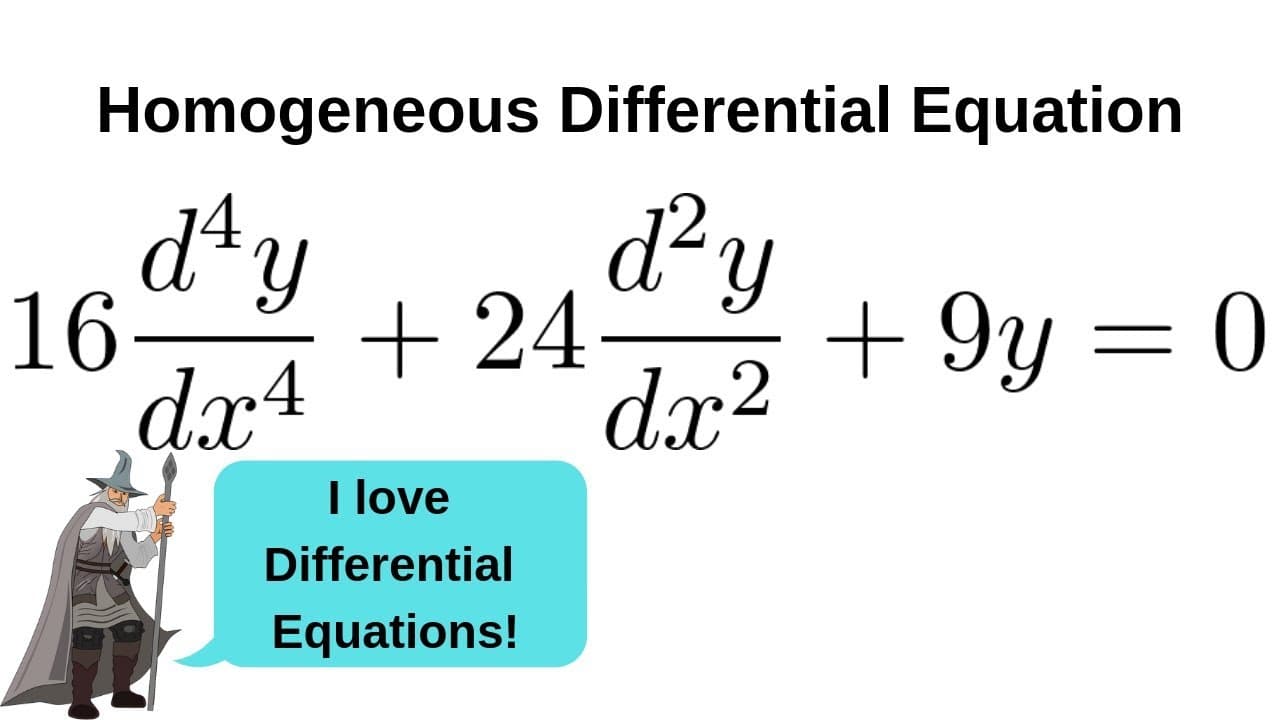
Fourth Order Linear Homogeneous Differential Equation with Repeated Complex Roots
TL;DR
Learn how to solve fourth-order differential equations using the characteristic equation method with complex roots.
Transcript
hey YouTube in this video we have a fourth order homogeneous differential equation so to solve this we'll start by writing down what's called the characteristic or auxilary equation so we have 16 and then this is a fourth derivative so we have M to the fourth so the power of M always matches the order of the derivative then plus 24 this is order 2 ... Read More
Key Insights
- ✋ The characteristic equation is crucial for solving higher-order homogeneous differential equations.
- 🧑🏭 Factoring the characteristic equation helps find the roots necessary for the differential equation solution.
- 🫚 Complex roots introduce the need for handling imaginary numbers in the solution.
- 🫚 Repeated complex roots require a specific approach to account for the repetition in the final solution.
- ✖️ The final solution of a differential equation with repeated complex roots involves multiplication by 'X'.
- 🫚 Understanding complex roots in differential equations is essential for solving more complex problems.
- 🫚 Differential equations with repeated complex roots may pose challenges but can be addressed methodically.
Install to Summarize YouTube Videos and Get Transcripts
Explore YouTube Video Summarizer or Get YouTube Transcript Extractor
Questions & Answers
Q: How do you start solving a fourth-order homogeneous differential equation?
To solve a fourth-order homogeneous differential equation, write down the characteristic equation by assigning powers to the variable 'M' based on the derivative order.
Q: What is the significance of the characteristic or auxiliary equation in differential equations?
The characteristic equation helps find the roots that determine the form of the solution for the differential equation, especially when dealing with higher-order derivatives.
Q: How are complex roots handled in solving differential equations?
Complex roots in differential equations like repeated complex roots involve expressing the solution as a combination of cosine and sine functions multiplied by 'X'.
Q: Why is dealing with repeated complex roots considered tricky in solving differential equations?
Repeated complex roots in differential equations require writing down the solution for the repeated root only once and then multiplying by 'X' to account for the repetition.
Summary & Key Takeaways
-
The video teaches how to solve a fourth-order homogeneous differential equation by writing and factoring the characteristic equation.
-
Complex roots are introduced and handled for repeated complex roots in the final solution.
-
The final solution is presented as a combination of cosine and sine functions with coefficients.
Read in Other Languages (beta)
Share This Summary 📚
Summarize YouTube Videos and Get Video Transcripts with 1-Click
Try YouTube Summary with ChatGPT & Claude or YouTube Transcript Generator
Explore More Summaries from The Math Sorcerer 📚



Summarize YouTube Videos and Get Video Transcripts with 1-Click
Try YouTube Summary with ChatGPT & Claude or YouTube Transcript Generator