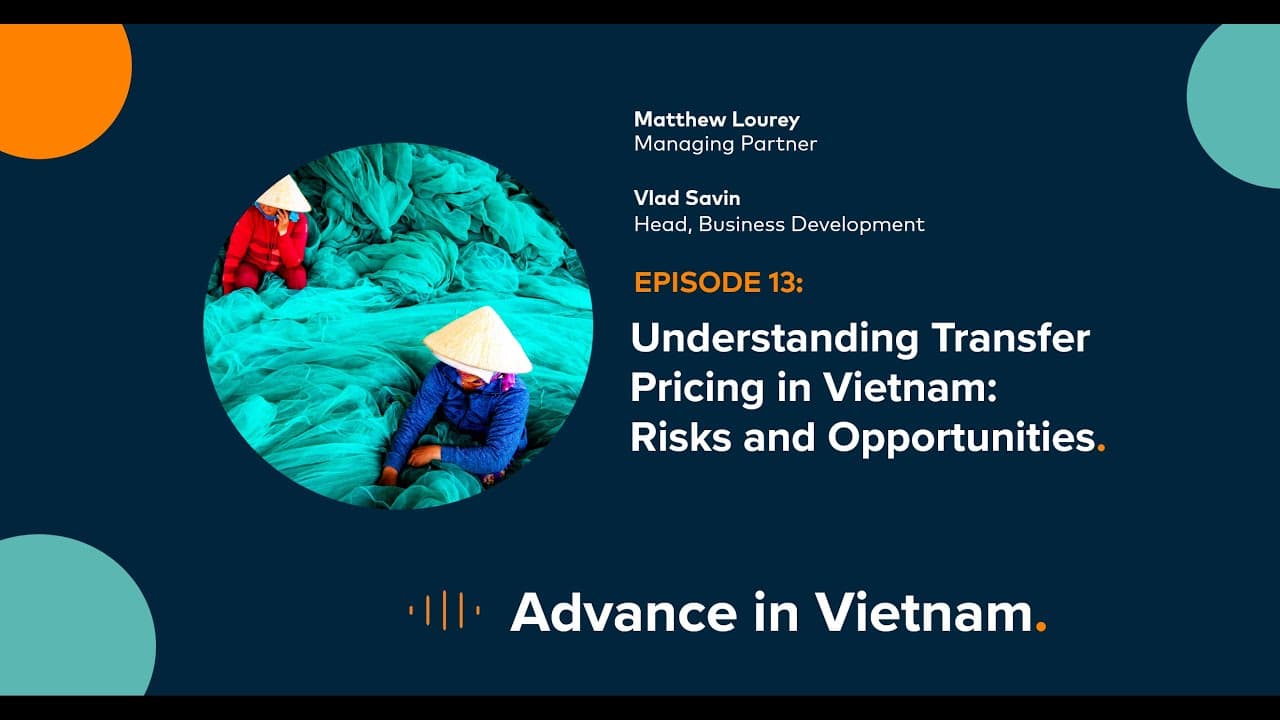
Understanding transfer pricing in Vietnam – risks and opportunities
TL;DR
Vietnam aligns transfer pricing with international standards.
Transcript
hello and welcome to climb's podcast series advancing vietnam with me vlad savin as your host throughout the following episodes we're looking to answering relevant questions about doing business in vietnam what are the opportunities and challenges faced by investors entering the market or existing players in major industries we will seek to underst... Read More
Key Insights
- Vietnam has adopted an OECD-aligned approach to transfer pricing, focusing on fair profit allocation and tax compliance.
- Decree 132, effective from December 2020, broadens related party definitions and narrows acceptable pricing ranges.
- Exemptions exist for businesses under certain revenue and transaction thresholds, simplifying compliance requirements.
- Transfer pricing documentation must align with international standards, requiring detailed country-by-country reports.
- Interest deductions are capped at 30% of EBITDA, with provisions for carrying forward excess deductions.
- Advanced Pricing Agreements offer pre-emptive compliance assurance for complex businesses.
- Transfer pricing compliance requires understanding related party transactions and potential tax savings.
- Vietnamese authorities are keen on enforcing compliance, with penalties for non-adherence potentially increasing effective tax rates.
Install to Summarize YouTube Videos and Get Transcripts
Explore YouTube Video Summarizer or Get YouTube Transcript Extractor
Questions & Answers
Q: What is the significance of Decree 132 in Vietnam's transfer pricing regulations?
Decree 132, effective from December 2020, marks a significant shift in Vietnam's transfer pricing regulations. It aligns the country's policies with international standards, particularly those of the OECD, ensuring fair profit allocation and tax compliance. The decree broadens the definition of related parties and narrows the acceptable pricing ranges, requiring businesses to adjust their practices to remain compliant. This alignment is crucial for foreign investors and businesses operating in Vietnam, as it provides a clearer framework for managing cross-border transactions and optimizing tax obligations.
Q: How do exemptions work under Vietnam's transfer pricing regulations?
Exemptions under Vietnam's transfer pricing regulations are designed to simplify compliance for smaller businesses. Companies with a turnover below 50 billion VND and related party transactions under 30 billion VND are exempt from detailed documentation requirements. Additionally, businesses with revenue under 200 billion VND can benefit from simplified compliance categories, such as a 5% margin for distribution or a 10-15% margin for manufacturing and processing. These exemptions aim to reduce the administrative burden on smaller enterprises while ensuring that larger entities adhere to stringent standards.
Q: What are the implications of interest deduction caps in Vietnam's transfer pricing rules?
Interest deduction caps in Vietnam's transfer pricing rules are set at 30% of EBITDA, a measure designed to prevent excessive profit shifting through interest payments. This cap ensures that businesses maintain adequate capitalization and do not excessively leverage their operations to reduce taxable income. Excess interest deductions can be carried forward to future periods, providing some flexibility for businesses. This rule is part of a broader effort to enforce compliance and prevent profit shifting, aligning Vietnam's tax policies with international norms and ensuring fair taxation.
Q: What are Advanced Pricing Agreements (APAs) and how do they benefit businesses in Vietnam?
Advanced Pricing Agreements (APAs) are pre-emptive arrangements between businesses and tax authorities that establish agreed-upon transfer pricing methods for specific transactions. In Vietnam, APAs offer businesses a proactive strategy to ensure compliance with transfer pricing regulations. By securing an APA, companies can avoid disputes and audits, as the agreed-upon pricing methods are recognized by the authorities. This is particularly beneficial for complex businesses with significant cross-border transactions, as it provides certainty and stability in tax planning, reducing the risk of penalties and adjustments.
Q: How does Vietnam's transfer pricing compliance impact foreign investors?
Vietnam's transfer pricing compliance impacts foreign investors by requiring them to align their practices with international standards, ensuring fair profit allocation and tax payments. The regulations, particularly under Decree 132, emphasize transparency and accountability in related party transactions. Foreign investors must understand and adhere to these rules to avoid penalties and optimize tax obligations. Compliance is crucial for maintaining good standing with Vietnamese authorities and ensuring smooth operations in the country. The focus on fair pricing and documentation also enhances Vietnam's attractiveness as an investment destination.
Q: What are the reporting requirements for transfer pricing in Vietnam?
Reporting requirements for transfer pricing in Vietnam include the submission of detailed country-by-country reports, which outline profits, transactions, and comparable benchmarks. Businesses must declare related party transactions when filing tax returns annually, with reports due within 12 months. However, during inspections, reports must be submitted within 30 days. These reports must be prepared in Vietnamese and align with international standards, requiring thorough documentation and analysis. Compliance with these reporting requirements is essential to avoid penalties and ensure that businesses are adhering to Vietnam's transfer pricing regulations.
Q: What strategies can businesses employ to optimize transfer pricing compliance in Vietnam?
To optimize transfer pricing compliance in Vietnam, businesses should first assess their related party transactions and exposure to regulatory thresholds. Understanding where they stand in terms of revenue and transaction volumes can help identify potential exemptions or safe harbors. Companies should also consider restructuring transactions to fit within simplified compliance categories or explore Advanced Pricing Agreements for complex operations. Regularly reviewing and adjusting pricing strategies to align with market benchmarks is crucial. By proactively managing compliance, businesses can minimize risks and optimize tax obligations, ensuring smooth operations in Vietnam.
Q: How do Vietnamese authorities enforce transfer pricing regulations?
Vietnamese authorities enforce transfer pricing regulations by closely monitoring related party transactions and ensuring compliance with Decree 132. They focus on identifying businesses with higher risks of profit shifting and scrutinize their documentation and pricing methods. Inspections are conducted to verify compliance, with penalties imposed for non-adherence, potentially increasing effective tax rates. The authorities use international standards as benchmarks, requiring businesses to align their practices accordingly. This enforcement approach aims to prevent tax avoidance and ensure fair profit allocation, contributing to a transparent and accountable business environment in Vietnam.
Summary & Key Takeaways
-
Vietnam has updated its transfer pricing regulations to align with international standards, focusing on fair profit allocation. Decree 132, effective from December 2020, introduces significant changes, including broader related party definitions and stricter pricing range requirements. Compliance is crucial to avoid penalties and optimize tax savings.
-
Businesses under specific revenue and transaction thresholds benefit from exemptions, simplifying compliance. Transfer pricing documentation must be thorough, with detailed country-by-country reports required. Advanced Pricing Agreements provide a proactive compliance strategy for complex businesses, offering pre-emptive assurance against audits.
-
Interest deductions are limited to 30% of EBITDA, with provisions for carrying forward excess deductions. Understanding related party transactions and potential tax savings is essential for compliance. Vietnamese authorities are vigilant in enforcing regulations, with penalties for non-compliance potentially increasing effective tax rates.
Read in Other Languages (beta)
Share This Summary 📚
Summarize YouTube Videos and Get Video Transcripts with 1-Click
Try YouTube Summary with ChatGPT & Claude or YouTube Transcript Generator
Explore More Summaries from Acclime Vietnam 📚




Summarize YouTube Videos and Get Video Transcripts with 1-Click
Try YouTube Summary with ChatGPT & Claude or YouTube Transcript Generator