Projects That Work: Mission to Mars

TL;DR
Students engage in project-based learning through a mission to Mars project, where they design testable landers and apply physics concepts to solve real-world problems.
Transcript
- My students learn the physics better when they're acting as though they are true physicists. I try to teach as much as possible in a project-based approach in all of my classes. I've seen enough success out of what it does for students that I'm hooked on it. One of the things about the project that I think helps to make it successful, and the sty... Read More
Key Insights
- 🧑🎓 Project-based learning enhances students' learning experience by providing a real-world context and motivation for deepening their understanding of physics.
- 🧑🎓 Assuming professional roles in a project helps students connect theoretical concepts to practical applications and potential career paths.
- 🤗 Hands-on experiments and data analysis allow students to explore physics concepts and develop problem-solving skills.
- 🧑🎓 Having a public product, such as presenting to industry experts, promotes meaningful learning and provides valuable feedback for students.
- 🤗 Students benefit from constructing their knowledge through project-based learning rather than simply being handed tools and concepts.
- 🧑🎓 Project-based learning helps students become more proficient in applying physics equations and math tools to real-world scenarios.
- 💪 Project-based learning fosters stronger communication skills and the ability to explain concepts more eloquently.
Install to Summarize YouTube Videos and Get Transcripts
Explore YouTube Video Summarizer or Get YouTube Transcript Extractor
Questions & Answers
Q: How does project-based learning benefit students in physics education?
Project-based learning encourages deeper understanding and motivation in students as they tackle real-world problems, relate physics concepts to practical applications, and assume professional roles.
Q: What is the role of the teacher in project-based learning?
The teacher's role is to facilitate the project and ensure students stay in character as the Systems Engineer, guiding them towards relevant physics concepts and providing support as needed.
Q: What physics concepts do students explore during the Mission to Mars project?
Students investigate air resistance, terminal velocity, impulse, and the conservation of mechanical energy as they design, test, and analyze their landers.
Q: How does project-based learning contribute to students' communication and application skills?
By engaging in project-based learning, students develop eloquent explanations, agile application skills, and an understanding of how to use math tools repetitively to solve complex problems.
Summary & Key Takeaways
-
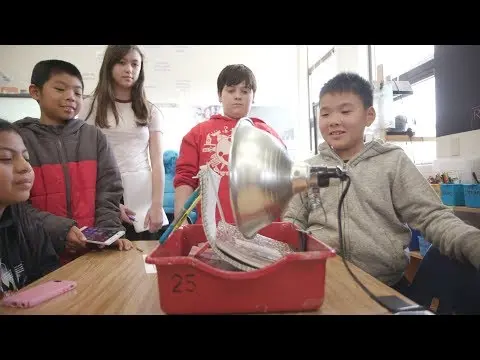
Students participate in a project-based learning activity called Mission to Mars, where they create testable landers for a simulated mission.
-
The project motivates students to learn physics concepts by providing a real-world context and the opportunity to assume the role of a Systems Engineer.
-
Students explore physics concepts such as air resistance, impulse, and mechanical energy through hands-on experiments and data analysis.
Read in Other Languages (beta)
Share This Summary 📚
Summarize YouTube Videos and Get Video Transcripts with 1-Click
Try YouTube Summary with ChatGPT & Claude or YouTube Transcript Generator
Explore More Summaries from Edutopia 📚




Summarize YouTube Videos and Get Video Transcripts with 1-Click
Try YouTube Summary with ChatGPT & Claude or YouTube Transcript Generator