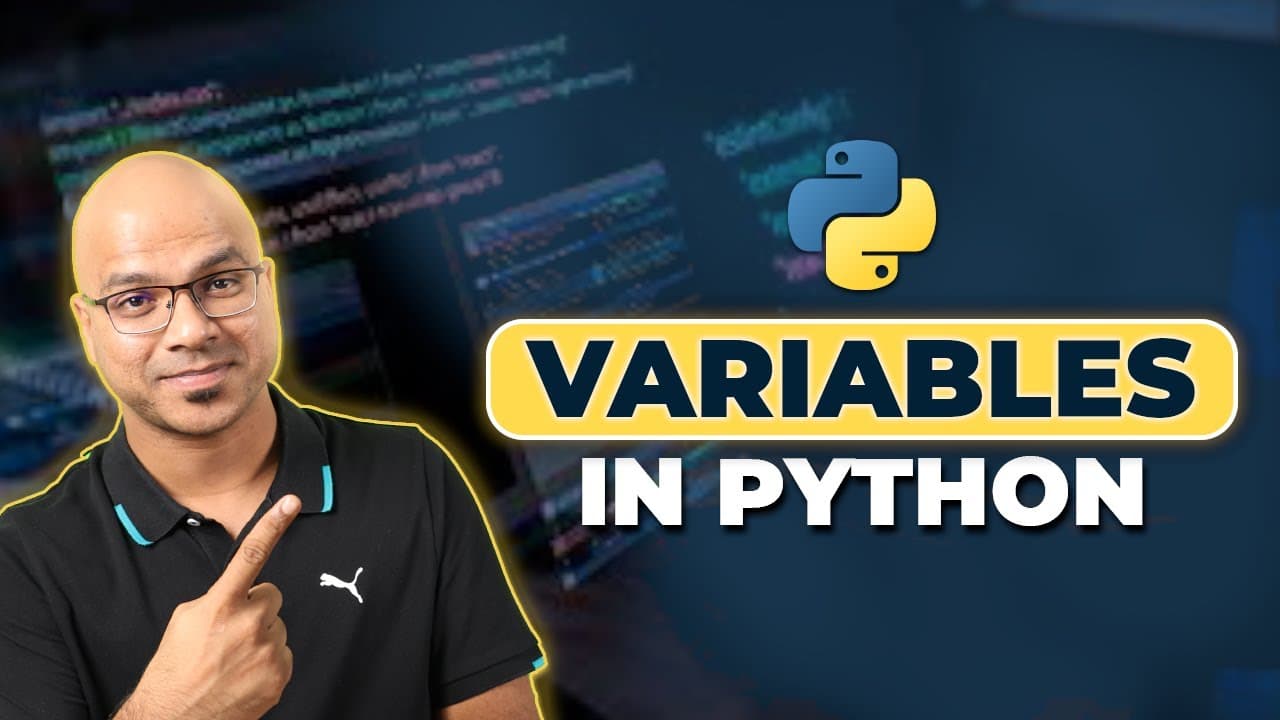
#4 Python Tutorial for Beginners | Variables in Python
TL;DR
This video explains the concept of variables in Python and how they can be used to store and manipulate values.
Transcript
welcome back aliens my name is Devin 20 and let's continue with this series on Python in fact in the earlier videos we have talked about what is Python we have we have installed two software's and we have also worked with certain operations right we had fun in the last session now in this video where I talk about what is variable but first of all w... Read More
Key Insights
- 🏪 Variables in Python are containers used to store values.
- 🅰️ They can be assigned different data types, such as integers, floats, and strings.
- ❓ Variables can be manipulated using various operations, such as addition and concatenation.
- ♿ In Python, string variables can be accessed and modified using indexing.
- 🤫 Python allows the use of inbuilt functions, such as len(), to perform operations on variables.
- 💱 Variables in Python are mutable, meaning their value can be changed.
- ❓ An error is thrown if a variable is used before it is defined.
Install to Summarize YouTube Videos and Get Transcripts
Explore YouTube Video Summarizer or Get YouTube Transcript Extractor
Questions & Answers
Q: What is a variable in Python?
In Python, a variable is a container used to store values. It can be assigned any valid value, such as numbers, strings, or other data types.
Q: How can we assign a value to a variable in Python?
To assign a value to a variable, you simply use the equal sign (=) operator. For example, "x = 5" assigns the value 5 to the variable x.
Q: Can we change the value of a variable in Python?
Yes, variables in Python are mutable, meaning the value they store can be changed. You can assign a new value to a variable, and it will be updated accordingly.
Q: Can we use variables with different data types in Python?
Yes, variables in Python can store values of different data types. You can assign integers, floats, strings, and other data types to variables.
Q: How can we access specific characters in a string variable?
In Python, you can access specific characters in a string variable by using indexing. The first character has an index of 0, and you can use square brackets [] to specify the index.
Key Insights:
- Variables in Python are containers used to store values.
- They can be assigned different data types, such as integers, floats, and strings.
- Variables can be manipulated using various operations, such as addition and concatenation.
- In Python, string variables can be accessed and modified using indexing.
- Python allows the use of inbuilt functions, such as len(), to perform operations on variables.
- Variables in Python are mutable, meaning their value can be changed.
- An error is thrown if a variable is used before it is defined.
- Python follows zero-based indexing, where the first character of a string has an index of 0.
Summary & Key Takeaways
-
The video introduces the concept of variables and explains that they are containers used to store values.
-
It demonstrates how to assign values to variables and perform operations using them.
-
The video also explores the use of variables with different data types, such as integers and strings.
Read in Other Languages (beta)
Share This Summary 📚
Summarize YouTube Videos and Get Video Transcripts with 1-Click
Try YouTube Summary with ChatGPT & Claude or YouTube Transcript Generator
Explore More Summaries from Telusko 📚



Summarize YouTube Videos and Get Video Transcripts with 1-Click
Try YouTube Summary with ChatGPT & Claude or YouTube Transcript Generator