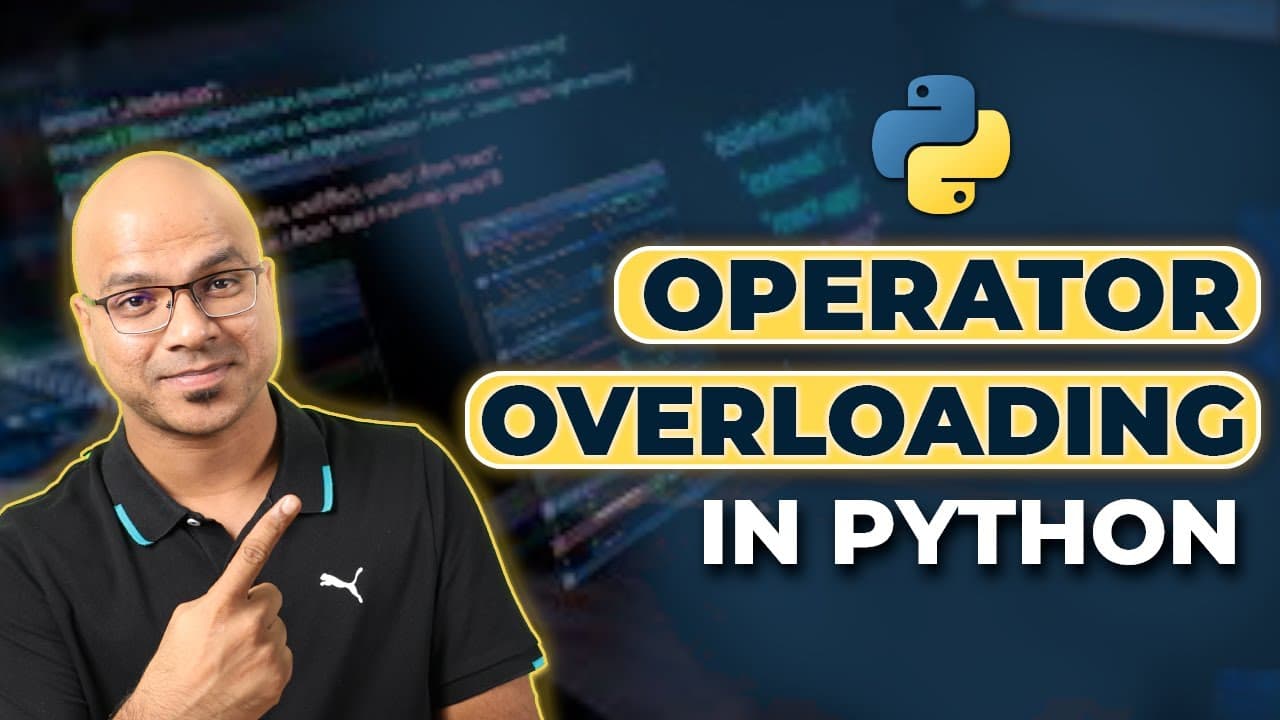
#59 Python Tutorial for Beginners | Operator Overloading | Polymorphism
TL;DR
This video explains the concept of operator overloading in Python, and how to use it to perform operations between objects of custom classes.
Transcript
my name is Ivan 20 I'll never give the city's on Python we have started talking about polymorphism right and in that we have seen one example of duck typing now in this video we'll talk about operator overloading so what is operator overloading so we know the concept of operators right so we have to offer example if you want to add two numbers you ... Read More
Key Insights
- 🎭 Operator overloading is the concept of defining how operators such as +, -, and * work with different types and objects in a programming language like Python.
- ⚡️ In Python, operator overloading is achieved by defining special methods such as add and sub for performing addition and subtraction, respectively.
- ♀️ These special methods are also known as magic methods because they allow us to define custom behavior for operators.
- 💡 When adding two strings in Python using the + operator, the operation is internally handled by the add method of the str class.
- 🐍 Similarly, when adding two integers, the operation is handled by the add method of the int class.
- 🔆 To perform operator overloading for user-defined objects, we need to define the appropriate special methods like add, sub, etc., and specify the desired behavior.
- 📚 By overloading the greater than (>) operator (gt), we can compare objects of a user-defined class based on specific attributes or conditions.
- 💥 When printing an object, Python internally calls the str method, which returns a string representation of the object with the desired values.
Install to Summarize YouTube Videos and Get Transcripts
Explore YouTube Video Summarizer or Get YouTube Transcript Extractor
Questions & Answers
Q: How does polymorphism relate to operator overloading in Python?
Polymorphism refers to the ability of an object to take on multiple forms. In the context of operator overloading, it means that operators can behave differently depending on the type of objects they are applied to. By overloading operators in custom classes, we can achieve polymorphic behavior.
Q: Can operator overloading be used for all operators in Python?
Yes, operator overloading can be used for most operators in Python, including arithmetic operators such as +, -, *, and comparison operators such as <, >, ==.
Q: Why do we need to define magic methods for operator overloading?
Magic methods are special methods in Python that are automatically called when certain operations are performed on objects. By defining these magic methods in a class, we can customize the behavior of operators for objects of that class.
Q: Is it possible to overload the assignment operator (=) in Python?
No, it is not possible to overload the assignment operator (=) in Python. This operator always performs assignment and cannot be customized for custom classes.
Q: How do we override the behavior of the print() function for custom classes?
The behavior of the print() function can be overridden by defining the str() method in a custom class. This method should return a string representation of the object, which will be printed when the object is passed to the print() function.
Answer: Operator overloading in Python allows us to define how operators behave between objects of custom classes. By defining special methods called magic methods, we can define the behavior of operators such as +, -, *, etc. between objects. This helps in achieving polymorphic behavior and customizing the behavior of operators for specific classes.
Summary & Key Takeaways
-
Operator overloading is the ability to use operators such as +, -, *, etc., with custom classes in Python.
-
When using operators between objects of custom classes, the corresponding magic methods (e.g., add for +) need to be defined in the class.
-
By defining these magic methods, it is possible to customize the behavior of operators for objects of the class.
Read in Other Languages (beta)
Share This Summary 📚
Summarize YouTube Videos and Get Video Transcripts with 1-Click
Try YouTube Summary with ChatGPT & Claude or YouTube Transcript Generator
Explore More Summaries from Telusko 📚
Summarize YouTube Videos and Get Video Transcripts with 1-Click
Try YouTube Summary with ChatGPT & Claude or YouTube Transcript Generator