Precalculus Final Exam Review
TL;DR
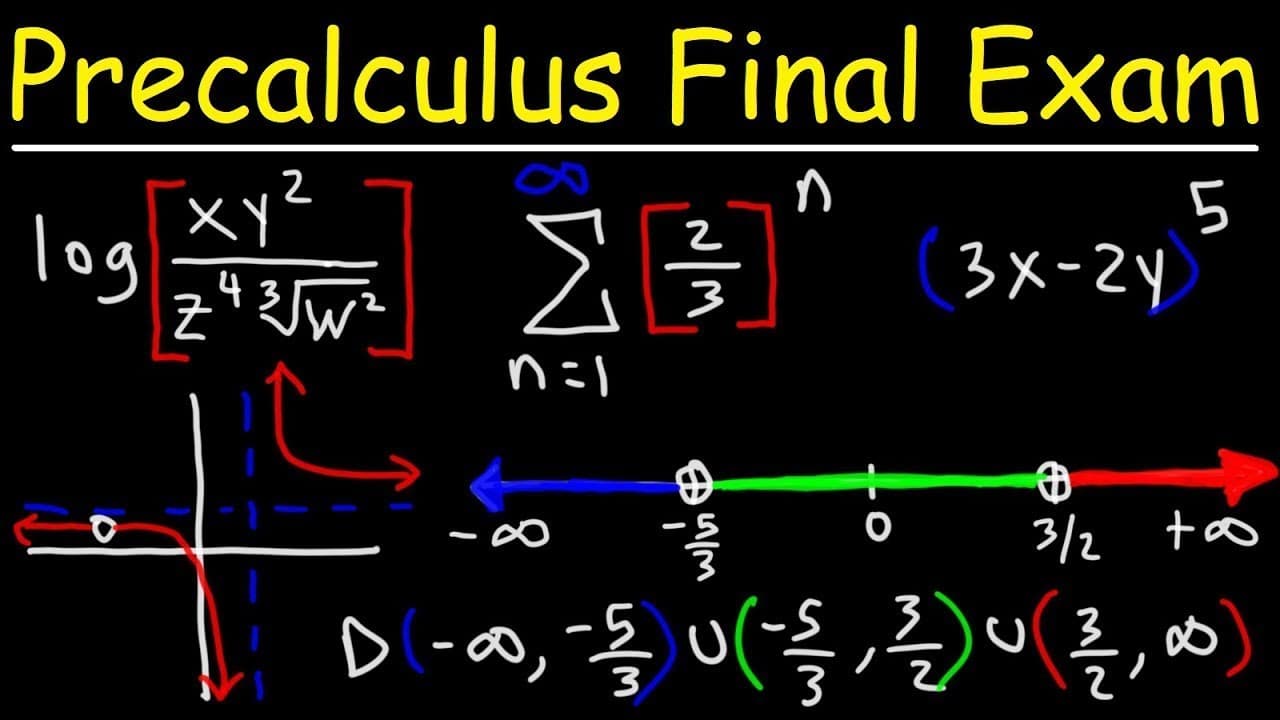
This video provides a comprehensive review of precalculus concepts for the final exam, covering topics such as exponential equations, logarithmic expressions, piecewise functions, composite functions, and graphing. It also includes practice problems with detailed explanations.
Transcript
this video is for those of you who are studying for the pre-calculus final exam now it really doesn't contain many trick questions aside from law of signs and law of cosines and a few triangle problems but if your exam does contain trig I do have a separate video dedicated for that if you go to YouTube and do a search type in trigonometry final exa... Read More
Key Insights
- 🎮 The video provides a comprehensive review of precalculus concepts commonly covered in a final exam.
- ❓ The instructor emphasizes step-by-step problem-solving techniques and provides detailed explanations for each topic.
- 👻 Practice problems are included to allow viewers to test their understanding before watching the solutions.
- 😒 The use of transformations is highlighted for graphing functions, such as exponential and piecewise functions.
- 🧡 The importance of understanding domain and range is emphasized, with specific examples provided for each concept.
- 🫵 The video encourages active participation from viewers, urging them to pause and attempt problems on their own before watching the solutions.
- 🎮 The video addresses common misconceptions and provides clear explanations to clarify concepts.
Install to Summarize YouTube Videos and Get Transcripts
Explore YouTube Video Summarizer or Get YouTube Transcript Extractor
Questions & Answers
Q: How do you solve an exponential equation with different bases?
In an exponential equation with different bases, you need to make sure the bases are the same. To do this, you can convert the bases by writing them in terms of a common base. Once the bases are the same, you can set the exponents equal to each other and solve for the variable.
Q: How do you find the inverse function of a given function?
To find the inverse function of a given function, you need to switch the x and y variables and solve for y. The resulting equation represents the inverse function. You can then evaluate the inverse function at a specific value to find the corresponding output.
Q: How do you evaluate a logarithmic expression?
To evaluate a logarithmic expression, you need to determine the value of the variable that makes the expression true. This can be done by writing the logarithmic expression as an exponential expression and solving for the variable. You can also use properties of logarithms and mental calculations to simplify the expressions.
Q: What is the process for finding the zeros of a polynomial function?
To find the zeros of a polynomial function, you need to set the function equal to zero and solve for the variable. This can be done by factoring the polynomial, using the quadratic formula, or using synthetic division. The resulting solutions represent the x-values for which the function equals zero.
Summary & Key Takeaways
-
The video focuses on reviewing precalculus concepts for the final exam, including exponential equations, logarithmic expressions, piecewise functions, and composite functions.
-
The instructor provides step-by-step explanations on how to solve various problems related to these topics.
-
Practice problems are included throughout the video, allowing viewers to pause and attempt the problems themselves before watching the solutions.
Read in Other Languages (beta)
Share This Summary 📚
Summarize YouTube Videos and Get Video Transcripts with 1-Click
Try YouTube Summary with ChatGPT & Claude or YouTube Transcript Generator
Explore More Summaries from The Organic Chemistry Tutor 📚




Summarize YouTube Videos and Get Video Transcripts with 1-Click
Try YouTube Summary with ChatGPT & Claude or YouTube Transcript Generator