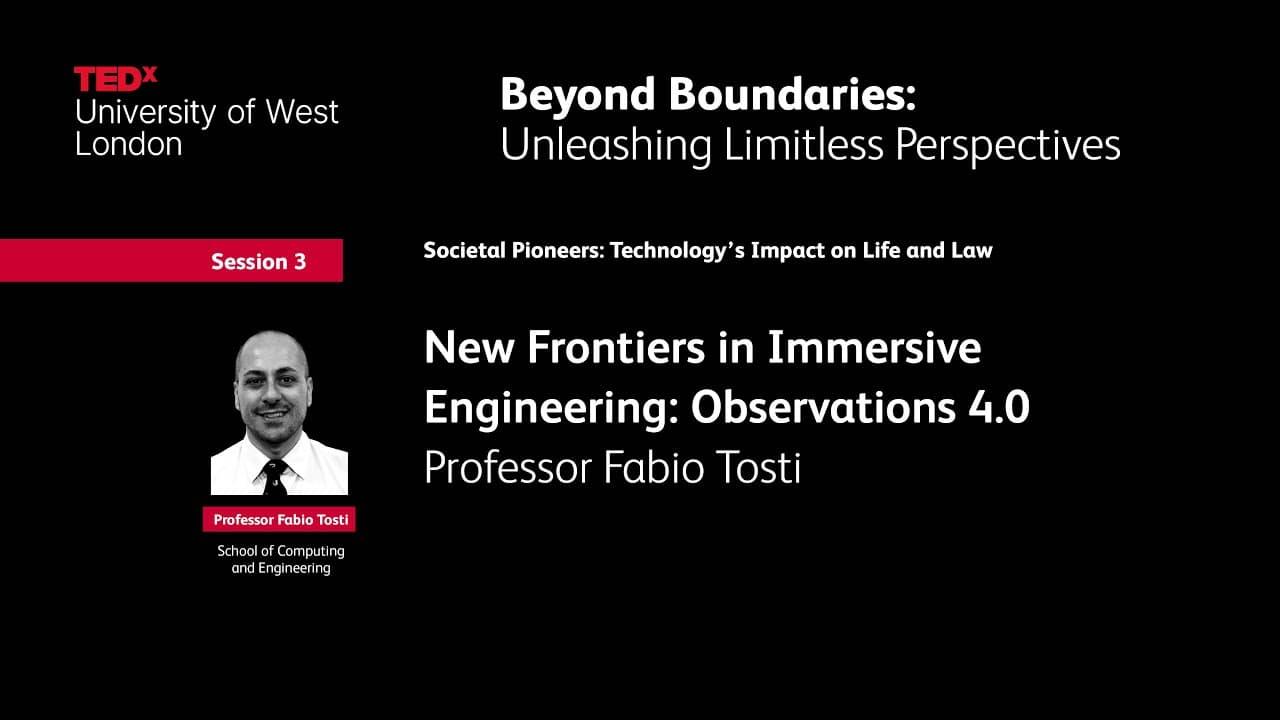
New Frontiers in Immersive Engineering | Fabio Tosti | TEDxUniversity of West London
TL;DR
Exploring the revolutionary impact of ground penetrating radar and stereoscopy on engineering observations in immersive technology.
Transcript
[Applause] good day everybody uh yes my name is Fabio and as it is trendy to say today of course I am an engineer that was meant to be my ice breaking Center sorry um Yes actually um you may be wondering why these two pieces of equipment and uh I'm going to explain it to you in a while but first of all I would really like to start from um quote by ... Read More
Key Insights
- 👋 Ground penetrating radar (GPR) enables subsurface imaging with electromagnetic waves, impacting various industries like archaeology, mining, and infrastructure monitoring.
- 🫚 Stereoscopy, from its historical roots in the 19th century, has evolved into immersive technology, influencing industries with advanced three-dimensional models and immersive experiences.
- ❓ Immersive technology, including virtual reality and augmented reality, is revolutionizing engineering observations, enhancing understanding and decision-making.
- 🧡 Engineering processes benefit from GPR and stereoscopy, with applications ranging from root investigation and 3D modeling to archaeological investigations and structural assessments.
Install to Summarize YouTube Videos and Get Transcripts
Explore YouTube Video Summarizer or Get YouTube Transcript Extractor
Questions & Answers
Q: How does ground penetrating radar (GPR) work and what are its main applications?
GPR uses electromagnetic waves to penetrate subsurfaces and image them without altering them. Its applications range from archaeology and infrastructure monitoring to planetary explorations, showcasing its versatility and depth imaging capabilities.
Q: What is the historical significance of stereoscopy and how has it evolved into immersive technology?
Stereoscopy originated in the 19th century, creating depth perception from two-dimensional images. Today, it has transformed into immersive technology, enabling advanced three-dimensional models and immersive experiences like virtual reality.
Q: What are the benefits of using GPR in engineering processes, particularly in root investigation and 3D modeling?
GPR aids in identifying roots, analyzing physical parameters, and creating 3D computer-generated models for enhanced understanding. In the context of immersive technology, it allows for overlaid information for better decision-making and validation.
Q: How does augmented reality enhance remote sensing systems like interferometric radar?
Augmented reality can provide context information for radar systems, allowing visualization of beam radiation and enhancing the level of information previously unattainable. This innovative approach can improve understanding and monitoring in remote sensing applications.
Summary & Key Takeaways
-
Discusses the historical impact and implications of ground penetrating radar (GPR) and stereoscopy in engineering observations.
-
Explores the capabilities of GPR in subsurface imaging and various applications in industries like archaeology, mining, and infrastructure monitoring.
-
Highlights how stereoscopy has evolved into immersive technology, impacting industries with its immersive experiences and revenue forecasts.
Read in Other Languages (beta)
Share This Summary 📚
Summarize YouTube Videos and Get Video Transcripts with 1-Click
Try YouTube Summary with ChatGPT & Claude or YouTube Transcript Generator
Explore More Summaries from TEDx Talks 📚

Summarize YouTube Videos and Get Video Transcripts with 1-Click
Try YouTube Summary with ChatGPT & Claude or YouTube Transcript Generator