What language shows cause and effect? | Reading | Khan Academy
TL;DR
Cause and effect relationships in writing can be compared to Rube Goldberg machines, where each action leads to a subsequent reaction.
Transcript
- [David] Hello, readers. Once upon a time in the previous century, there lived a cartoonist and engineer named, Rube Goldberg, who became well-known for his drawings of wacky, overcomplicated machines. This is one such machine, the self-operating napkin. You see how it works is you lift the spoon, which jerks the string, which causes the cracker t... Read More
Key Insights
- 🛟 Cause and effect relationships can be observed in both real-life situations and written texts.
- 😒 Authors use specific words and phrases to signal cause and effect connections in their writing.
- ✍️ Cause and effect relationships in writing can be multi-faceted and not always follow a linear structure.
- ❓ It is essential to consider the potential outcomes or effects of a cause when analyzing a text.
- 🔑 Clue words like "because," "since," "so," and "therefore" can help identify cause and effect relationships in a text.
- 🤔 Understanding cause and effect relationships in writing enhances comprehension and critical thinking skills.
- 🎰 Rube Goldberg machines provide a visual representation of cause and effect relationships.
Install to Summarize YouTube Videos and Get Transcripts
Explore YouTube Video Summarizer or Get YouTube Transcript Extractor
Questions & Answers
Q: What are some clue words that signal cause in a text?
Some clue words that indicate cause in a text include "because," "since," "due to," and "as a result of." These words provide information about why something happened.
Q: How can cause and effect relationships be reversed in a sentence?
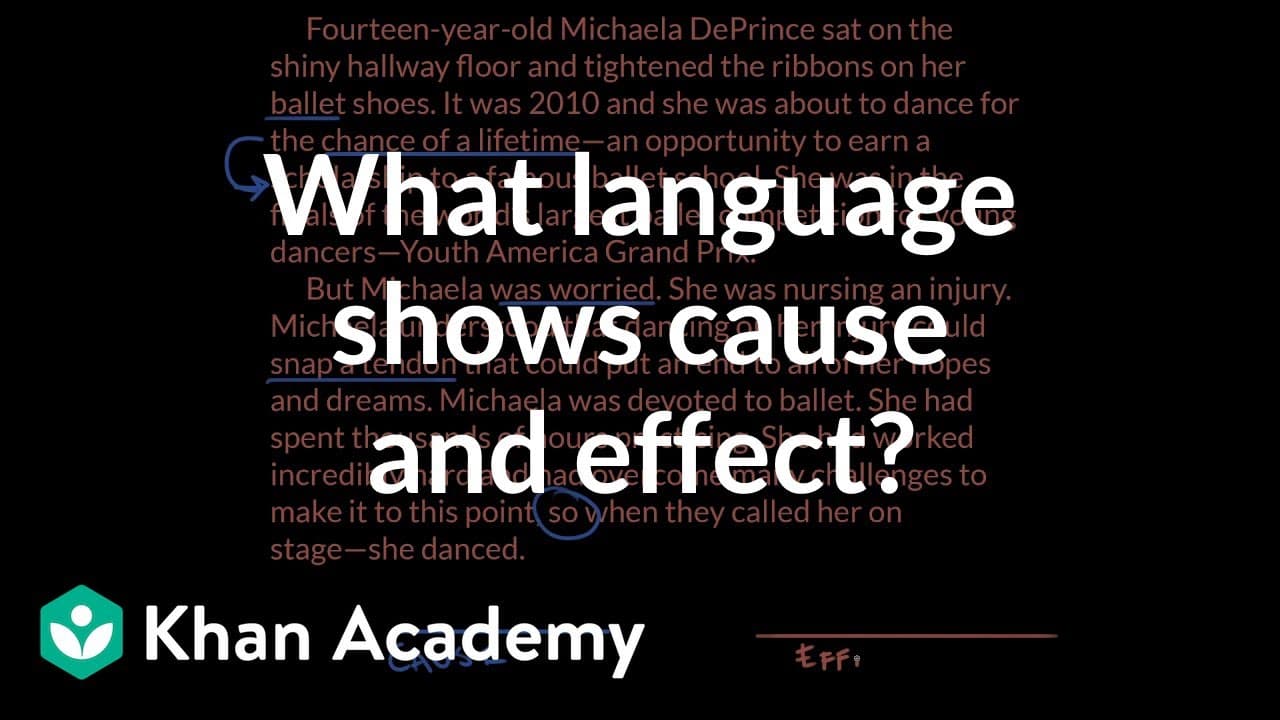
Cause and effect relationships don't always follow a straight-forward order. For example, a sentence can be written as "I took a nap because I was tired" or "Because I was tired, I took a nap." It's important to consider how actions are connected and why they occur.
Q: Why does Michaela worry in the given text?
Michaela worries because she doesn't want to risk snapping a tendon, which could potentially end her dreams and aspirations. The injury represents a significant threat to her future.
Q: What motivates Michaela to dance despite her injury?
Michaela dances despite her injury because she has already overcome numerous challenges, has a deep devotion to ballet, and sees the opportunity to earn a scholarship to a prestigious ballet school as a chance of a lifetime.
Summary & Key Takeaways
-
Cause and effect relationships can be seen in everyday life, as well as in writing.
-
Authors use clue words to signal cause and effect connections in their texts.
-
Cause and effect relationships in writing can be complex and not always follow a linear sequence.
Read in Other Languages (beta)
Share This Summary 📚
Summarize YouTube Videos and Get Video Transcripts with 1-Click
Try YouTube Summary with ChatGPT & Claude or YouTube Transcript Generator
Explore More Summaries from Khan Academy 📚



Summarize YouTube Videos and Get Video Transcripts with 1-Click
Try YouTube Summary with ChatGPT & Claude or YouTube Transcript Generator