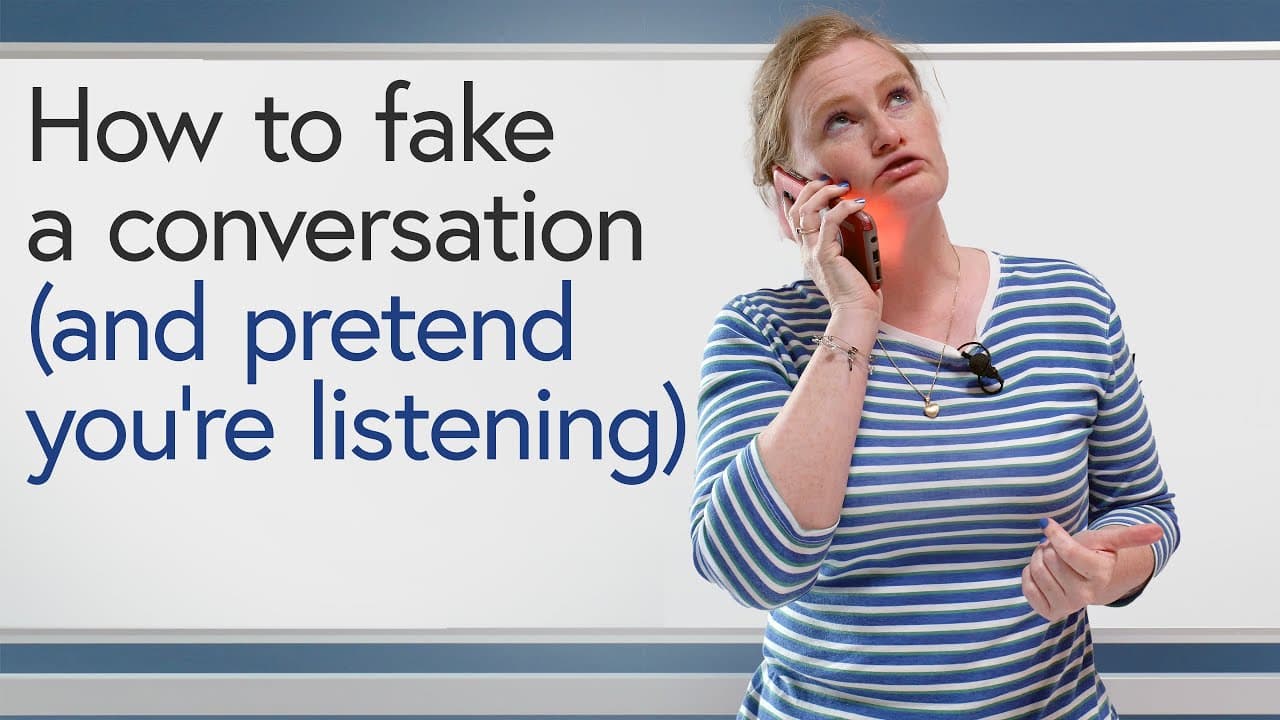
How to fake a conversation (when people are boring or annoying)
TL;DR
Learn how to fake conversations to avoid unnecessary interactions or appear engaged in situations where you need to multitask.
Transcript
Yeah. Uh-huh. Yeah. Okay. Yeah, yeah. Yeah. I think... Seven? No. Maybe... Maybe eight? Yeah. No, no, no. No. It'll be perfect. I'm going to love it. It's going to be so great. Yeah? Okay. Yeah. Oh. Oh. Oh. Oh. Oh. Hi. Yeah. Yeah. I was just talking to my friends. Yeah. Yeah. So... Actually, I wasn't talking to my friends. I was faking a conversati... Read More
Key Insights
- ❓ Faking conversations is a strategy to avoid unwanted interactions and multitask effectively.
- 😃 Non-verbal cues such as eye contact, facial expressions, and body language are critical in appearing engaged during a fake conversation.
- 😷 Filler words and asking relevant questions can maintain the illusion of active listening.
- 🥰 Faking conversations can be useful in professional situations to ensure clients or customers feel heard and valued.
- ☢️ These techniques can also be applied genuinely to enhance active listening and engagement in conversations.
- 🤗 Keeping your hands visible and avoiding distractions like gaming or texting during a conversation is essential.
- ❓ Faking conversations requires attentiveness to the topic being discussed to maintain coherence in the interaction.
Install to Summarize YouTube Videos and Get Transcripts
Explore YouTube Video Summarizer or Get YouTube Transcript Extractor
Questions & Answers
Q: Why do people fake conversations?
People fake conversations to avoid unnecessary interactions, multitask, or politely end a conversation without being rude.
Q: What are some tips for faking a conversation effectively?
Maintaining eye contact, using facial expressions such as smiling, and keeping your hands visible can help create the illusion of engagement.
Q: How can faking a conversation be useful in a professional setting?
Faking conversations can help create the impression of active listening during work-related calls or meetings, ensuring clients or customers feel valued and attended to.
Q: Are there any verbal cues that can help fake a conversation?
Using filler words like "Mm-hmm" or asking relevant questions to the speaker can give the impression of active listening and engagement.
Summary & Key Takeaways
-
Faking conversations with fake phone calls can help avoid unwanted interactions, especially when walking a pet.
-
Faking conversations is useful when you need to appear attentive during work-related calls or meetings.
-
Maintaining eye contact, using facial expressions, and keeping your hands visible can help create the illusion of paying attention.
Read in Other Languages (beta)
Share This Summary 📚
Summarize YouTube Videos and Get Video Transcripts with 1-Click
Try YouTube Summary with ChatGPT & Claude or YouTube Transcript Generator
Explore More Summaries from English with Ronnie · EnglishLessons4U with engVid 📚



Summarize YouTube Videos and Get Video Transcripts with 1-Click
Try YouTube Summary with ChatGPT & Claude or YouTube Transcript Generator