How to Convert Any Fraction to a Decimal
TL;DR
To convert any fraction into a decimal, simply divide the numerator by the denominator. You can do this manually or use a calculator for convenience. Be aware that some fractions will result in repeating decimal patterns, which can be noted with a line over the repeating digits.
Transcript
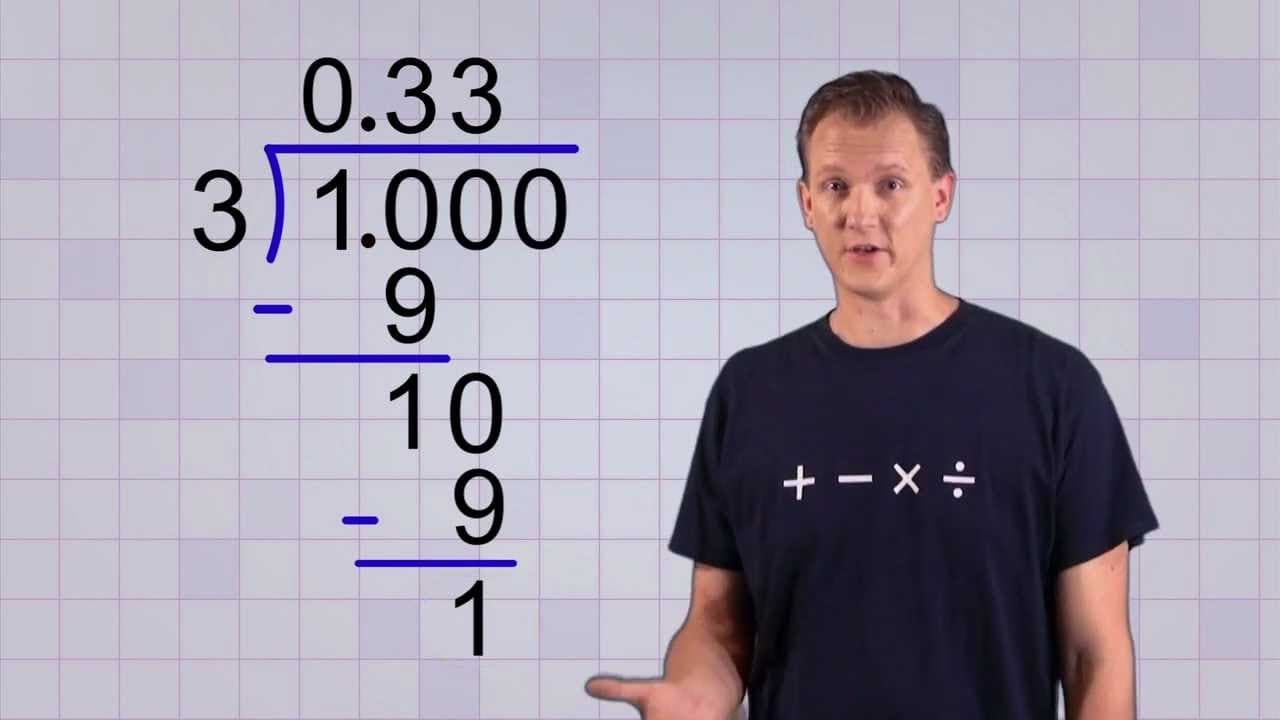
In the last section, we learned how to convert some special Base 10 fractions into decimals, and vice versa. Now, were going to learn how to convert ANY fraction into a decimal. And it turns out to be really simple… all you have to do is divide. Since a fraction is really just a division problem, if you go ahead and DO the division, you’ll get an a... Read More
Key Insights
- 🗂️ Converting a fraction to a decimal involves dividing the numerator by the denominator.
- 💨 The hard way of conversion involves manually dividing and adjusting decimal places.
- 🔁 Some fractions result in repeating decimal patterns.
- ❓ A calculator can be used for quick and easy conversion.
- 🔁 Repeating patterns in decimals can be indicated with a line over the repeating digits.
- ❓ Common fractions like 1/4, 1/3, 1/2, 2/3, and 3/4 have memorizable decimal values.
- 🪜 Decimal division may require adding zeros to continue dividing.
Install to Summarize YouTube Videos and Get Transcripts
Explore YouTube Video Summarizer or Get YouTube Transcript Extractor
Questions & Answers
Q: How do you convert a fraction into a decimal?
To convert a fraction to a decimal, divide the numerator by the denominator. This will give you the decimal value of the fraction.
Q: What is the difference between the easy way and the hard way of converting a fraction to a decimal?
The easy way involves using a calculator to perform the division. The hard way is done manually by dividing and adjusting the decimal places as needed.
Q: What should be done when a fraction does not divide evenly into a whole number?
When there is a remainder after division, additional zeros can be added to the decimal places to continue dividing until there is no remainder.
Q: How can repeating decimal patterns be indicated?
If the division results in a repeating pattern of digits, a line can be drawn over the repeating digits to indicate that the pattern continues indefinitely.
Key Insights:
- Converting a fraction to a decimal involves dividing the numerator by the denominator.
- The hard way of conversion involves manually dividing and adjusting decimal places.
- Some fractions result in repeating decimal patterns.
- A calculator can be used for quick and easy conversion.
- Repeating patterns in decimals can be indicated with a line over the repeating digits.
- Common fractions like 1/4, 1/3, 1/2, 2/3, and 3/4 have memorizable decimal values.
- Decimal division may require adding zeros to continue dividing.
- Conversion from fractions to decimals and vice versa is an important math skill to practice.
Summary & Key Takeaways
-
Converting a fraction to a decimal is as simple as dividing the numerator by the denominator.
-
The division can be done the easy way using a calculator or the hard way manually.
-
Some fractions result in repeating decimal patterns that can be indicated with a line over the repeating digits.
Read in Other Languages (beta)
Share This Summary 📚
Summarize YouTube Videos and Get Video Transcripts with 1-Click
Try YouTube Summary with ChatGPT & Claude or YouTube Transcript Generator
Explore More Summaries from mathantics 📚




Summarize YouTube Videos and Get Video Transcripts with 1-Click
Try YouTube Summary with ChatGPT & Claude or YouTube Transcript Generator