Algebra Basics: Solving Basic Equations Part 2 - Math Antics
TL;DR
Learn to solve one-step equations with multiplication or division.
Transcript
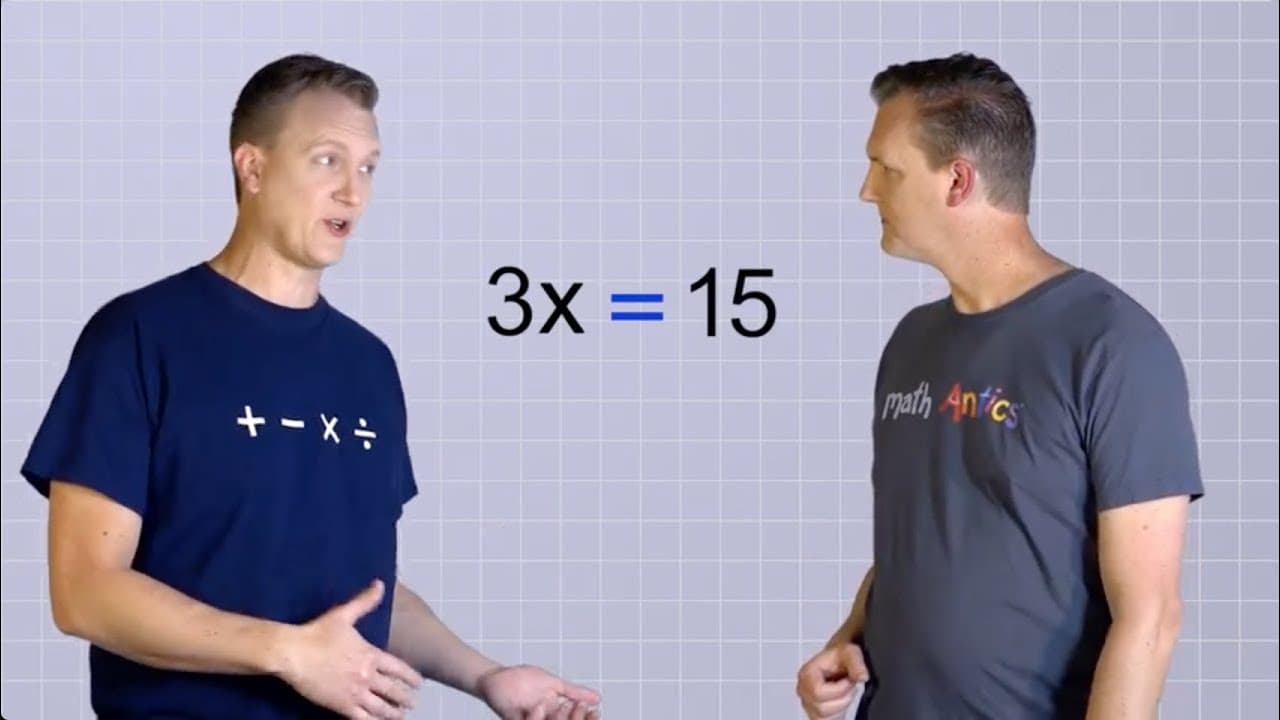
Hi I’m Rob. Welcome to Math Antics. In our last video, we learned how to solve basic algebraic equations that only had one addition or one subtraction operation. In this video, we’ll focus on equations that have only one multiplication or one division operation. Now before we see some examples, do you remember the key strategy for solving an equat... Read More
Key Insights
- The video teaches solving algebraic equations involving multiplication and division, focusing on isolating the unknown variable.
- Inverse operations are crucial; multiplication is undone by division and vice versa, maintaining balance in equations.
- Multiplication is the default operation in algebra, indicated by juxtaposition of numbers and symbols.
- To solve equations, perform the same arithmetic operation on both sides to keep the equation balanced.
- Fraction form is preferred for division, simplifying the process of canceling common factors.
- Equations with division can be tricky, especially when the unknown is in the denominator, requiring multiplication to simplify.
- Practice is essential for mastering algebraic equation solving, reinforcing understanding through repetition.
- The video is part of a series aimed at building foundational algebra skills, encouraging further learning through practice and review.
Install to Summarize YouTube Videos and Get Transcripts
Explore YouTube Video Summarizer or Get YouTube Transcript Extractor
Questions & Answers
Q: What is the main focus of this Math Antics video?
The main focus of the video is teaching viewers how to solve basic algebraic equations that involve only one multiplication or one division operation. It emphasizes the use of inverse operations to isolate the unknown variable and maintain equation balance by performing the same arithmetic operation on both sides.
Q: How does multiplication relate to algebra in this video?
In algebra, multiplication is often the default operation when numbers and variables are placed next to each other without an explicit operator. This video explains that when you see expressions like '3x', it means 3 times x. Understanding this concept is crucial for solving equations involving multiplication.
Q: Why is it important to perform the same operation on both sides of an equation?
Performing the same operation on both sides of an equation is essential to maintain balance. If one side of the equation is altered without making the corresponding change on the other side, the equation becomes unbalanced, leading to incorrect solutions. This principle ensures the integrity of the equation is preserved.
Q: What is the preferred method for handling division in algebraic equations?
The preferred method for handling division in algebraic equations is to rewrite them in fraction form. This approach simplifies the process of canceling common factors, making it easier to solve the equation. Fraction form allows for a clearer understanding of the division operation and aids in simplifying the equation.
Q: What challenge is associated with equations where the unknown is in the denominator?
Equations where the unknown is in the denominator present a challenge because division does not have the commutative property, meaning the order matters. To address this, the video suggests multiplying both sides by the unknown to eliminate it from the denominator, transforming the equation into a more solvable form.
Q: What advice does the video give for mastering algebraic equation solving?
The video advises viewers to practice solving algebraic equations independently to reinforce their understanding and mastery of the concepts. It suggests re-watching the videos for clarity and encourages frequent practice with various problems to solidify the skills learned in the video.
Q: How does the video fit into the larger Math Antics series?
This video is part of the Algebra Basics series by Math Antics, which aims to build foundational skills in algebra. It complements previous lessons on addition and subtraction, progressively teaching viewers how to handle more complex equations involving multiplication and division. The series encourages comprehensive learning through structured lessons.
Q: What resources does Math Antics offer for further learning?
Math Antics offers additional resources for further learning, including more free math videos and subscription-based content available on their website. These resources provide viewers with opportunities to explore various math topics, practice problems, and deepen their understanding of mathematical concepts beyond the videos.
Summary & Key Takeaways
-
This Math Antics video focuses on solving basic algebraic equations involving multiplication and division. The host, Rob, emphasizes the importance of using inverse operations to isolate the unknown variable. By applying the same arithmetic operation to both sides of the equation, balance is maintained, allowing for successful equation solving.
-
Rob explains that multiplication is the default operation in algebra, represented by juxtaposition of numbers and variables. He demonstrates the process of solving equations by converting division to fraction form, simplifying the equation through canceling common factors. The video also addresses the complexity of equations with the unknown in the denominator.
-
The video is part of a series designed to teach algebra basics, encouraging viewers to practice independently to reinforce learning. Rob suggests re-watching the videos for clarity and understanding, and directs viewers to Math Antics for additional resources and practice problems.
Read in Other Languages (beta)
Share This Summary 📚
Summarize YouTube Videos and Get Video Transcripts with 1-Click
Try YouTube Summary with ChatGPT & Claude or YouTube Transcript Generator
Explore More Summaries from mathantics 📚
Summarize YouTube Videos and Get Video Transcripts with 1-Click
Try YouTube Summary with ChatGPT & Claude or YouTube Transcript Generator