Constructors in Java classes Parameterized constructors
TL;DR
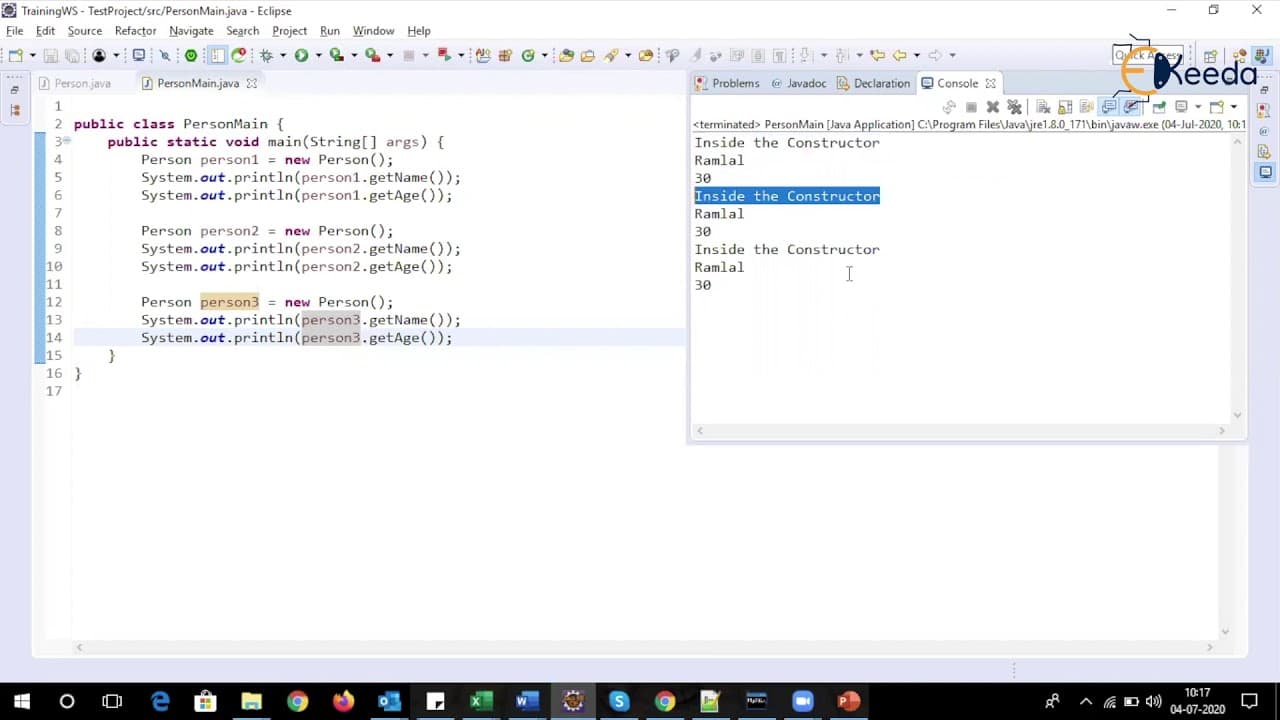
Parameterized constructors in Java allow for the initialization of object variables during object creation, providing the ability to pass arguments to the constructor.
Transcript
hello and welcome to the next session of Porsche in continuation with the discussion about constructors the next point which we are going to discuss is parametrized constructor in the last session we discussed about basics of constructors as what is a constructor it is a special function which has got name same as that of class it's invoked at the ... Read More
Key Insights
- ❓ Constructors in Java are special functions responsible for initializing object variables.
- ❓ The default constructor is automatically provided by Java when no other constructor is specified.
- 👻 Parameterized constructors allow for the initialization of object variables with specific values by accepting arguments.
- 👨💻 Using parameterized constructors can simplify code by initializing object variables during object creation.
- ❓ Each object created with a parameterized constructor can have different values assigned to its variables.
- 🏛️ The default constructor is not available once a parameterized constructor is specified in the class.
- ♿ The "this" keyword in Java represents the current instance and is used to access instance variables in constructors.
Install to Summarize YouTube Videos and Get Transcripts
Explore YouTube Video Summarizer or Get YouTube Transcript Extractor
Questions & Answers
Q: What is a constructor in Java?
A constructor in Java is a special function with the same name as the class, responsible for initializing object variables. It is invoked at the time of object creation.
Q: What is the default constructor in Java?
The default constructor in Java is provided by Java itself when no other constructor is specified in the class. It initializes data members to their default values.
Q: What is the difference between a default constructor and a parameterized constructor?
The default constructor is called automatically when an object is created and initializes data members to their default values. On the other hand, a parameterized constructor accepts arguments and allows for the initialization of object variables with specific values.
Q: How do parameterized constructors work in Java?
Parameterized constructors in Java accept arguments in their signature and can initialize object variables with specific values. These values are passed during object creation and provide flexibility in assigning different values to different objects.
Summary & Key Takeaways
-
Constructors in Java are special functions with the same name as the class, responsible for object initialization.
-
The default constructor is provided by Java and initializes data members to their default values.
-
Parameterized constructors allow for the initialization of object variables by passing arguments to the constructor.
Read in Other Languages (beta)
Share This Summary 📚
Summarize YouTube Videos and Get Video Transcripts with 1-Click
Try YouTube Summary with ChatGPT & Claude or YouTube Transcript Generator
Explore More Summaries from Ekeeda 📚






Summarize YouTube Videos and Get Video Transcripts with 1-Click
Try YouTube Summary with ChatGPT & Claude or YouTube Transcript Generator