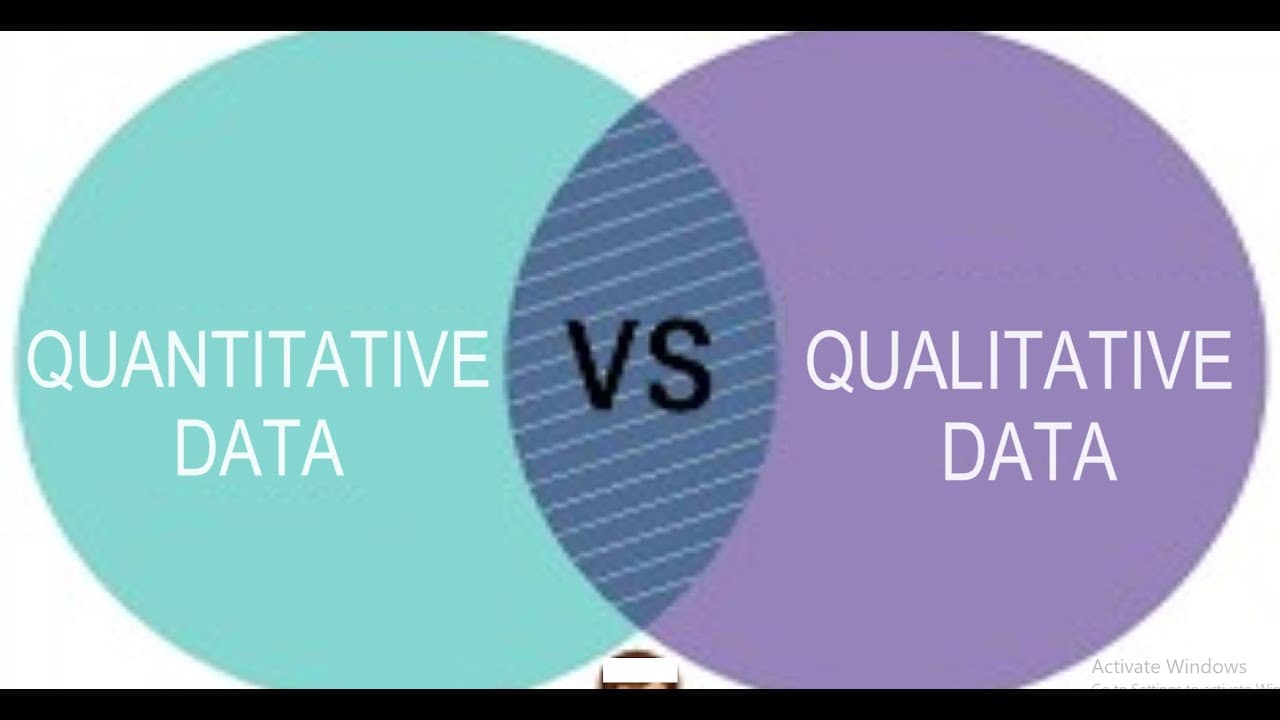
How Does Quantitative Data Differ from Qualitative Data?
TL;DR
Quantitative data is numerical and collected through structured questionnaires, answering questions like 'how many' or 'how often.' In contrast, qualitative data is nonnumerical, offering deep insights through interviews and open-ended questions, addressing 'why' and 'how.' Combining both data types enhances research depth.
Transcript
hello and welcome to lesson 26 quantitative and qualitative data collection the contents that will be covered in this lesson are quantitative and qualitative data merits and demerits of qualitative and quantitative data when to use each of them and lastly I will provide an exercise to check your understanding now let us see the difference between t... Read More
Key Insights
- ❓ Data can be categorized into quantitative (numerical) and qualitative (nonnumerical) data.
- 😚 Quantitative data is obtained from a large sample using closed-ended questionnaires and is analyzed statistically.
- 🤗 Qualitative data provides in-depth understanding through open-ended questions, interviews, and observations.
- ❓ Quantitative data is precise but may oversimplify phenomena, while qualitative data captures richness but is subjective.
- 🥺 Using both quantitative and qualitative data can lead to more comprehensive research findings.
- 👋 Quantitative data is best for confirming hypotheses and generalizing results, while qualitative data is suitable for exploring complex phenomena and understanding the reasons behind behaviors.
- ⁉️ Quantitative data answers "how many" or "how often" questions, while qualitative data answers "why" and "how" questions.
Install to Summarize YouTube Videos and Get Transcripts
Explore YouTube Video Summarizer or Get YouTube Transcript Extractor
Questions & Answers
Q: What is the difference between quantitative and qualitative data?
Quantitative data is numerical and obtained from closed-ended questionnaires, while qualitative data is nonnumerical and collected using open-ended questions, interviews, and observations.
Q: How is quantitative data analyzed?
Quantitative data is analyzed using statistical analysis, which allows for precise and conclusive results based on a larger population sample.
Q: What types of questions can quantitative data answer?
Quantitative data can answer questions like "how many," "how much," or "how often," using numerical values.
Q: Why is qualitative data subject to bias?
Qualitative data is subjective and can be influenced by biases during interpretation or transcription, making it prone to subjectivity and bias.
Q: When is it best to use qualitative data?
Qualitative data is best used when little is known about the subject, when exploring complex phenomena, or to investigate the reasons behind certain behaviors or factors.
Q: What are the disadvantages of quantitative data?
Quantitative data may oversimplify complex phenomena, ignore contextual aspects, lack flexibility in exploring unexpected insights, and may not capture the richness of the human experience.
Q: How can the limitations of both quantitative and qualitative data be mitigated?
Using a mixed method or mixed data approach, combining both quantitative and qualitative data, can increase the credibility and reliability of findings.
Summary & Key Takeaways
-
Quantitative data is numerical and obtained from a large group using closed-ended questionnaires. It can answer questions like "how many" or "how often."
-
Qualitative data is nonnumerical and provides in-depth understanding, collected using open-ended questions, interviews, and observations. It answers questions like "why" and "how."
-
Quantitative data is accurate, objective, and easy to analyze, while qualitative data is more subjective, rich in detail, and suitable for exploring complex phenomena.
Read in Other Languages (beta)
Share This Summary 📚
Summarize YouTube Videos and Get Video Transcripts with 1-Click
Try YouTube Summary with ChatGPT & Claude or YouTube Transcript Generator
Explore More Summaries from Solomon Getachew 📚


Summarize YouTube Videos and Get Video Transcripts with 1-Click
Try YouTube Summary with ChatGPT & Claude or YouTube Transcript Generator