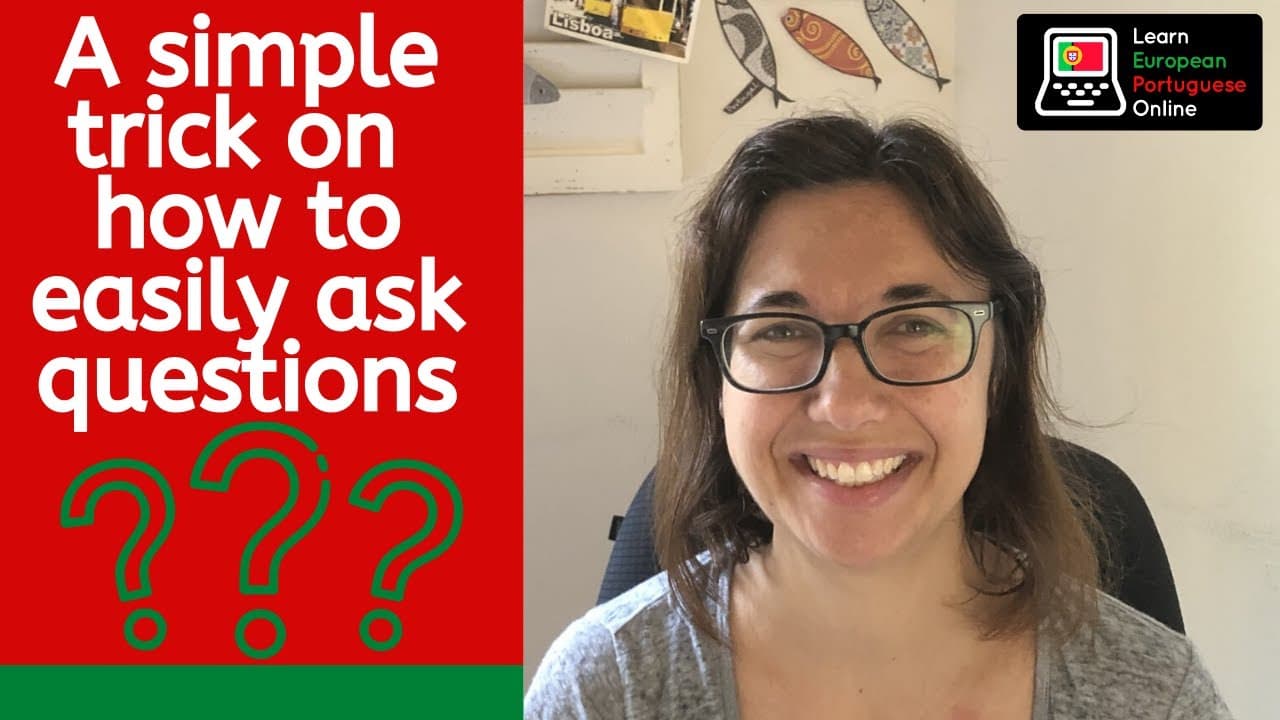
How to Easily Ask Questions in European Portuguese
TL;DR
Learn to form questions in Portuguese using simple sentence structures.
Transcript
hey everybody welcome Allah says only meanders and mizen webisode you do canal to learn European Portuguese online Ilsa a Sandra and today I wanted to talk about a very very helpful topic that can be a big game changer for you guys I'm going to talk about sentence structures little tips simple tips that will make a big difference in your communicat... Read More
Key Insights
- Portuguese uses the same sentence structure for both questions and answers, which is a significant difference from English.
- Intonation is crucial in Portuguese to differentiate between a statement and a question, given the identical structure.
- The video provides examples to illustrate how simple statements can be turned into questions by altering punctuation and intonation.
- Possessive sentences in Portuguese can also use the same structure for questions and answers, enhancing learning efficiency.
- The video emphasizes the importance of intuition in understanding and forming questions in Portuguese.
- By practicing with complex sentences, learners can grasp the concept of forming questions without changing the sentence structure.
- The method of using identical structures for questions and answers is a practical and easy-to-memorize technique for learners.
- The video encourages learners to create lists of questions and answers to practice and solidify their understanding of this concept.
Install to Summarize YouTube Videos and Get Transcripts
Explore YouTube Video Summarizer or Get YouTube Transcript Extractor
Questions & Answers
Q: How does Portuguese differ from English in forming questions?
In Portuguese, questions and answers often use the same sentence structure, unlike English where the structure typically changes. The key difference is the use of intonation and punctuation, such as replacing a period with a question mark, to indicate a question. This allows for a simpler approach to forming questions.
Q: Why is intonation important in Portuguese questions?
Intonation is crucial in Portuguese because it helps distinguish between a statement and a question when the sentence structure remains the same. By changing the tone at the end of the sentence, speakers can indicate that they are asking a question, which is vital for effective communication in Portuguese.
Q: What examples are provided to illustrate Portuguese question structures?
The video provides examples such as 'Maria é alta' (Mary is tall) and 'É Maria alta?' (Is Mary tall?), demonstrating how the structure remains unchanged while punctuation and intonation differentiate the statement from the question. Similar examples are given with possessives and more complex sentences.
Q: How can learners practice forming questions in Portuguese?
Learners are encouraged to create lists of questions they wish to ask and practice forming them using the same structure as their answers. This involves writing statements and converting them into questions by adjusting punctuation and using the correct intonation, which aids in memorization and understanding.
Q: What role does intuition play in learning Portuguese question structures?
Intuition plays a significant role in learning Portuguese question structures because it helps learners understand when to apply the same sentence structure for questions and answers. By relying on intuition, learners can more effectively grasp the nuances of Portuguese intonation and sentence formation.
Q: How does the video suggest using possessives in questions?
The video suggests that possessives in Portuguese can also follow the same structure for questions and answers. For example, 'A tua casa é amarela' (Your house is yellow) can become 'É a tua casa amarela?' (Is your house yellow?), demonstrating the simplicity and consistency of this method.
Q: What is the practical benefit of using identical structures for questions and answers?
Using identical structures for questions and answers simplifies the learning process, making it easier for learners to remember and apply the rules. This method reduces the complexity of forming questions and allows learners to focus on mastering intonation and punctuation, which are critical for effective communication.
Q: What additional resources does the video offer for learning Portuguese?
The video encourages viewers to subscribe to their YouTube channel for more content and follow them on social media for creative posts. They also promote their online store and Patreon page for exclusive videos and audios, providing learners with multiple resources to enhance their Portuguese learning experience.
Summary & Key Takeaways
-
The video explains a unique aspect of Portuguese where questions and answers share the same sentence structure, differing from English. Intonation is key to distinguishing between them. Examples are provided to demonstrate this concept, making it easier for learners to ask questions without needing interrogative words.
-
Learners are encouraged to practice with both simple and complex sentences, using possessives and other structures. This approach is practical and easy to memorize, offering a game-changing method for those learning Portuguese, especially in forming questions accurately.
-
The video also highlights the importance of intuition in understanding Portuguese sentence structures. By using examples and encouraging practice, the video aims to help learners become more confident in asking questions in Portuguese, enhancing their overall communication skills.
Read in Other Languages (beta)
Share This Summary 📚
Summarize YouTube Videos and Get Video Transcripts with 1-Click
Try YouTube Summary with ChatGPT & Claude or YouTube Transcript Generator
Explore More Summaries from Learn European Portuguese Online 📚


Summarize YouTube Videos and Get Video Transcripts with 1-Click
Try YouTube Summary with ChatGPT & Claude or YouTube Transcript Generator