Emotions: cerebral hemispheres and prefrontal cortex | MCAT | Khan Academy
TL;DR
The cerebral cortex, specifically the left and right hemispheres, play a role in emotions, with positive emotions being associated with the left hemisphere and negative emotions with the right hemisphere.
Transcript
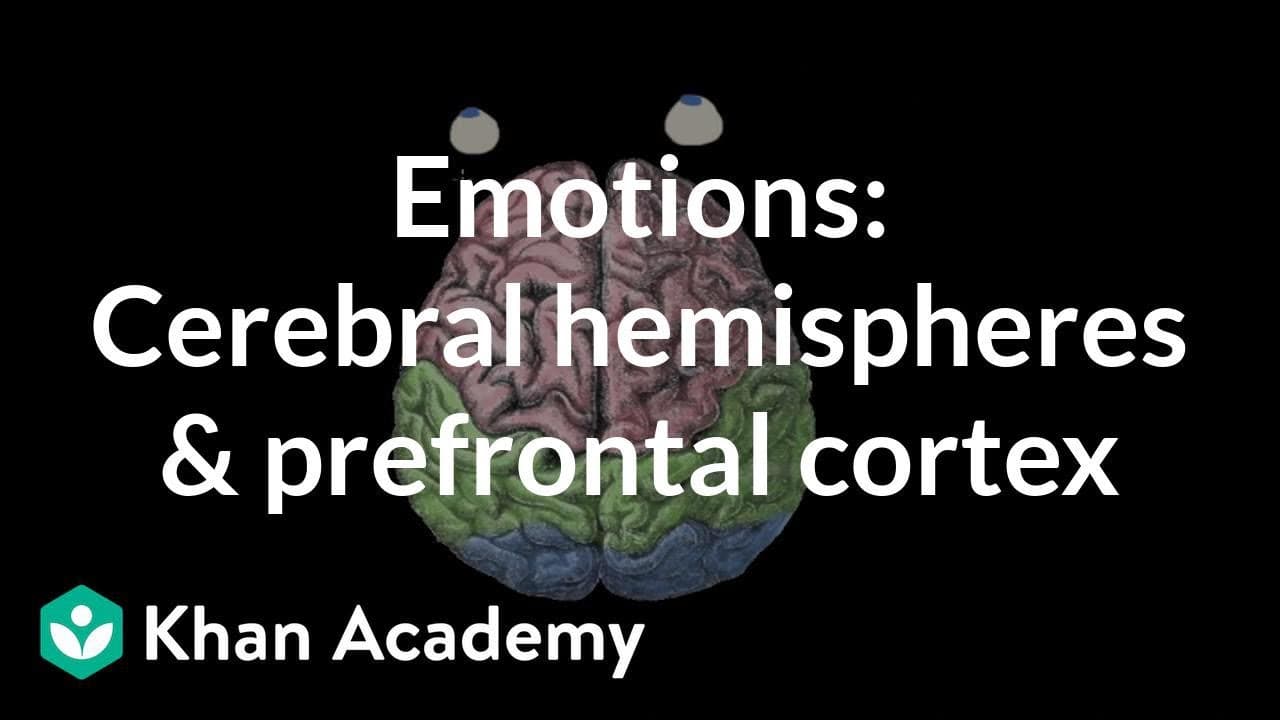
So what we have here is a brain. And this is like we're above the person, looking down into their brain. To orient you, let me draw two eyes here. And this is the front of the brain and this is the back of the brain. And we're looking at it, like I said, from the top. Now, why are we looking at a brain? Well, I want to talk about a certain area of ... Read More
Key Insights
- ↔️ Positive emotions are associated with increased electrical activity in the left hemisphere, while negative emotions activate the right hemisphere.
- 🗨️ Hemispheric activity can vary depending on social interaction, with sociable individuals showing more left hemisphere activity.
- 🖐️ The prefrontal cortex plays a crucial role in managing behavior in social situations and inhibiting aggressive impulses.
- 〽️ Damage to the prefrontal cortex can significantly alter an individual's personality and behavior.
- ✋ The prefrontal cortex is responsible for higher-order functions such as language and problem-solving.
- 🥳 The prefrontal cortex is well-developed in humans and undergoes significant development after birth.
- ❓ The cerebral cortex, particularly the prefrontal cortex, distinguishes humans from other animals.
Install to Summarize YouTube Videos and Get Transcripts
Explore YouTube Video Summarizer or Get YouTube Transcript Extractor
Questions & Answers
Q: How do researchers study the activity of the brain's hemispheres during emotional experiences?
Researchers use EEG recordings to measure electrical activity in the brain and videotape participants' facial expressions while watching films to determine the hemispheric activity associated with positive and negative emotions.
Q: What are the characteristics of individuals with an active left hemisphere?
People with more active left hemispheres tend to be interested, joyful, and enthusiastic about things.
Q: How does the prefrontal cortex contribute to human behavior?
The prefrontal cortex is responsible for problem-solving, decision-making, and managing behavior in social situations. It allows individuals to follow social norms and expectations, even when experiencing anger or aggression.
Q: What happened to Phineas Gage after his prefrontal cortex was damaged?
Phineas Gage became rude, gruff, and behaved inappropriately after experiencing damage to his prefrontal cortex, demonstrating the importance of this brain region in social behavior.
Key Insights:
- Positive emotions are associated with increased electrical activity in the left hemisphere, while negative emotions activate the right hemisphere.
- Hemispheric activity can vary depending on social interaction, with sociable individuals showing more left hemisphere activity.
- The prefrontal cortex plays a crucial role in managing behavior in social situations and inhibiting aggressive impulses.
- Damage to the prefrontal cortex can significantly alter an individual's personality and behavior.
- The prefrontal cortex is responsible for higher-order functions such as language and problem-solving.
- The prefrontal cortex is well-developed in humans and undergoes significant development after birth.
- The cerebral cortex, particularly the prefrontal cortex, distinguishes humans from other animals.
- The ability to control behavior and follow social norms comes from the prefrontal cortex's influence.
Summary & Key Takeaways
-
The cerebral cortex can be divided into hemispheres, with positive emotions evoking more activity in the left hemisphere, and negative emotions in the right hemisphere.
-
Research studies have shown that participants watching pleasurable films had increased activity in the left hemisphere, while films evoking disgust resulted in more activity in the right hemisphere.
-
Another study observed that sociable children exhibited increased left hemisphere activity, while isolated children had more right hemisphere activity.
Read in Other Languages (beta)
Share This Summary 📚
Summarize YouTube Videos and Get Video Transcripts with 1-Click
Try YouTube Summary with ChatGPT & Claude or YouTube Transcript Generator
Explore More Summaries from khanacademymedicine 📚






Summarize YouTube Videos and Get Video Transcripts with 1-Click
Try YouTube Summary with ChatGPT & Claude or YouTube Transcript Generator