Energy of a capacitor | Circuits | Physics | Khan Academy
TL;DR
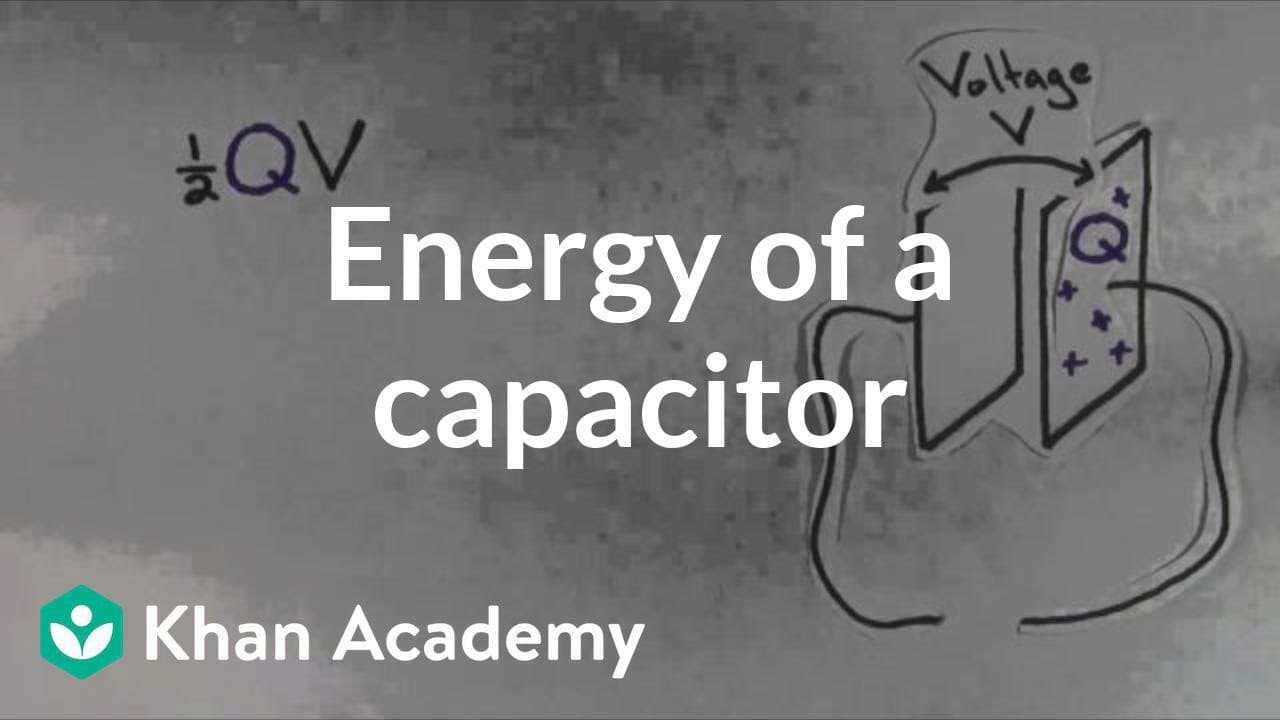
Capacitors store energy and release it when connected to a circuit, with the energy formula being 1/2 the charge times the voltage.
Transcript
SPEAKER 1: Check out this capacitor. Look at what happens if I hook it up to this light bulb. CHILDREN (IN UNISON): Boo! SPEAKER 1: Yeah, nothing happened because the capacitor is not charged up. But if we look at up to a battery first, to charge up the capacitor, and then hook it up to the light bulb, the light bulb lights up. CHILDREN (IN UNISON)... Read More
Key Insights
- 🈂️ Capacitors store both charge and energy when charged up.
- 🙂 Energy stored in a capacitor is released as light and heat when connected to a circuit.
- 💦 The energy formula for capacitors includes a 1/2 factor because charges drop through decreasing voltages during discharge.
- ❓ There are two alternative formulas for calculating capacitor energy, depending on the known variables.
- ⚡ The voltage in the energy formula refers to the voltage across the capacitor, not necessarily the battery voltage.
Install to Summarize YouTube Videos and Get Transcripts
Explore YouTube Video Summarizer or Get YouTube Transcript Extractor
Questions & Answers
Q: How does a capacitor store energy?
When a capacitor is connected to a battery, charges get separated, creating electrical potential energy stored in the capacitor.
Q: Why does the energy formula for capacitors include a 1/2 factor?
During discharge, only the first charge that gets transferred drops through the full voltage. Subsequent charges drop through decreasing voltages, resulting in the 1/2 factor in the formula.
Q: Can the energy formula for capacitors be written differently?
Yes, it can also be expressed as 1/2 times the capacitance times the voltage squared. The choice of formula depends on whether or not the charge is known.
Q: How does the voltage in the energy formula relate to the battery voltage?
In the case of a single battery charging up a single capacitor, the voltage across the capacitor is equal to the voltage of the battery. But in circuits with multiple capacitors, the voltage across a specific capacitor must be used.
Summary & Key Takeaways
-
Capacitors that are charged up store electrical potential energy, which can be converted into light and heat when connected to a circuit.
-
The energy of a capacitor is 1/2 the product of the charge and voltage, not just the product.
-
During discharge, the charges dropped through decreasing voltages, leading to the inclusion of the 1/2 factor in the energy formula.
Read in Other Languages (beta)
Share This Summary 📚
Summarize YouTube Videos and Get Video Transcripts with 1-Click
Try YouTube Summary with ChatGPT & Claude or YouTube Transcript Generator
Explore More Summaries from khanacademymedicine 📚






Summarize YouTube Videos and Get Video Transcripts with 1-Click
Try YouTube Summary with ChatGPT & Claude or YouTube Transcript Generator