How to Differentiate Butylcyclopentane Structures
TL;DR
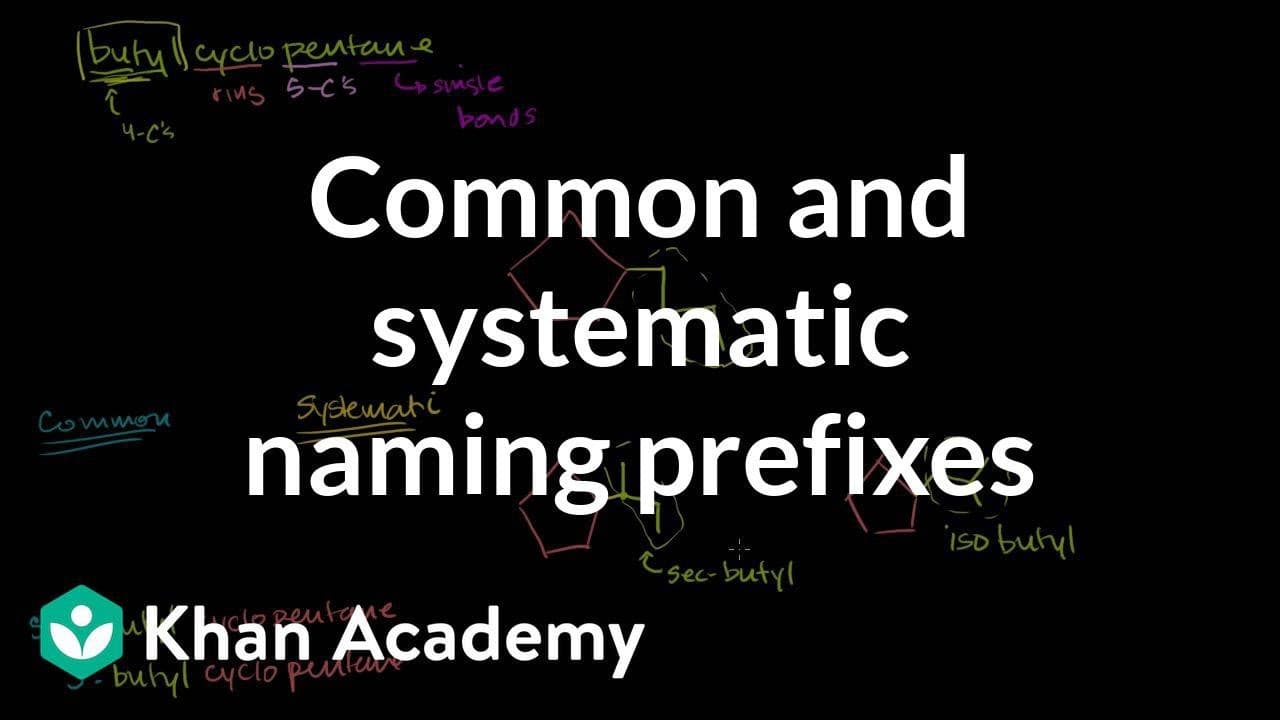
Butylcyclopentane can have various structural names that reflect different attachment points of the butyl group. Common names include butylcyclopentane, sec-butylcyclopentane, iso-butylcyclopentane, and tert-butylcyclopentane, while systematic names describe the group attachments more explicitly, such as 1-methylpropylcyclopentane and 1,1-dimethylethylcyclopentane.
Transcript
Let's see if we can get the molecular structure for butylcyclopentane. So you just break this up the way we've done it in the last several videos, the suffix is -ane, so it is an alkane, all single bonds. So single bonds. It's pentane, so we're dealing with five carbons on the base, or on the backbone. So this is five carbons and it's a cyclopentan... Read More
Key Insights
- 😋 Butylcyclopentane is an organic compound with a five-carbon ring and a butyl group attached to it.
- 👥 Common naming differentiates structures based on where the attachment occurs on the butyl group, while systematic naming focuses on the group attached to the broader chain.
- 💀 The common names for different structures of butylcyclopentane include butylcyclopentane, sec-butylcyclopentane, iso-butylcyclopentane, and tert-butylcyclopentane.
- 📛 The systematic names for the same structures are 1-methylpropylcyclopentane, 2-methylpropylcyclopentane, and 1,1-dimethylethylcyclopentane.
- 🤝 The common naming system can be easier to spell and pronounce, but it may be confusing when dealing with multiple attachments or larger alkyl groups.
Install to Summarize YouTube Videos and Get Transcripts
Explore YouTube Video Summarizer or Get YouTube Transcript Extractor
Questions & Answers
Q: How does the common naming system differentiate between different structures of butylcyclopentane?
The common naming system differentiates structures based on the carbon atom to which the butyl group is attached. The term "sec-butyl" is used when the butyl group is connected to a carbon bonded to two other carbons, while "iso-butyl" is used when the attachment is at the end of a four-carbon chain branching off elsewhere.
Q: What is the significance of "tert-butyl" in the common naming system?
"Tert-butyl" is used when the butyl group is attached to a carbon bonded to three other carbons. This naming convention helps distinguish structures where the attachment occurs at a different position on the four-carbon chain.
Q: How does the systematic naming system approach the naming of butylcyclopentane?
In the systematic naming system, emphasis is placed on the group attached to the broader chain. The name starts with the chain name (e.g., propyl), followed by a hyphen and the attached groups. For example, "1-methylpropylcyclopentane" indicates that a methyl group is attached to the first carbon of a propyl group, which is then connected to the cyclopentane.
Q: Why is the systematic naming considered easier for naming organic compounds?
The systematic naming system provides a more logical approach by breaking down the compound into its constituent parts. By considering the longest chain starting from the attachment point, it becomes easier to identify and name the different groups present. This system allows for more accuracy and clarity in naming complex organic compounds.
Summary & Key Takeaways
-
Butylcyclopentane is an organic compound with a five-carbon ring and a butyl group attached to it.
-
The common naming system indicates the attachment of the butyl group to the first or last carbon of the ring, while the systematic naming system emphasizes the way the group is attached to the broader chain.
-
The common names for different structures are butylcyclopentane, sec-butylcyclopentane, iso-butylcyclopentane, and tert-butylcyclopentane.
-
The systematic names for the same structures are 1-methylpropylcyclopentane, 2-methylpropylcyclopentane, and 1,1-dimethylethylcyclopentane.
Read in Other Languages (beta)
Share This Summary 📚
Summarize YouTube Videos and Get Video Transcripts with 1-Click
Try YouTube Summary with ChatGPT & Claude or YouTube Transcript Generator
Explore More Summaries from Khan Academy 📚



Summarize YouTube Videos and Get Video Transcripts with 1-Click
Try YouTube Summary with ChatGPT & Claude or YouTube Transcript Generator