Derivatives of sec(x) and csc(x) | Derivative rules | AP Calculus AB | Khan Academy
TL;DR
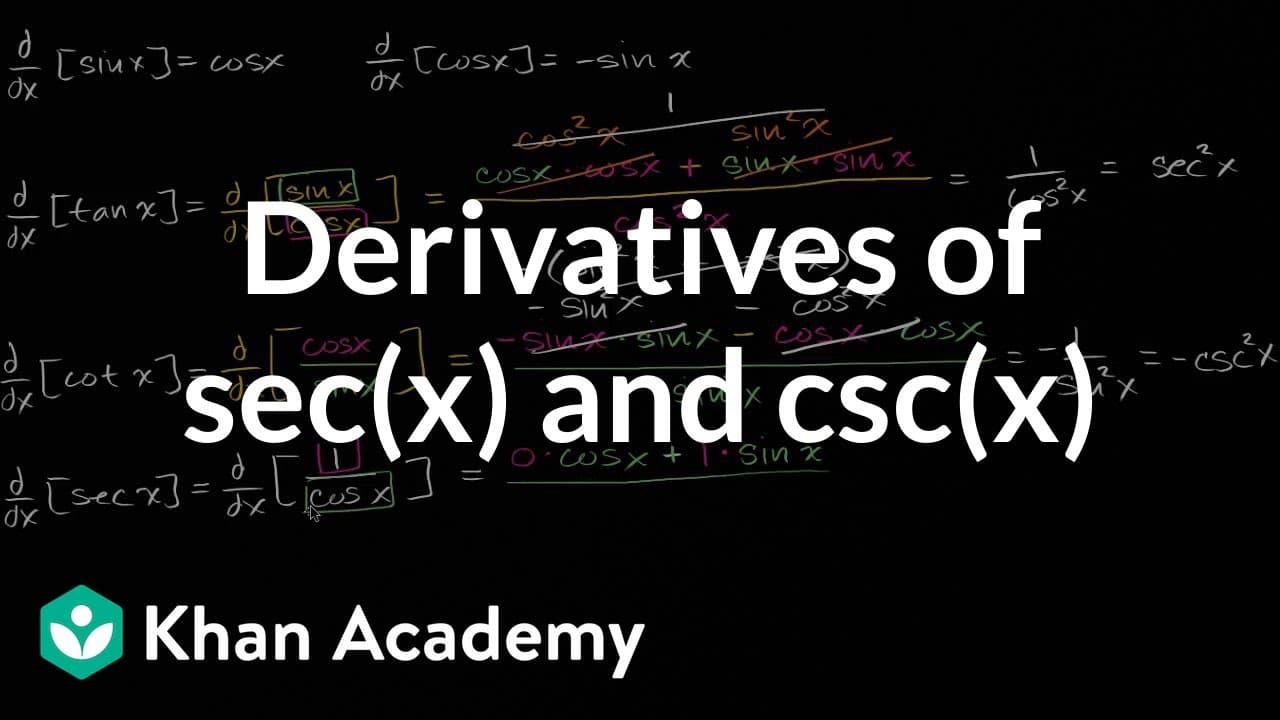
The video explains how to find the derivatives of secant and cosecant functions using the quotient rule.
Transcript
- [Voiceover] In a previous video we used the quotient rule in order to find the derivatives of tangent of x and cotangnet of x. And what I what to do in this video is to keep going and find the derivatives of secant of x and cosecant of x. So let's start with secant of x. The derivative with respect to x of secant of x. Well, secant of x is the sa... Read More
Key Insights
- ☺️ Secant x is equivalent to 1 over cosine x, and cosecant x is equivalent to 1 over sine x.
- ☺️ The quotient rule can be used to find the derivatives of both secant x and cosecant x.
- 😑 The derivatives can be expressed in terms of other trigonometric functions, such as tangent x, cotangent x, and secant x.
Install to Summarize YouTube Videos and Get Transcripts
Explore YouTube Video Summarizer or Get YouTube Transcript Extractor
Questions & Answers
Q: How do you find the derivative of secant x using the quotient rule?
To find the derivative of secant x, we can rewrite it as 1 over cosine x and then apply the quotient rule. The derivative is given by (sine x) over (cosine squared x).
Q: What is the derivative of cosecant x using the quotient rule?
By rewriting cosecant x as 1 over sine x and applying the quotient rule, we find that the derivative is (-cosine x) over (sine squared x).
Q: Can the derivatives of secant x and cosecant x be expressed in terms of other trigonometric functions?
Yes, the derivative of secant x can be expressed as tangent x times secant x, while the derivative of cosecant x is negative cotangent x times cosecant x.
Q: Why do the derivatives of secant x and cosecant x have the same structure when using the quotient rule?
The structure of the derivatives is due to the relationship between the trigonometric functions and their definitions in terms of sine, cosine, tangent, and cotangent.
Summary & Key Takeaways
-
The derivative of secant of x can be found by applying the quotient rule, resulting in sine x over cosine squared x.
-
The derivative of cosecant of x can also be found using the quotient rule, giving negative cosine x over sine squared x.
-
Both derivatives can also be expressed in terms of other trigonometric functions, with secant of x equal to tangent x times secant x, and cosecant of x equal to negative cotangent x times cosecant x.
Read in Other Languages (beta)
Share This Summary 📚
Summarize YouTube Videos and Get Video Transcripts with 1-Click
Try YouTube Summary with ChatGPT & Claude or YouTube Transcript Generator
Explore More Summaries from Khan Academy 📚



Summarize YouTube Videos and Get Video Transcripts with 1-Click
Try YouTube Summary with ChatGPT & Claude or YouTube Transcript Generator