What Are the Force Components on an Inclined Plane?
TL;DR
Forces acting on a block on an inclined plane can be divided into two components: a perpendicular component that helps keep the block stationary and a parallel component that causes it to accelerate down the slope. The perpendicular component is calculated using the cosine of the incline angle, while the parallel component uses the sine of the incline angle to determine the effect of gravity.
Transcript
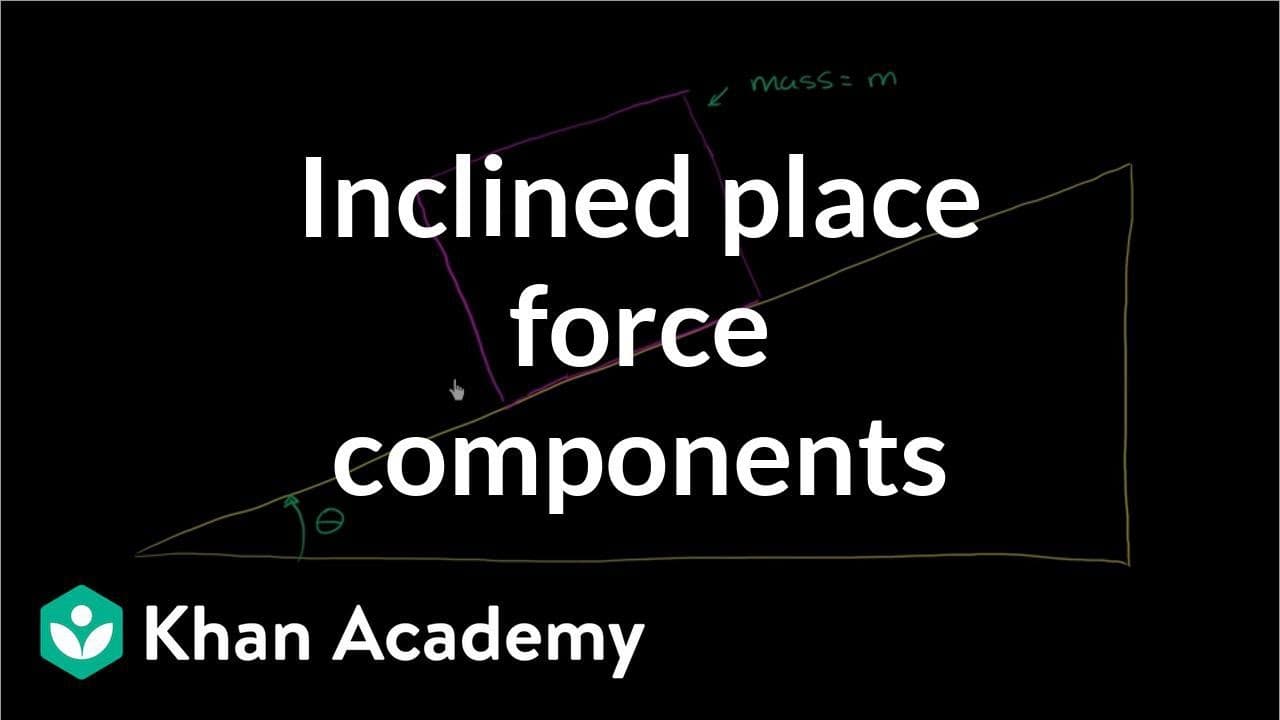
Let's say I have some type of a block here. And let's say this block has a mass of m. So the mass of this block is equal to m. And it's sitting on this-- you could view this is an inclined plane, or a ramp, or some type of wedge. And we want to think about what might happen to this block. And we'll start thinking about the different forces that mig... Read More
Key Insights
- 🍳 Forces on an inclined plane can be analyzed by breaking down the force of gravity into perpendicular and parallel components.
- 🥇 The perpendicular component of the force of gravity is responsible for keeping the block in place.
- ✈️ The parallel component of the force of gravity can cause the block to start accelerating down the inclined plane.
Install to Summarize YouTube Videos and Get Transcripts
Explore YouTube Video Summarizer or Get YouTube Transcript Extractor
Questions & Answers
Q: How does the force of gravity affect the block on the inclined plane?
The force of gravity, which is determined by the mass of the block and the gravitational field near the surface of the Earth, pulls the block towards the surface of the Earth.
Q: Is the force of gravity the only force acting on the block?
No, there are other forces at play. The normal force, which is perpendicular to the surface of the plane, acts against the force of gravity to keep the block in place.
Q: How can the force of gravity be broken down into components?
By using basic trigonometry, the force of gravity can be broken down into the perpendicular component and the parallel component to the surface of the inclined plane.
Q: What are the magnitudes of the perpendicular and parallel components of the force of gravity?
The perpendicular component is equal to the magnitude of the total force of gravity multiplied by the cosine of the angle of inclination. The parallel component is equal to the magnitude of the total force of gravity multiplied by the sine of the angle of inclination.
Summary & Key Takeaways
-
A block with mass is placed on an inclined plane, and the forces acting on it are examined.
-
The force of gravity acts on the block, pulling it towards the center of the Earth.
-
The force of gravity can be broken down into perpendicular and parallel components to the surface of the plane.
Read in Other Languages (beta)
Share This Summary 📚
Summarize YouTube Videos and Get Video Transcripts with 1-Click
Try YouTube Summary with ChatGPT & Claude or YouTube Transcript Generator
Explore More Summaries from Khan Academy 📚



Summarize YouTube Videos and Get Video Transcripts with 1-Click
Try YouTube Summary with ChatGPT & Claude or YouTube Transcript Generator