Arithmetic & Logical Instructions in 8086 Microprocessor- 8086 Microprocessor Microprocessor
TL;DR
This video explains the various arithmetic and logical instructions in 8086 microprocessors, including addition, subtraction, logical AND/OR, compare, increment, decrement, and bitwise operations.
Transcript
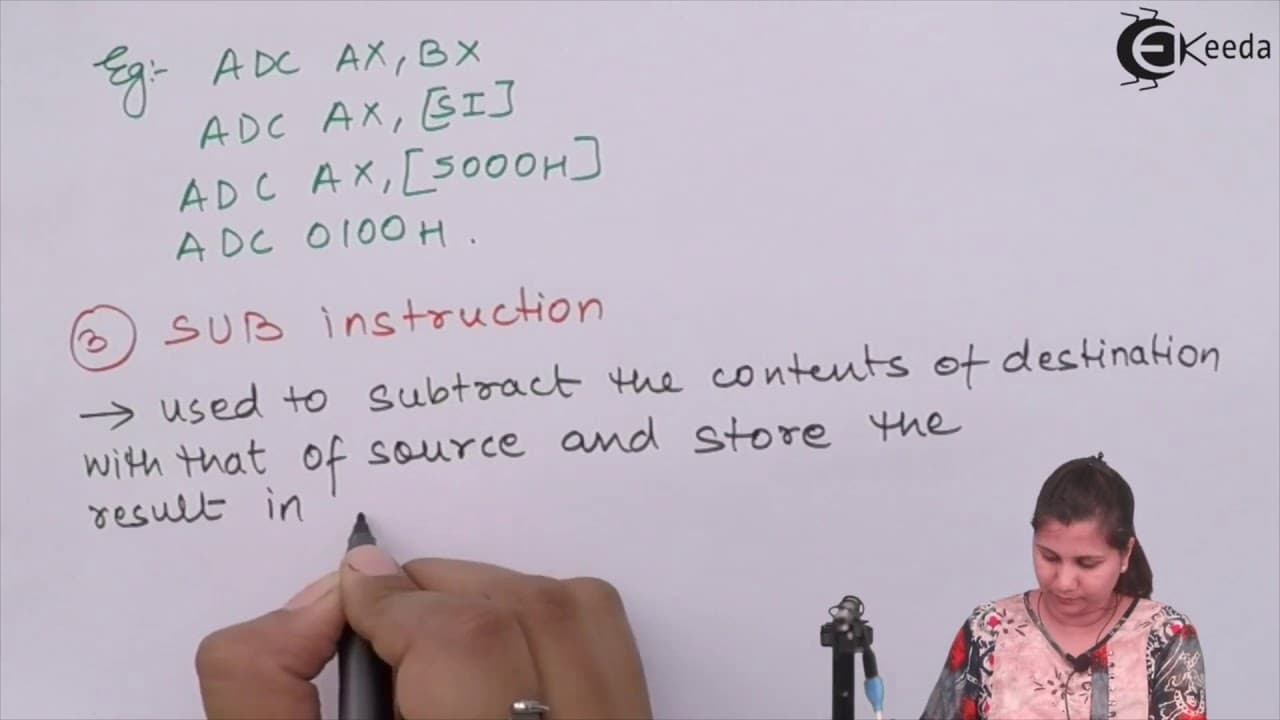
the arithmetic and logical instructions they are used to perform the arithmetic and logical operations like addition subtraction logical and logical or compare increment decrement so whenever these operations are to be performed in 8086 these instructions are used so let us start with our first instruction which is used for addition that is add the... Read More
Key Insights
- 👻 Arithmetic instructions like ADD, SUB, ADC, and SBB are used for addition and subtraction operations, affecting flags and allowing for various operand types.
- 🎏 Logical instructions such as AND, OR, XOR, and NOT are used for bitwise operations, modifying flags and performing logical comparisons.
- 😫 Comparison instructions like CMP are crucial for comparing operands and setting flags for conditional execution.
- 👻 Increment and decrement instructions are used to manipulate register values, affecting flags and allowing for convenient data operations.
- 🎏 Understanding the different instructions and their effects on flags is important for effective programming and error detection.
- ℹ️ The format for most instructions involves specifying the mnemonic (e.g., ADD, SUB), destination, and source operands.
- 📳 Immediate addressing mode allows for direct specification of data in the instruction itself, while implicit addressing mode uses a default register.
Install to Summarize YouTube Videos and Get Transcripts
Explore YouTube Video Summarizer or Get YouTube Transcript Extractor
Questions & Answers
Q: What is the purpose of the ADD instruction in 8086 microprocessors?
The ADD instruction is used to add the contents of the destination and source operands, storing the result in the destination. It can work with registers, immediate data, or memory locations.
Q: How are flags affected by the ADD instruction?
All the flags, including carry, auxiliary carry, sign, parity, zero, and overflow, are affected by the ADD instruction. They can be used to check the status of the result, such as detecting carry or zero results.
Q: What is the difference between ADD and ADC instructions?
The ADC instruction performs addition with carry. It adds the source and destination operands along with the carry flag. The carry flag can be set or reset based on previous instructions, acting as a borrow flag during subtraction.
Q: How does the SUB instruction work in 8086 microprocessors?
The SUB instruction subtracts the contents of the source operand from the destination operand and stores the result in the destination. It affects all the flags, allowing for checking conditions like zero, negative, or carry.
Q: What is the purpose of the CMP instruction?
The CMP instruction compares the contents of two operands by subtracting the source operand from the destination operand. It modifies the flags, such as setting the zero flag if the operands are equal or the carry flag if the source is greater than the destination.
Q: How are the logical AND and OR instructions used in 8086 microprocessors?
The AND instruction performs a logical AND operation between the bits of the source and destination operands, while the OR instruction performs a logical OR operation. Both instructions modify the flags and store the result in the destination operand.
Q: What does the NOT instruction do?
The NOT instruction complements or inverts the bits of the specified register or memory location without affecting the flags. It changes ones to zeros and vice versa.
Q: How does the XOR instruction work?
The XOR instruction performs a logical XOR operation between the bits of the source and destination operands. It produces a high output (1) when the bits are dissimilar and a low output (0) when they are similar.
Summary & Key Takeaways
-
The video covers the arithmetic instructions in 8086 microprocessors, such as addition, subtraction, addition with carry, and subtraction with borrow.
-
It also discusses the logical instructions, including logical AND/OR, XOR, and NOT operations.
-
The video explains how these instructions affect the flags and provides examples of their usage and formats.
Read in Other Languages (beta)
Share This Summary 📚
Summarize YouTube Videos and Get Video Transcripts with 1-Click
Try YouTube Summary with ChatGPT & Claude or YouTube Transcript Generator
Explore More Summaries from Ekeeda 📚

Summarize YouTube Videos and Get Video Transcripts with 1-Click
Try YouTube Summary with ChatGPT & Claude or YouTube Transcript Generator