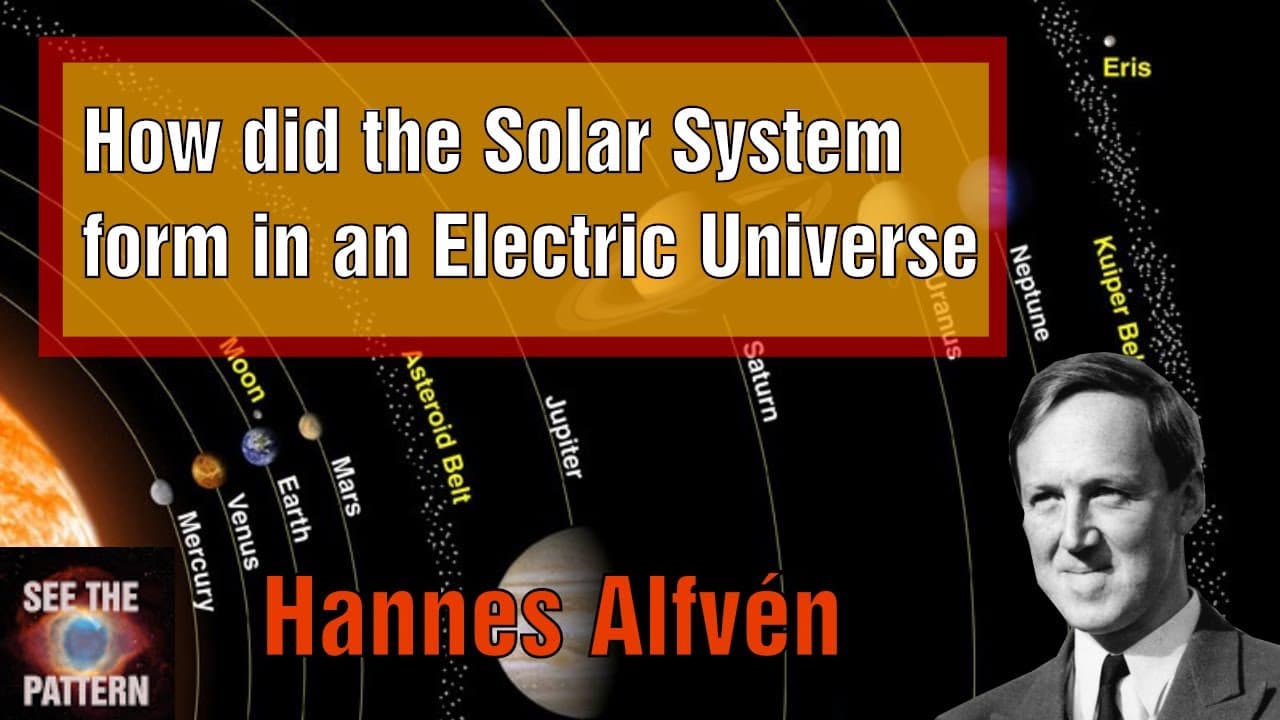
How did the Solar System form in an Electric Universe?
TL;DR
Hannes Alfven's theory integrates electromagnetic forces in solar system formation.
Transcript
what would the formation of the solar system look like if we took into consideration the electromagnetic force let's explore Hana's Alvin's theory for the formation of the solar system the current theories on the formation of the solar system are dominated by two theories Laplace's theory and the tidal theory the lap... Read More
Key Insights
- Hannes Alfven's theory suggests that electromagnetic forces play a critical role in the solar system's formation, unlike traditional models that focus solely on gravitational forces.
- The theory addresses the distribution of angular momentum, explaining why outer planets hold most of it rather than the Sun, contradicting the Laplacian model.
- Ionized gas clouds interacting with the Sun's magnetic field could lead to the formation of planets, with denser planets forming at specific locations due to ionization limits.
- Alfven proposes that inner planets may have formed from a meteoric dust cloud rather than gas clouds, accounting for their higher density compared to outer planets.
- The unique formation process of Saturn's rings is attributed to its mass and gravitational field, which prevent larger body formation at its Roche limit.
- The theory suggests that the asteroid belt's inability to coalesce into a planet might be due to Jupiter's gravitational resonance.
- Alfven highlights a potential connection between Mars and the Moon, suggesting they may have formed through a similar process, challenging conventional Moon formation theories.
- The theory emphasizes the importance of understanding ionized material behavior around magnetic fields, which could have broader implications for cosmic phenomena.
Install to Summarize YouTube Videos and Get Transcripts
Explore YouTube Video Summarizer or Get YouTube Transcript Extractor
Questions & Answers
Q: How does Alfven's theory explain the angular momentum distribution in the solar system?
Alfven's theory suggests that the electromagnetic force, particularly the Sun's magnetic field, plays a significant role in the angular momentum distribution. Ionized gas clouds interact with the magnetic field, transferring angular momentum to the outer planets. This explains why outer planets hold most of the solar system's angular momentum, unlike traditional models that struggle with this aspect.
Q: What role do ionized gas clouds play in planet formation according to Alfven?
Ionized gas clouds, influenced by the Sun's magnetic field, are crucial in Alfven's planet formation model. As these clouds interact with the magnetic field, they experience forces that guide their movement and condensation into planets. The ionization limits determine where denser planets form, providing a framework for understanding the distribution of planets in the solar system.
Q: How does Alfven's theory account for the formation of inner planets?
Alfven suggests that inner planets may have formed from a meteoric dust cloud rather than gas clouds. This accounts for their higher density compared to outer planets. The dust cloud, upon reaching the inner solar system, undergoes a process similar to gas clouds, becoming heated and eventually ionized, leading to planet formation through electromagnetic interactions.
Q: Why does Saturn have rings according to Alfven's theory?
Saturn's rings are explained by its mass and gravitational field, which influence the ionization of material. The ionization point is close enough to Saturn that its gravitational field prevents larger bodies from coalescing, resulting in the formation of rings. This is known as the Roche limit, where gravitational forces prevent the agglomeration of ring material into larger bodies.
Q: What explanation does Alfven offer for the asteroid belt's formation?
Alfven suggests that the asteroid belt's inability to coalesce into a planet might be due to Jupiter's gravitational resonance. The gravitational influence of Jupiter could disturb the formation of larger bodies within the asteroid belt, preventing them from coalescing into a single planetary body. This resonance effect offers a potential explanation for the belt's current state.
Q: What is the proposed connection between Mars and the Moon in Alfven's theory?
Alfven proposes that Mars and the Moon might have formed through a similar process, as indicated by their similar densities. This challenges conventional Moon formation theories and suggests that both bodies were part of an early formation phase involving meteoric dust clouds. This connection implies a shared origin and similar formation conditions for Mars and the Moon.
Q: How does Alfven's theory challenge conventional Moon formation theories?
Alfven's theory challenges conventional Moon formation theories by suggesting a connection between Mars and the Moon based on their similar densities. He proposes that both bodies were formed through a similar process involving meteoric dust clouds, rather than the widely accepted giant impact hypothesis. This raises questions about the Moon's origin and its relationship with Mars.
Q: What broader implications does Alfven's theory have for understanding cosmic phenomena?
Alfven's theory emphasizes the importance of understanding ionized material behavior around magnetic fields, which has broader implications for cosmic phenomena. If the universe is predominantly plasma, as suggested by Alfven, then electromagnetic forces and ionized material interactions could play a crucial role in various cosmic processes, from star and planet formation to the behavior of galaxies and black holes.
Summary & Key Takeaways
-
Hannes Alfven's theory integrates electromagnetic forces into the solar system's formation process, diverging from traditional gravitational models. It explains angular momentum distribution and suggests ionized gas clouds form planets, with denser bodies forming at specific ionization limits.
-
Inner planets may have formed from meteoric dust clouds, accounting for their higher density. Saturn's rings are explained by its mass and gravitational influence, while the asteroid belt's formation is linked to Jupiter's gravitational resonance.
-
Alfven proposes a connection between Mars and the Moon, challenging conventional Moon formation theories. Understanding ionized material behavior around magnetic fields is crucial for broader cosmic phenomena insights.
Read in Other Languages (beta)
Share This Summary 📚
Summarize YouTube Videos and Get Video Transcripts with 1-Click
Try YouTube Summary with ChatGPT & Claude or YouTube Transcript Generator
Explore More Summaries from See the Pattern 📚
Summarize YouTube Videos and Get Video Transcripts with 1-Click
Try YouTube Summary with ChatGPT & Claude or YouTube Transcript Generator