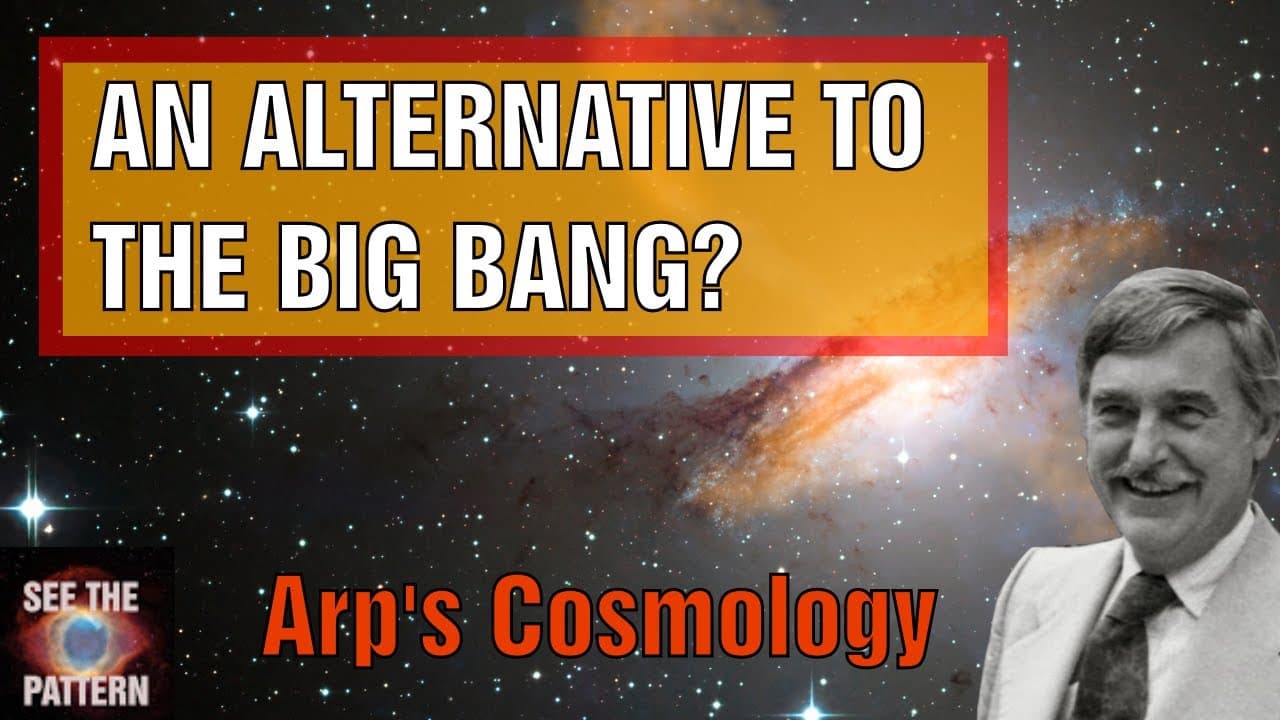
An Alternative to the Big Bang Theory? - Arp's Cosmology
TL;DR
Exploration of Arp's cosmology as an alternative to the Big Bang.
Transcript
hello and welcome back to see the pattern in today's episode we are going to be exploring Arps view of the universe his ideas around cosmology about 60 years ago George Abel started to catalog the distribution of the clusters of galaxies the cause of these were predominantly old stellar population etype galaxies which were believed to be mo... Read More
Key Insights
- Halton Arp proposed an alternative cosmological model, suggesting that quasars are ejected from galaxies and evolve into dwarf galaxies, challenging the Big Bang theory.
- Arp's observations indicate that quasars are linked to active galaxies and their redshift decreases as they move away, implying a different understanding of their formation and evolution.
- The standard cosmological model suggests that companion galaxies result from collisions, but Arp's findings challenge this by showing alignment along the galaxy's axis of rotation.
- Narlikar's modification to Einstein's equations suggests that mass increases over time, leading to a flat space-time, challenging the notion of an expanding universe.
- The Quasi-Steady State Cosmology, developed by Hoyle, Narlikar, and Burbidge, allows for mini Big Bangs and suggests that mass creation can explain intrinsic redshifts.
- Arp's theory aligns with the Electric Universe model, proposing that galaxies form from vast cosmic currents and that quasars are ejected material.
- The idea of mass variation offers a potential explanation for the intrinsic redshift of younger cosmic objects, although the theory has unresolved implications.
- Arp's work is often overlooked, but it presents intriguing possibilities for understanding galaxy formation and the nature of the universe.
Install to Summarize YouTube Videos and Get Transcripts
Explore YouTube Video Summarizer or Get YouTube Transcript Extractor
Questions & Answers
Q: What is Halton Arp's view on quasars?
Halton Arp viewed quasars as objects ejected from galaxies, challenging the conventional understanding of them as distant, high-redshift objects. He observed that quasars are associated with active galaxies and their redshift decreases as they move away from the galaxy, suggesting a different mechanism for their formation and evolution.
Q: How does Arp's theory challenge the Big Bang model?
Arp's theory challenges the Big Bang model by proposing that quasars and galaxies form through ejection and evolution rather than from a singular explosive event. His observations indicate that quasars are linked to active galaxies and evolve into dwarf galaxies, contradicting the idea that all matter originated from a single point 13.8 billion years ago.
Q: What is Narlikar's contribution to the alternative cosmology theory?
Narlikar contributed to the alternative cosmology theory by modifying Einstein's equations to allow for mass to increase over time, leading to a flat space-time. This challenges the concept of an expanding universe and suggests that redshift is related to the age of objects rather than their velocity, offering a different perspective on cosmic expansion.
Q: What is the Quasi-Steady State Cosmology?
The Quasi-Steady State Cosmology, developed by Hoyle, Narlikar, and Burbidge, is an evolution of the steady state theory that incorporates the variable mass hypothesis. It allows for mini Big Bang events throughout the universe, suggesting that new matter is intermittently created, offering an alternative explanation for intrinsic redshifts and cosmic phenomena.
Q: How does Arp's theory align with the Electric Universe model?
Arp's theory aligns with the Electric Universe model by proposing that galaxies form from vast cosmic currents, known as Birkeland currents, which create pinch points where matter forms. This model suggests that quasars are ejected material from active galactic nuclei, challenging the conventional view of galaxy formation and supporting a plasma-based cosmology.
Q: What are the implications of mass variation in Arp's theory?
The mass variation in Arp's theory implies that as cosmic objects like quasars are ejected, their mass increases over time, which could explain the intrinsic redshift observed in younger objects. However, this raises questions about the conservation of mass and energy in the universe, as continuous mass increase could lead to an exponential growth of mass.
Q: Why is Arp's work often overlooked in the scientific community?
Arp's work is often overlooked because it challenges the widely accepted Big Bang theory and presents unconventional ideas that contradict mainstream cosmology. Despite providing extensive observational data, his theories have been marginalized, possibly due to the scientific community's reluctance to deviate from established models and the complexity of his proposals.
Q: What are the key takeaways from Arp's alternative cosmology theory?
Key takeaways from Arp's alternative cosmology theory include the idea that quasars are ejected from galaxies and evolve into dwarf galaxies, challenging the Big Bang model. His theory suggests a different mechanism for redshift and cosmic evolution, aligning with the Electric Universe model. While not fully accepted, his ideas offer intriguing possibilities for understanding galaxy formation.
Summary & Key Takeaways
-
Halton Arp's cosmological model challenges the Big Bang theory by suggesting that quasars are ejected from galaxies and evolve into dwarf galaxies. His observations show that quasars are linked to active galaxies and their redshift decreases as they move away, implying a different understanding of cosmic evolution.
-
Arp's findings contradict the standard model, which suggests companion galaxies result from collisions. Instead, his data shows alignment along the galaxy's axis of rotation. Narlikar's modification to Einstein's equations proposes that mass increases over time, leading to a flat space-time, challenging the notion of an expanding universe.
-
The Quasi-Steady State Cosmology, developed by Hoyle, Narlikar, and Burbidge, allows for mini Big Bangs and suggests mass creation can explain intrinsic redshifts. Arp's theory aligns with the Electric Universe model, proposing galaxies form from cosmic currents and quasars are ejected material, offering new insights into galaxy formation.
Read in Other Languages (beta)
Share This Summary 📚
Summarize YouTube Videos and Get Video Transcripts with 1-Click
Try YouTube Summary with ChatGPT & Claude or YouTube Transcript Generator
Explore More Summaries from See the Pattern 📚
Summarize YouTube Videos and Get Video Transcripts with 1-Click
Try YouTube Summary with ChatGPT & Claude or YouTube Transcript Generator