How to Prepare a Diluted Solution in Chemistry
TL;DR
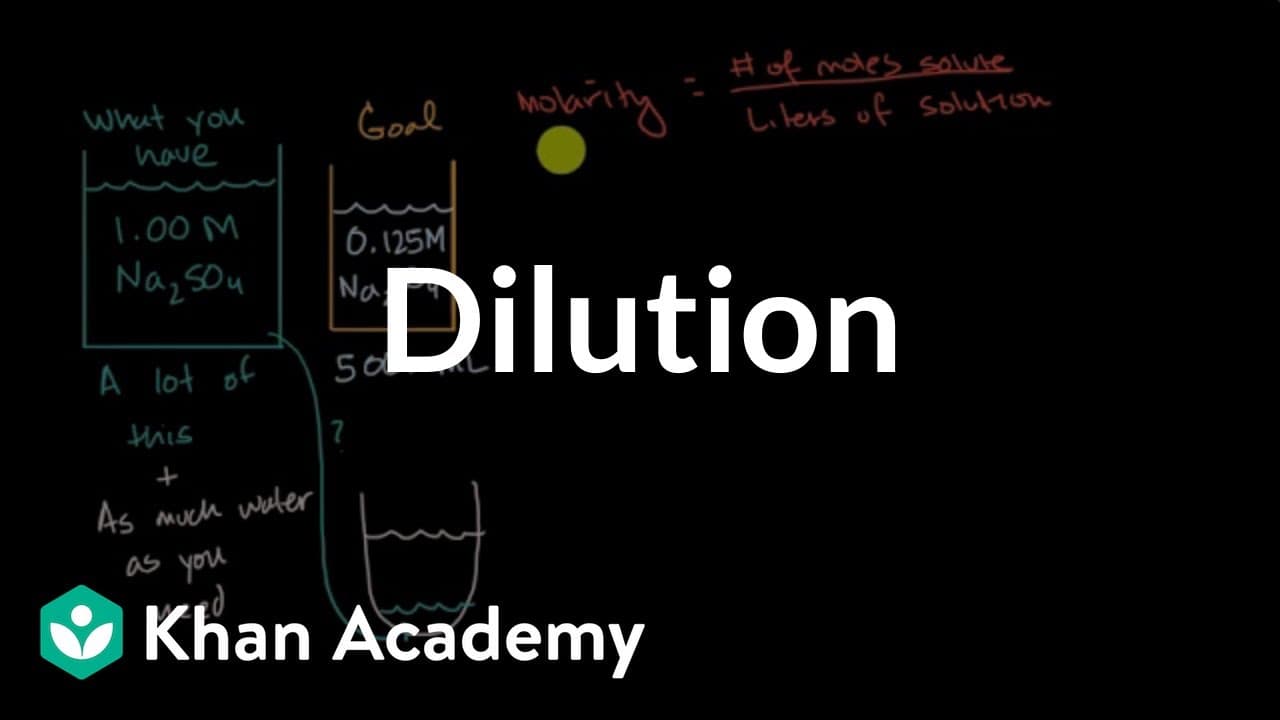
To prepare a diluted solution, calculate the necessary moles of solute based on the desired concentration and volume. For example, to create a 0.125 M sodium sulfate solution in 500 mL, you need 62.5 mL of 1 M sodium sulfate and then dilute it with water to the final volume.
Transcript
- [Instructor] In this video, we're gonna talk about a concept in chemistry that's quite important, known as dilutions. So let's do an example. So let's say we have a large vat, as much as we need. It's a one-molar solution of sodium sulfate, and it's an aqueous solution. So sodium sulfate is dissolved in water. And let's say we also have as much w... Read More
Key Insights
- ❓ Dilutions in chemistry involve creating solutions with different concentrations.
- ❓ Molarity is often used to measure concentration.
- 🔊 The number of moles needed for a desired concentration is calculated to determine the volume of the higher concentration solution.
- 🔊 Dilutions are achieved by adding the appropriate volume of the higher concentration solution and diluting it with water.
- 🖐️ Significant figures play a role in ensuring accuracy in calculations.
- ❓ Dilutions are important in various chemical processes and experiments.
- ❓ The process of dilution requires careful measurement and attention to detail.
Install to Summarize YouTube Videos and Get Transcripts
Explore YouTube Video Summarizer or Get YouTube Transcript Extractor
Questions & Answers
Q: What is the purpose of dilutions in chemistry?
Dilutions are used to create solutions with different concentrations by adding a specific volume of a higher concentration solution and diluting it with water.
Q: How is the concentration of a solution determined in chemistry?
In chemistry, concentration is often measured in molarity (moles per liter). It is calculated by dividing the number of moles of solute by the volume of the solution in liters.
Q: How can dilutions be used to prepare a solution with a lower concentration?
To prepare a solution with a lower concentration, a specific volume of a higher concentration solution is added, and then the solution is diluted with water until the desired concentration is achieved.
Q: How do you calculate the volume of the higher concentration solution needed for a dilution?
The volume of the higher concentration solution is determined by calculating the number of moles needed for the desired concentration and then dividing it by the concentration of the higher concentration solution.
Summary & Key Takeaways
-
Dilutions in chemistry involve creating a solution with a different concentration.
-
The process involves adding a specific volume of a higher concentration solution and diluting it with water.
-
To calculate the required volume of the higher concentration solution, the number of moles needed for the desired concentration is determined.
Read in Other Languages (beta)
Share This Summary 📚
Summarize YouTube Videos and Get Video Transcripts with 1-Click
Try YouTube Summary with ChatGPT & Claude or YouTube Transcript Generator
Explore More Summaries from Khan Academy 📚



Summarize YouTube Videos and Get Video Transcripts with 1-Click
Try YouTube Summary with ChatGPT & Claude or YouTube Transcript Generator