Laminar Flow - Problem 3 - Real Fluid Flows - Fluid Mechanics 1
TL;DR
This content provides a step-by-step solution to a problem involving laminar flow in an inclined pipe.
Transcript
as we have studied in laminar flow the equation of shear stress viscosity as well as the pressure difference between the two ends of the pipe now we'll apply these equations to solve problems related to laminar flow so let us solve a problem on laminar flow so we have a problem over here which says that an inclined pipe of inclination three degrees... Read More
Key Insights
- 🦾 Laminar flow equations, including shear stress, viscosity, and pressure difference, can be applied to solve problems in fluid mechanics.
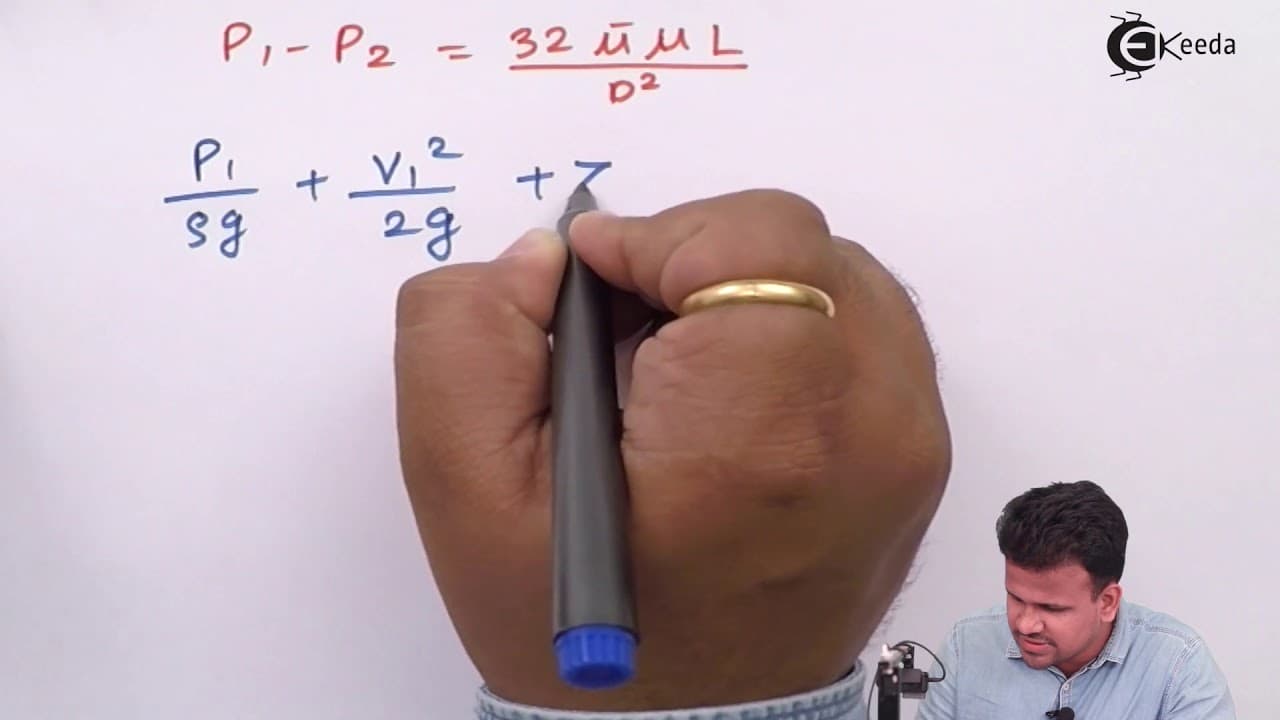
- 😒 Inclined pipes require the use of Bernoulli's equation instead of the formula for pressure difference in horizontal pipes.
- 🤕 Calculating head loss involves considering factors such as dynamic viscosity, average velocity, length of the pipe, density, gravitational acceleration, and diameter.
Install to Summarize YouTube Videos and Get Transcripts
Explore YouTube Video Summarizer or Get YouTube Transcript Extractor
Questions & Answers
Q: What are the given parameters of the problem related to laminar flow in an inclined pipe?
The given parameters are the specific gravity of the oil (0.859), length of the pipe (2.5 kilometers), flow rate (60 liters per second), kinematic viscosity (0.2 stokes), and diameter of the pipe (30 mm).
Q: Why can't the formula for pressure difference in horizontal pipes be used in this problem?
The formula only applies to horizontal pipes, but in this case, the pipe is inclined at an angle of 3 degrees to the horizontal. Therefore, Bernoulli's equation is used instead.
Q: How is the head loss calculated in this problem?
The head loss is calculated using the given values of dynamic viscosity, average velocity, length of the pipe, density of the oil, and diameter. The formula for head loss is 32 * viscosity * average velocity * length / (density * gravitational acceleration * diameter^2).
Q: How is the pressure difference between the two ends of the pipe determined?
By substituting the calculated values of head loss, velocity, and elevation into Bernoulli's equation, we can isolate the pressure difference term and solve for it. The resulting value is 1261.028 kilonewton per meter squared.
Summary & Key Takeaways
-
An inclined pipe with a specific gravity of 0.859 and length of 2.5 kilometers carries oil at a flow rate of 60 liters per second.
-
The problem requires calculating the pressure difference between the two ends of the pipe using the given values of kinematic viscosity, diameter, and density of the oil.
-
By applying Bernoulli's equation and calculating the head loss, as well as the values of velocity and elevation at each section, the pressure difference is determined to be 1261.028 kilonewton per meter squared.
Read in Other Languages (beta)
Share This Summary 📚
Summarize YouTube Videos and Get Video Transcripts with 1-Click
Try YouTube Summary with ChatGPT & Claude or YouTube Transcript Generator
Explore More Summaries from Ekeeda 📚





Summarize YouTube Videos and Get Video Transcripts with 1-Click
Try YouTube Summary with ChatGPT & Claude or YouTube Transcript Generator