2015 AP Physics 1 free response 2 c and d
TL;DR
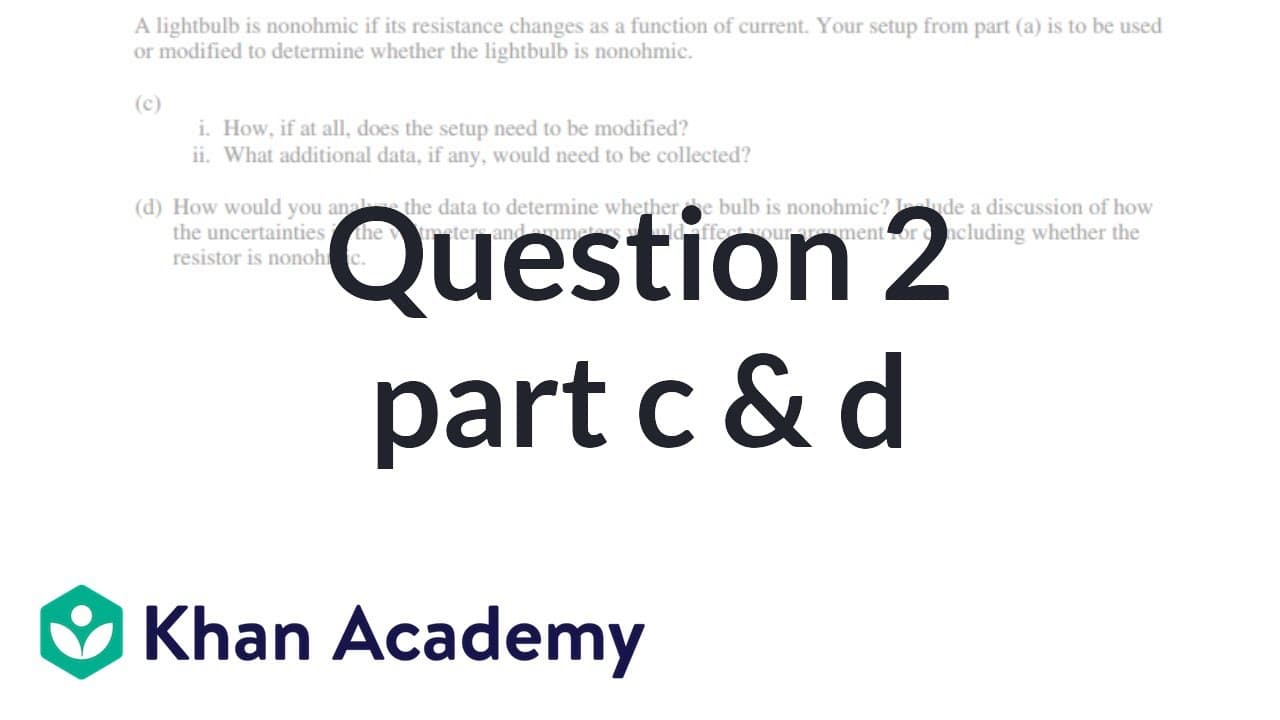
The setup needs no modification, but additional data on the voltage and current across the bulb as the power source varies should be collected to analyze whether the light bulb is non-ohmic.
Transcript
- [Voiceover] Let's now tackle the rest of this problem. So they say a light-bulb is non-ohmic if its resistance changes as a function of current. Your setup from part a, which we have right over here, is to be used or modified to determine whether the light-bulb is non-ohmic. How, if at all, does the setup need to be modified? Well, we want to be ... Read More
Key Insights
- 💡 The setup for determining if a light bulb is non-ohmic does not require modification.
- ⚡ The current through the light bulb can be changed by varying the power source's voltage.
- 💡 Data on the voltage and current across the bulb as the power source changes should be collected to analyze if the light bulb is non-ohmic.
- 💡 The resistance of the light bulb can be calculated by dividing the voltage across the bulb by the current entering or exiting the bulb.
- ⚡ Comparing the ratios of voltage to current before and after changing the power source's voltage can determine if the light bulb is non-ohmic.
- 🥡 Instrument sensitivity and rounding can affect the accuracy of the measurements, so caution must be taken when interpreting the results.
- 🕵️ Changes in resistance may not be detected if they are smaller than the sensitivity of the instruments used.
Install to Summarize YouTube Videos and Get Transcripts
Explore YouTube Video Summarizer or Get YouTube Transcript Extractor
Questions & Answers
Q: How can the resistance of the light bulb be measured using the setup?
The resistance of the light bulb can be calculated by dividing the voltage across the bulb by the current entering or exiting the bulb, as stated by Ohm's law (V = IR).
Q: How can the current through the light bulb be changed?
The current through the light bulb can be changed by varying the voltage of the power source, as changing the voltage will alter the current flowing through the circuit.
Q: What additional data needs to be collected to analyze if the light bulb is non-ohmic?
It is necessary to collect data on the voltage across the bulb and the current entering or exiting the bulb as the voltage of the power source is varied.
Q: How would the data be analyzed to determine if the light bulb is non-ohmic?
The data would be analyzed by comparing the ratios of voltage to current before and after changing the power source's voltage. If the ratios are equal, the resistance has not changed, indicating the light bulb is ohmic. If the ratios are not equal, the resistance has changed, indicating the light bulb is non-ohmic.
Summary & Key Takeaways
-
The setup for determining if a light bulb is non-ohmic does not need modification.
-
Changing the current through the light bulb can be done by varying the power source's voltage.
-
To analyze whether the light bulb is non-ohmic, it is necessary to collect data on the voltage and current across the bulb as the power source varies.
Read in Other Languages (beta)
Share This Summary 📚
Summarize YouTube Videos and Get Video Transcripts with 1-Click
Try YouTube Summary with ChatGPT & Claude or YouTube Transcript Generator
Explore More Summaries from Khan Academy 📚



Summarize YouTube Videos and Get Video Transcripts with 1-Click
Try YouTube Summary with ChatGPT & Claude or YouTube Transcript Generator