Plotting projectile displacement, acceleration, and velocity | Khan Academy
TL;DR
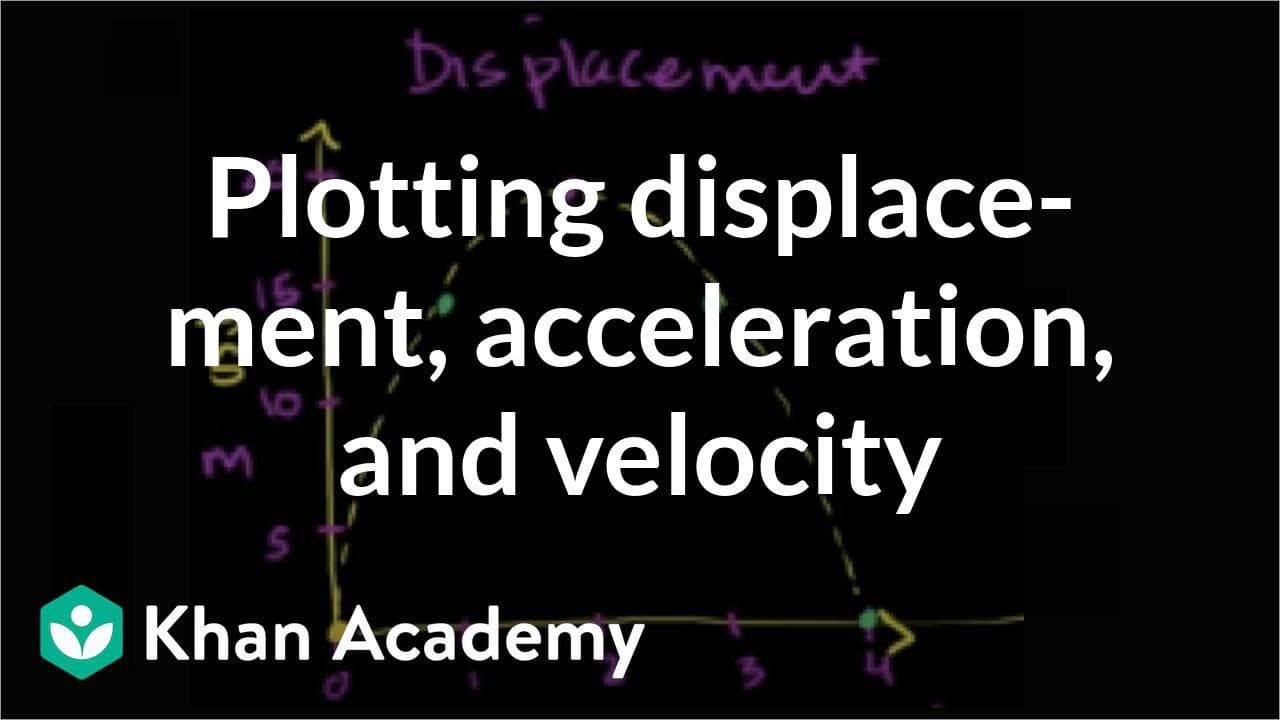
This video explains the relationship between displacement, final velocity, and acceleration in projectile motion.
Transcript
What I want to do in this video, now that we have displacement as a function of time, given constant acceleration and an initial velocity. I want to plot displacement, final velocity, and acceleration, all of those as functions of time. Just so we really understand what's happening as the ball is going up and then down. So we know this is our displ... Read More
Key Insights
- ❓ Displacement, velocity, and acceleration are interconnected in projectile motion.
- 👾 The velocity of a projectile decreases at a constant pace due to the downward acceleration from gravity.
- 🟰 The acceleration in projectile motion is constant and equal to the acceleration due to gravity.
- 🤘 The convention is to assign a negative sign to acceleration due to gravity since it acts in the downward direction.
- 🙊 Displacement increases during the upward motion of a projectile, reaches a maximum at the peak, and then decreases during the downward motion.
- ❓ The relationship between displacement, velocity, and acceleration can be represented graphically.
- 📉 The displacement versus time graph for projectile motion resembles a downward-opening parabola.
Install to Summarize YouTube Videos and Get Transcripts
Explore YouTube Video Summarizer or Get YouTube Transcript Extractor
Questions & Answers
Q: What is the formula for calculating the final velocity in projectile motion?
The final velocity can be calculated by adding the initial velocity to the product of acceleration and the change in time.
Q: Why is acceleration due to gravity negative?
The convention is to assign a negative value to the acceleration due to gravity because it acts in the downward direction.
Q: How does displacement change during projectile motion?
Displacement increases as the object moves upward, reaches a maximum at the peak, and then decreases as it moves downward.
Q: How does the velocity change during projectile motion?
Velocity decreases at a constant pace during projectile motion due to the constant downward acceleration.
Summary & Key Takeaways
-
The video explores the relationship between displacement, final velocity, and acceleration in projectile motion.
-
It shows graphs of displacement, velocity, and acceleration as functions of time.
-
The video demonstrates how velocity decreases at a constant pace due to the downward acceleration from gravity.
Read in Other Languages (beta)
Share This Summary 📚
Summarize YouTube Videos and Get Video Transcripts with 1-Click
Try YouTube Summary with ChatGPT & Claude or YouTube Transcript Generator
Explore More Summaries from Khan Academy 📚



Summarize YouTube Videos and Get Video Transcripts with 1-Click
Try YouTube Summary with ChatGPT & Claude or YouTube Transcript Generator