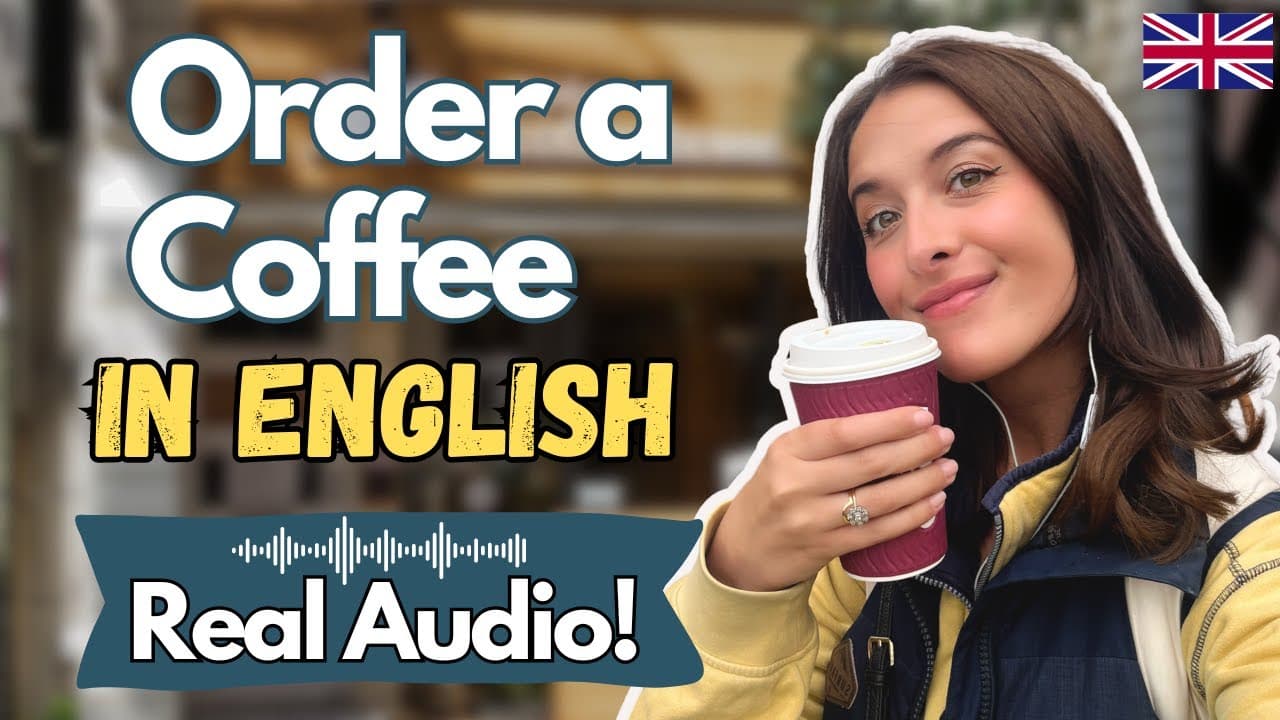
How to Order a Coffee in English! (Come to 5 Coffee Shops With Me!)
TL;DR
Learn how to order coffee in English with real examples.
Transcript
Do you want to get some coffee? Good morning, good afternoon, and good evening! Welcome to Smashing English. Before we start this video, be sure to subscribe because we make new videos all the time, and I don't want you to miss any. So with that said, let's get on with the video! Ordering coffee is something millions of peop... Read More
Key Insights
- Ordering coffee in English can be challenging for non-native speakers, but common phrases make it easier.
- Phrases like 'Could I get' are slightly more polite than 'Can I get', although both are acceptable.
- The phrase 'Do you do' is commonly used to inquire about the availability of items in coffee shops.
- Small talk, such as asking 'Have you been busy today?', is common in cafes and can ease interactions.
- Phrasal verbs like 'top up' are used in cafes to describe adding more of a drink or ingredient.
- Using positive adjectives like 'perfect' or 'brilliant' can convey satisfaction with service.
- Clarifying questions like 'How large is a large one?' are useful for ensuring accurate orders.
- Understanding payment methods is crucial, as some shops only accept card payments.
Install to Summarize YouTube Videos and Get Transcripts
Explore YouTube Video Summarizer or Get YouTube Transcript Extractor
Questions & Answers
Q: What is the main challenge non-native speakers face when ordering coffee in English?
Non-native speakers often find it challenging to order coffee in English due to unfamiliarity with common phrases and interactions. The video aims to address this by providing real examples and highlighting key phrases that make the process easier and more comfortable.
Q: How does the video suggest handling specific coffee orders?
The video suggests acknowledging the specificity of your order by saying something like 'It's a bit of a weird order' to preempt any confusion. This approach helps to clarify that while the order may be unusual, it is exactly what you want, making it easier for the barista to accommodate.
Q: What is the significance of using phrases like 'Could I get'?
Using 'Could I get' is slightly more polite than 'Can I get', which can be beneficial in maintaining a courteous tone. However, in fast-paced environments like coffee shops, 'Can I get' is also acceptable and not considered impolite, allowing for flexibility based on the situation.
Q: Why is small talk important in coffee shop interactions?
Small talk, such as asking 'Have you been busy today?', is important as it helps to create a friendly atmosphere and ease any potential awkwardness. It also provides an opportunity for positive interaction, which can enhance the overall experience for both the customer and the barista.
Q: What role do positive affirmations play in coffee shop interactions?
Positive affirmations like 'perfect' and 'brilliant' are used to convey satisfaction with the service provided. These words help to fill conversational gaps and reassure the barista that the order meets the customer's expectations, contributing to a pleasant interaction.
Q: How can customers clarify their orders effectively?
Customers can clarify their orders by asking questions like 'How large is a large one?' to ensure they understand what they are ordering. This approach helps to avoid misunderstandings and ensures that the customer receives exactly what they want, making the interaction smoother.
Q: What is the importance of understanding payment methods in coffee shops?
Understanding payment methods is crucial as some coffee shops may only accept card payments. Being aware of this can prevent confusion and ensure a seamless transaction. The video emphasizes the importance of asking questions like 'Do you take cash?' to confirm the accepted payment methods.
Q: How do interactions differ between village and city coffee shops?
Interactions in village coffee shops tend to be more relaxed and chatty, allowing for more small talk and conversation. In contrast, city coffee shops are often more fast-paced with less chit-chat, focusing on quick and efficient service. The video highlights these differences to prepare viewers for varying experiences.
Summary & Key Takeaways
-
The video explores how to order coffee in English, focusing on common phrases and interactions at various coffee shops. It highlights the differences between using 'could' and 'can', and emphasizes the importance of small talk and polite language.
-
Through real audio examples, viewers learn about common questions and responses in coffee shops, such as 'Do you do takeaway?' and 'Have you been busy today?'. The video also discusses the use of positive affirmations like 'perfect' to show satisfaction.
-
The video provides practical tips for non-native speakers, including how to handle specific orders, ask clarifying questions, and understand payment options. It also contrasts interactions in village and city coffee shops, noting differences in pace and conversation.
Read in Other Languages (beta)
Share This Summary 📚
Summarize YouTube Videos and Get Video Transcripts with 1-Click
Try YouTube Summary with ChatGPT & Claude or YouTube Transcript Generator
Explore More Summaries from Smashing English! Free and Fun English Lessons! 📚




Summarize YouTube Videos and Get Video Transcripts with 1-Click
Try YouTube Summary with ChatGPT & Claude or YouTube Transcript Generator