Products
Features
YouTube Video Summarizer
Summarize YouTube videos
Web & PDF Highlighter
Highlight web pages & PDFs
Chat with PDF
Ask any PDF questions with AI
Ask AI Clone
Chat with your highlights & memories
Audio Transcriber
Transcribe audio files to text
Glasp Reader
Read and highlight articles
Kindle Highlight Export
Export your Kindle highlights
Idea Hatch
Hatch ideas from your highlights
Integrations
Obsidian Plugin
Notion Integration
Pocket Integration
Instapaper Integration
Medium Integration
Readwise Integration
Snipd Integration
Hypothesis Integration
Apps & Extensions
Chrome Extension
Safari Extension
Edge Add-ons
Firefox Add-ons
iOS App
Android App
Discover
Discover
Ideas
Discover new ideas and insights
Articles
Curated articles and insights
Books
Book recommendations by great minds
Posts
Essays and notes from readers
Quotes
Inspiring quotes collection
Videos
Curated videos and summaries
Explore Glasp
Glasp Newsletter
Weekly insights and updates
Glasp Talk
Interview series with great minds
Glasp Blog
Latest news and articles
Glasp Use Cases
Learn how others use Glasp
Build & Support
Glasp API
Access Glasp's API for developers
MCP Connector
Connect Glasp to Claude & ChatGPT
Community
Glasp Reddit Community
Students
Student discount and benefits
FAQs
Frequently Asked Questions
AboutPricing
DashboardLog inSign up

Algebra 60 - Parametric Equations with Gauss-Jordan Elimination
11.4K views
•
December 14, 2016
by
MyWhyU
YouTube video player
Algebra 60 - Parametric Equations with Gauss-Jordan Elimination

TL;DR

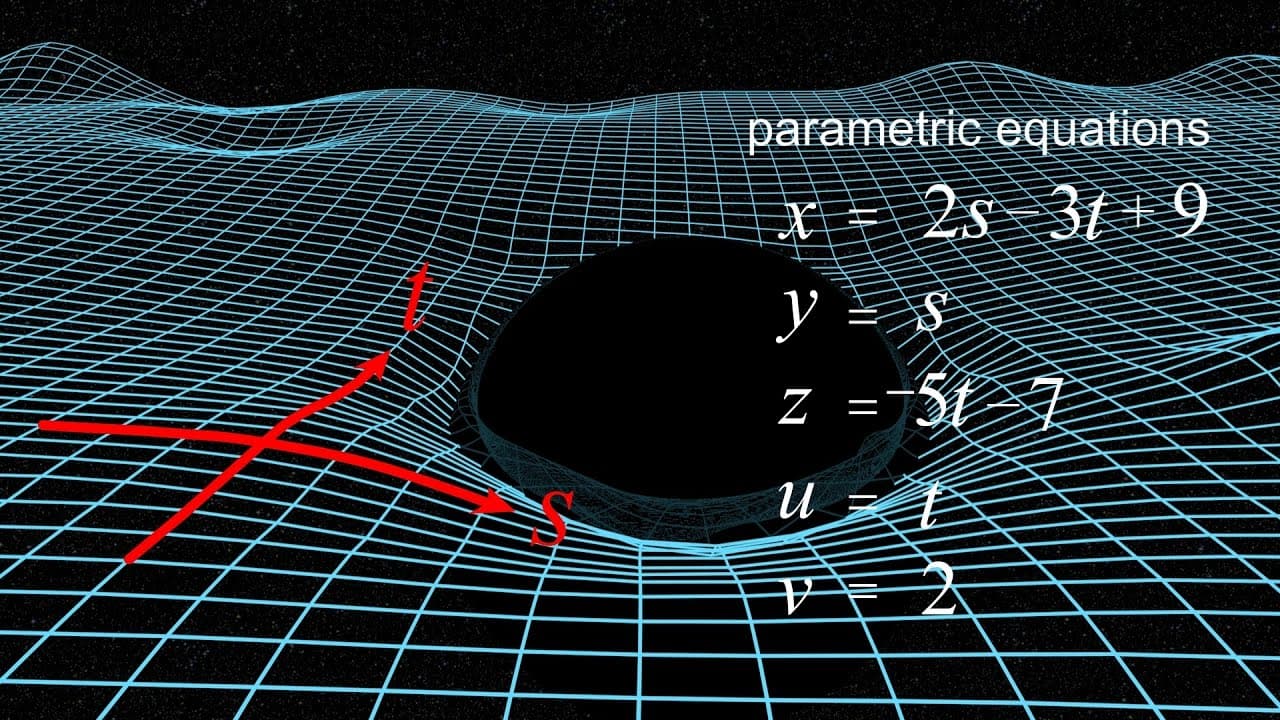
The lecture explains how to determine the type of solutions a system of equations has by looking at its reduced row echelon form matrix and how to create parametric equations to describe infinite solution sets.

Transcript

Hello. I'm Professor Von Schmohawk and welcome to Why U. In the lecture entitled "Describing Infinite Solution Sets Parametrically" we saw how infinite solution sets could be described using parametric equations. In this lecture, we will show that once an augmented matrix representing a system of equations with infinitely many solutions has been tr... Read More

Key Insights

  • 🤨 A matrix in reduced row echelon form can determine the type of solutions a system of equations has.
  • 🤨 Pivot columns in a reduced row echelon matrix indicate the type of solution set.
  • 😫 Parametric equations can be used to describe infinite solution sets in a simplified manner.
  • #️⃣ The number of free variables corresponds to the number of dimensions required to graphically represent the solution set.

Install to Summarize YouTube Videos and Get Transcripts

Explore YouTube Video Summarizer or Get YouTube Transcript Extractor

Questions & Answers

Q: How can a reduced row echelon matrix indicate if a system has no solutions?

A matrix in reduced row echelon form has no solutions if it contains a row with all zero coefficient entries and a non-zero constant entry.

Q: What is a pivot column in a reduced row echelon matrix?

In a reduced row echelon matrix, the columns that contain the left-most non-zero entry in each row (leading entry) are called pivot columns.

Q: How do you describe the solution set when a system has infinitely many solutions?

In a reduced row echelon matrix, the dependent variables (corresponding to pivot columns) are expressed as functions of the free variables. A set of parametric equations is created, equating each free variable to a parameter.

Q: What is a subspace in the context of solution sets?

A subspace is a lower-dimensional space embedded within a higher-dimensional space. The solution set of a system forms a subspace of lower dimension than the system itself.

Summary & Key Takeaways

  • The lecture discusses how an augmented matrix in reduced row echelon form can be used to determine the type of solutions a system of equations has.

  • By examining the positions of pivot columns in the matrix, it is possible to determine if the system has a single unique solution or infinitely many solutions.

  • To create parametric equations for infinite solution sets, the dependent variables (corresponding to pivot columns) are treated as functions of the free variables, which can vary freely.


Read in Other Languages (beta)

English

Share This Summary 📚

Summarize YouTube Videos and Get Video Transcripts with 1-Click

Download browser extensions on:

Try YouTube Summary with ChatGPT & Claude or YouTube Transcript Generator

Explore More Summaries from MyWhyU 📚

Algebra 31 - Calculating Mixtures of Solutions thumbnail
Algebra 31 - Calculating Mixtures of Solutions
MyWhyU
Algebra 83 - Polynomials thumbnail
Algebra 83 - Polynomials
MyWhyU
What Are Whole Numbers, Integers, and the Number Line? thumbnail
What Are Whole Numbers, Integers, and the Number Line?
MyWhyU
Algebra 61 - Gauss-Jordan Elimination with Inconsistent Systems thumbnail
Algebra 61 - Gauss-Jordan Elimination with Inconsistent Systems
MyWhyU
Algebra 65 - Creating Quadratic Expressions Using the FOIL Method thumbnail
Algebra 65 - Creating Quadratic Expressions Using the FOIL Method
MyWhyU
Pre-Algebra 2 - Roman Numerals: Sign-Value vs Positional Notation thumbnail
Pre-Algebra 2 - Roman Numerals: Sign-Value vs Positional Notation
MyWhyU

Summarize YouTube Videos and Get Video Transcripts with 1-Click

Download browser extensions on:

Try YouTube Summary with ChatGPT & Claude or YouTube Transcript Generator

Apps & Extensions

  • Chrome Extension
  • Safari Extension
  • Edge Add-ons
  • Firefox Add-ons
  • iOS App
  • Android App

Key Features

  • YouTube Video Summarizer
  • Web & PDF Summarizer
  • Web & PDF Highlighter
  • Chat with PDF
  • Ask AI Clone
  • Audio Transcriber
  • Glasp Reader
  • Kindle Highlight Export
  • Idea Hatch

Integrations

  • Obsidian Plugin
  • Notion Integration
  • Pocket Integration
  • Instapaper Integration
  • Medium Integration
  • Readwise Integration
  • Snipd Integration
  • Hypothesis Integration

More Features

  • APIs
  • MCP Connector
  • Blog & Post
  • Embed Links
  • Image Highlight
  • Personality Test
  • Quote Shots

Company

  • About us
  • Blog
  • Community
  • FAQs
  • Job Board
  • Newsletter
  • Pricing
Terms

•

Privacy

•

Guidelines

© 2026 Glasp Inc. All rights reserved.