Magnitude and direction of vector sums | Vectors | Precalculus | Khan Academy
TL;DR
Vector addition involves finding the magnitude and direction of the resulting vector, which is determined by the sum of the individual vectors' components.
Transcript
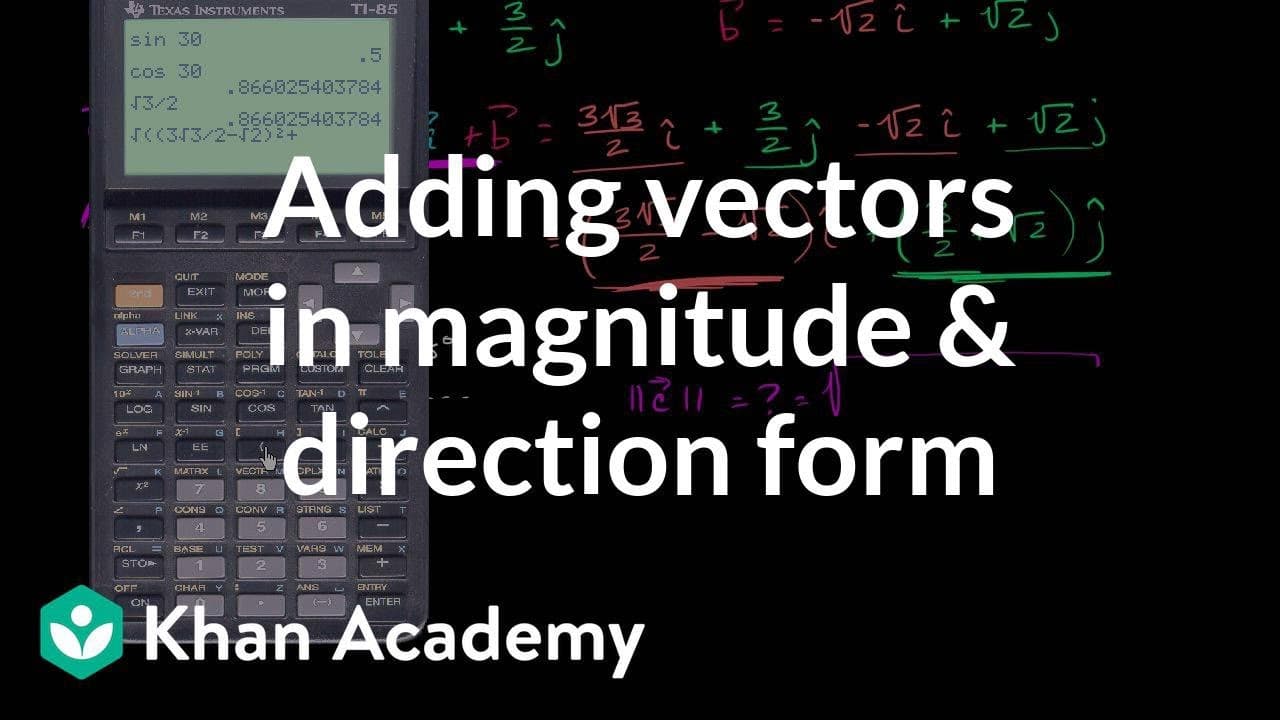
Voiceover: In the last video, we were able to figure out what vectors a plus b is when you view it from a component point of view, and so if we were to visualize that, that's vector a. Then let me paste vector b here. It's a little bit messy. That is vector b there. Actually, let me see if I can clean this up a little bit. Let me clean this up. I'l... Read More
Key Insights
- ❓ Vector addition involves both magnitude and direction of the resulting vector.
- ❎ The Pythagorean theorem is used to find the magnitude of a vector by calculating the square root of the sum of the squared magnitudes of its components.
- 🚥 The direction of a vector can be determined using the tangent function of the angle between the vertical and horizontal components.
- 🤪 The magnitude of an added vector is typically less than the sum of the magnitudes of the individual vectors, unless they are going in the exact same direction.
- 🈸 Understanding vector addition is crucial in various mathematical and physics applications.
- 🦻 Visualizing vectors and their components can aid in comprehending the concepts of magnitude and direction.
- 🖐️ Trigonometric functions, such as tangent, play a fundamental role in vector analysis.
Install to Summarize YouTube Videos and Get Transcripts
Explore YouTube Video Summarizer or Get YouTube Transcript Extractor
Questions & Answers
Q: How can the magnitude of a vector be calculated using the Pythagorean theorem?
The magnitude of a vector can be found by squaring the magnitudes of its horizontal and vertical components, summing them, and then taking the square root of the result.
Q: What equation can be used to determine the direction of a vector?
The tangent of the angle, also known as the arc tangent or inverse tangent, can be used to find the direction of a vector by relating the opposite side (vertical component) to the adjacent side (horizontal component) of a right triangle formed by the vector and its components.
Q: Is the magnitude of an added vector always equal to the sum of the magnitudes of the individual vectors?
No, the magnitude of an added vector is typically less than the sum of the magnitudes of the individual vectors unless they are going in the exact same direction. If the vectors are even slightly different in direction, the magnitude of the sum will be less.
Q: How does the magnitude of a vector relate to its components?
The magnitude of a vector is determined by the lengths of its horizontal and vertical components, as found using the Pythagorean theorem. It represents the overall length or size of the vector.
Summary & Key Takeaways
-
The magnitude of a vector is found using the Pythagorean theorem, which involves squaring the magnitudes of the vector's horizontal and vertical components and taking the square root of the sum.
-
The direction of a vector can be determined using the tangent function, which relates the opposite side (vertical component) to the adjacent side (horizontal component) of a right triangle formed by the vector and its components.
-
The magnitude of an added vector is typically less than the sum of the magnitudes of the individual vectors, unless they are going in the exact same direction.
Read in Other Languages (beta)
Share This Summary 📚
Summarize YouTube Videos and Get Video Transcripts with 1-Click
Try YouTube Summary with ChatGPT & Claude or YouTube Transcript Generator
Explore More Summaries from Khan Academy 📚



Summarize YouTube Videos and Get Video Transcripts with 1-Click
Try YouTube Summary with ChatGPT & Claude or YouTube Transcript Generator