How to Solve Circuit Equations Using Ohm's Law
TL;DR
To solve circuit equations, set up simultaneous equations based on Kirchhoff's laws and substitute Ohm's Law expressions. Eliminate one current variable through multiplication and addition, then substitute real values to find unknown currents and voltages. This process allows for effective circuit analysis and solution derivation.
Transcript
- So in the last video, we did our circuit analysis. We set up the four equations that we needed to solve in order to figure out all the voltages and currents in our example circuit. And so now, we're gonna solve it. This is a matter of doing the algebra to solve a set of four simultaneous equations. What I wanna do now is just write my equations d... Read More
Key Insights
- 😫 Circuit analysis involves setting up and solving a set of simultaneous equations.
- 😑 Ohm's Law expressions help substitute voltages with current variables in the equations.
- 🪜 By multiplying and adding equations, one unknown current can be eliminated.
- 👻 Substituting real values into the equations allows for the determination of unknown currents and voltages.
Install to Summarize YouTube Videos and Get Transcripts
Explore YouTube Video Summarizer or Get YouTube Transcript Extractor
Questions & Answers
Q: How many equations are needed to solve a circuit using algebra?
Four equations are needed to solve a circuit using algebra, with two equations for the voltage and two equations for the current.
Q: How are Ohm's Law expressions used in the circuit analysis?
Ohm's Law expressions are used to substitute for the voltages in the circuit equations, allowing the problem to be solved in terms of currents.
Q: How is one of the unknown currents eliminated in the solution process?
One of the unknown currents can be eliminated by multiplying one of the equations by a resistance value and adding the resulting equations together.
Q: What are the final values obtained in the circuit analysis?
The final values obtained in the circuit analysis are the two unknown currents (i1 and i2) and the voltages across the resistors (V1 and V2).
Summary & Key Takeaways
-
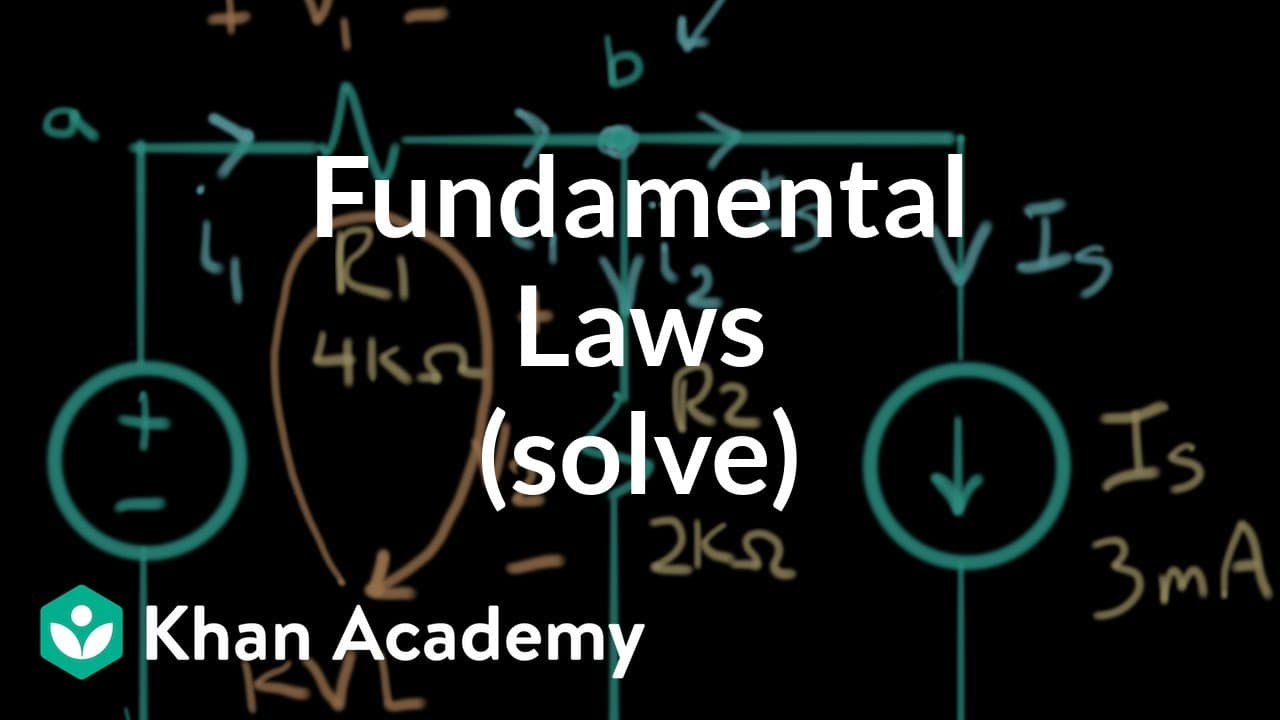
The video explains how to solve circuit equations using algebra by setting up four equations and substituting variables with Ohm's Law expressions.
-
By eliminating one of the currents through multiplication and addition, the solution for one current variable can be found symbolically.
-
The real circuit example involves a voltage source, resistors, and a current source. The unknown currents are determined by substituting values into the equations.
Read in Other Languages (beta)
Share This Summary 📚
Summarize YouTube Videos and Get Video Transcripts with 1-Click
Try YouTube Summary with ChatGPT & Claude or YouTube Transcript Generator
Explore More Summaries from Khan Academy 📚



Summarize YouTube Videos and Get Video Transcripts with 1-Click
Try YouTube Summary with ChatGPT & Claude or YouTube Transcript Generator