Multi-step inequalities 3 | Linear inequalities | Algebra I | Khan Academy
TL;DR
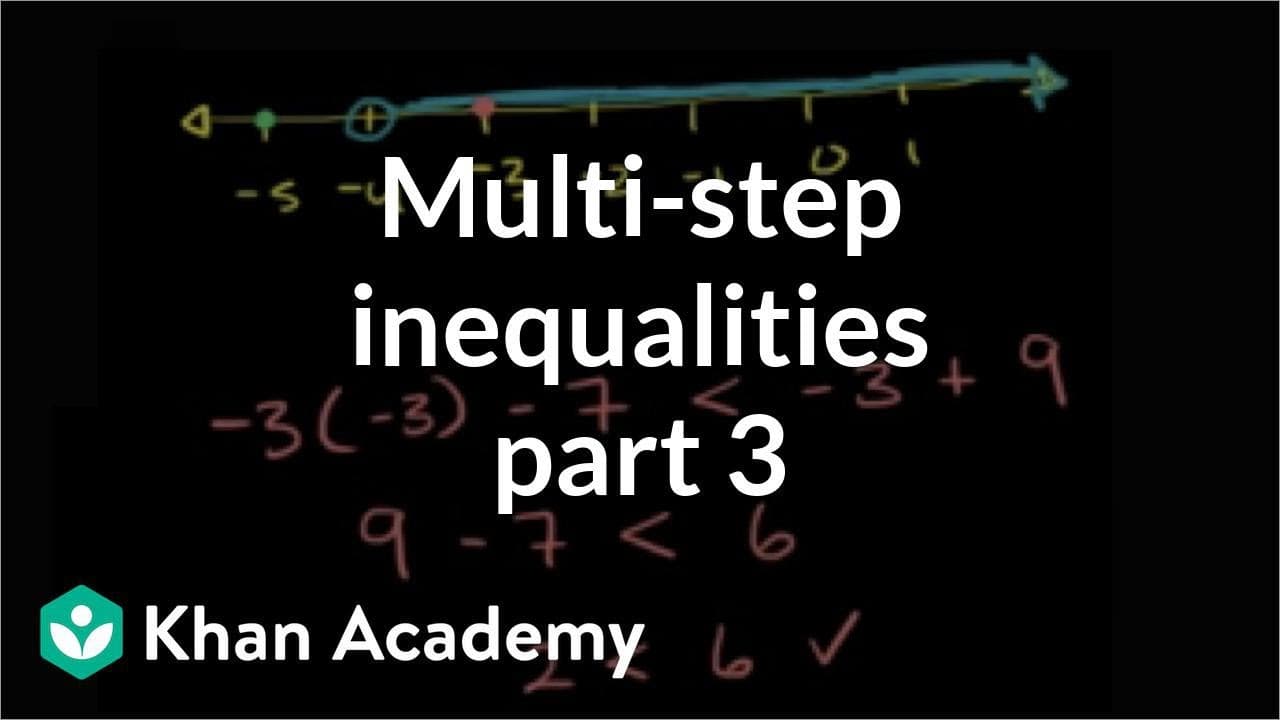
The video explains how to solve an inequality with variables on both sides step by step, and shows how to graph the solution set on a number line.
Transcript
We're asked to solve for p. And we have the inequality here negative 3p minus 7 is less than p plus 9. So what we really want to do is isolate the p on one side of this inequality. And preferably the left-- that just makes it just a little easier to read. It doesn't have to be, but we just want to isolate the p. So a good step to that is to get rid... Read More
Key Insights
- 🙃 Solving inequalities with variables on both sides involves isolating the variable on one side and using opposite operations to eliminate terms.
- 🙃 Maintaining the inequality requires performing the same operation on both sides simultaneously.
- 😫 Substituting values into the original inequality helps determine which values satisfy the inequality and belong to the solution set.
- 😥 Boundary points, such as the value that satisfies the related equation but not the inequality, need to be analyzed separately.
Install to Summarize YouTube Videos and Get Transcripts
Explore YouTube Video Summarizer or Get YouTube Transcript Extractor
Questions & Answers
Q: What is the first step in solving an inequality with variables on both sides?
The first step is to eliminate the variable on one side by performing the opposite operation. In this case, subtracting the variable from both sides is a common approach.
Q: Why should we perform the same operation on both sides of the inequality?
To maintain the inequality, whatever operation is performed on one side must also be performed on the other side. This ensures that the inequality remains valid throughout the process.
Q: How can we determine the solution set for the inequality?
After isolating the variable, we can graph the solution set on a number line. The different intervals represent the range of values for which the inequality is true.
Q: What is the difference between an inequality and a related equation?
An inequality represents a range of values where the inequality is either true or false. A related equation, on the other hand, represents a specific value that satisfies the equation. It is important to distinguish between the two when testing values.
Summary & Key Takeaways
-
The video demonstrates the steps to solve an inequality with variables on both sides, including isolating the variable on the left side and using appropriate operations to eliminate terms.
-
It emphasizes the importance of maintaining the inequality by performing the same operation on both sides simultaneously.
-
The video provides examples of substituting values to test if they satisfy the inequality and discusses the difference between the original inequality and the related equation.
Read in Other Languages (beta)
Share This Summary 📚
Summarize YouTube Videos and Get Video Transcripts with 1-Click
Try YouTube Summary with ChatGPT & Claude or YouTube Transcript Generator
Explore More Summaries from Khan Academy 📚



Summarize YouTube Videos and Get Video Transcripts with 1-Click
Try YouTube Summary with ChatGPT & Claude or YouTube Transcript Generator