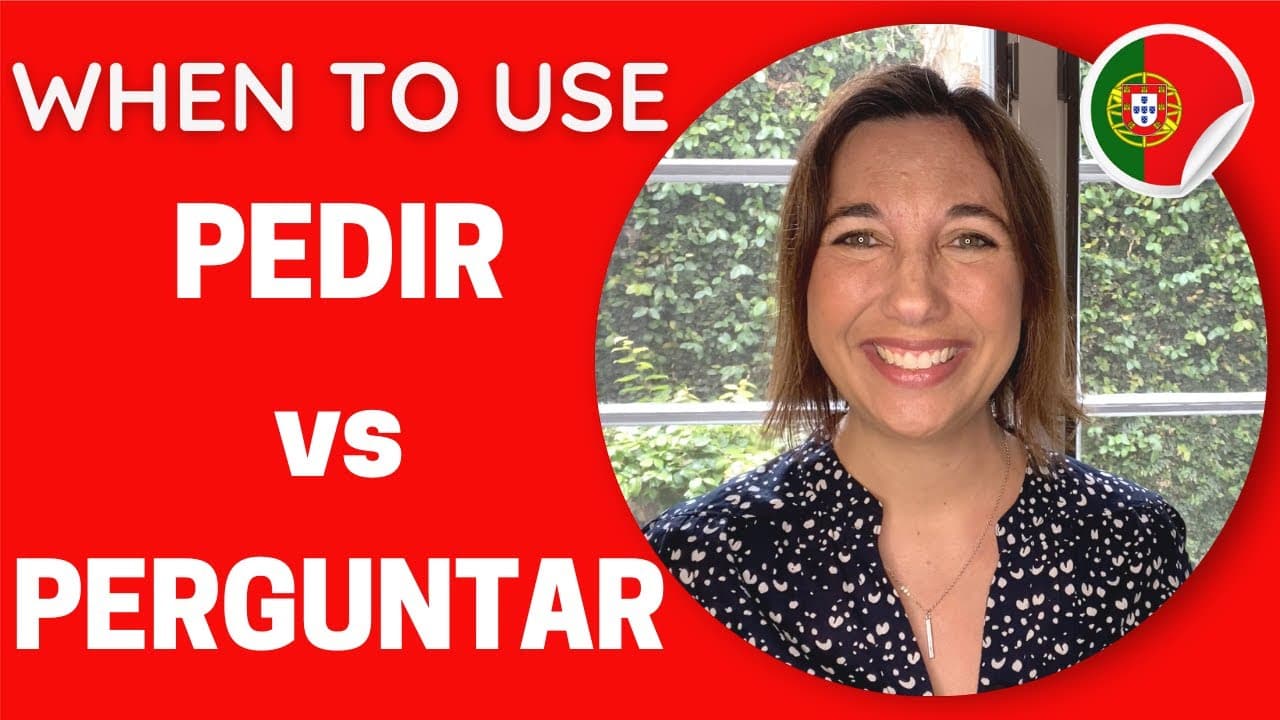
PEDIR vs PERGUNTAR in European Portuguese. 2 tricky verbs that mean "to ask"
TL;DR
Learn when to use 'pedir' and 'perguntar' in Portuguese.
Transcript
today i will be talking about the verbs and while in english we only have one verb to ask in portuguese we have two pivir and purgontad have specific uses from my experience these can be tricky for students to differentiate i'll explain when and how to use each with practical examples as usual if you enjoy my videos don't forget to subscribe yester... Read More
Key Insights
- In Portuguese, 'pedir' is used for making requests or demands, while 'perguntar' is used for asking questions.
- The verb 'pedir' is more commonly used than 'perguntar' and has a broader range of applications, including ordering and borrowing.
- 'Pedir' does not require a preposition in Portuguese, unlike the English 'to ask for.'
- 'Perguntar' is used with question words like who, what, when, where, and if, aiming to get an answer.
- The outcome of 'pedir' is often an action or object, whereas 'perguntar' results in a response or answer.
- In practical examples, 'pedir' might be used in contexts like ordering food, while 'perguntar' would be used inquiring about information.
- Understanding the noun forms related to these verbs, 'pedido' and 'pergunta', can help in distinguishing their uses.
- Practicing sentence construction and listening to native Portuguese can aid in mastering the use of these verbs.
Install to Summarize YouTube Videos and Get Transcripts
Explore YouTube Video Summarizer or Get YouTube Transcript Extractor
Questions & Answers
Q: What is the main difference between 'pedir' and 'perguntar'?
The main difference between 'pedir' and 'perguntar' is their usage context. 'Pedir' is used for making requests, demands, or asking for something tangible, while 'perguntar' is used for inquiring or asking questions to receive information or an answer.
Q: How is 'pedir' used in a sentence?
In a sentence, 'pedir' is used to express a request or demand. For example, "Eu pedi uma bicicleta aos meus pais" translates to "I asked my parents for a bicycle." It involves asking someone for something specific, often resulting in an action or object being provided.
Q: What are some common contexts for using 'perguntar'?
'Perguntar' is commonly used in contexts where information is sought. It is employed with question words such as who, what, when, where, and if. For instance, "Ele perguntou se podia ter um gelado" means "He asked if he could have an ice cream," highlighting the need for a response.
Q: Why is 'pedir' more frequently used than 'perguntar'?
'Pedir' is more frequently used because it covers a broader range of actions, such as requesting, ordering, borrowing, and demanding. Its versatility in various contexts, such as restaurants or formal requests, makes it more commonly applicable than 'perguntar,' which is specific to asking questions.
Q: Can 'pedir' and 'perguntar' be used interchangeably?
No, 'pedir' and 'perguntar' cannot be used interchangeably. They serve distinct purposes: 'pedir' is for requests and demands, while 'perguntar' is for asking questions. Using them interchangeably would result in incorrect sentence structures and meanings in Portuguese.
Q: What role do the nouns 'pedido' and 'pergunta' play?
The nouns 'pedido' and 'pergunta' help clarify the verbs' uses. 'Pedido' refers to a request or demand, aligning with 'pedir,' while 'pergunta' means a question, corresponding to 'perguntar.' Understanding these nouns aids in distinguishing the verbs' contexts and applications.
Q: How can learners practice using 'pedir' and 'perguntar'?
Learners can practice using 'pedir' and 'perguntar' by constructing sentences and engaging with Portuguese media, such as TV shows or conversations. Recognizing these verbs in context and practicing sentence formation will enhance understanding and proficiency in their correct usage.
Q: What is the opposite of 'pedir' and 'perguntar'?
The opposite of 'pedir' is 'dar,' meaning to give, as 'pedir' involves asking for something. The opposite of 'perguntar' is 'responder,' meaning to respond, as 'perguntar' involves seeking an answer. These opposites highlight the verbs' intended outcomes and usage contexts.
Summary & Key Takeaways
-
This video explains the different uses of 'pedir' and 'perguntar' in European Portuguese, highlighting their specific contexts and meanings. It provides practical examples to help learners understand when to use each verb correctly.
-
The key distinction between 'pedir' and 'perguntar' lies in their outcomes: 'pedir' results in an action or object being requested, while 'perguntar' seeks an answer to a question.
-
By understanding the nuances of these verbs and practicing with sentences, learners can improve their proficiency in Portuguese. The video also encourages engagement with Portuguese media for better comprehension.
Read in Other Languages (beta)
Share This Summary 📚
Summarize YouTube Videos and Get Video Transcripts with 1-Click
Try YouTube Summary with ChatGPT & Claude or YouTube Transcript Generator
Explore More Summaries from Learn European Portuguese Online 📚




Summarize YouTube Videos and Get Video Transcripts with 1-Click
Try YouTube Summary with ChatGPT & Claude or YouTube Transcript Generator