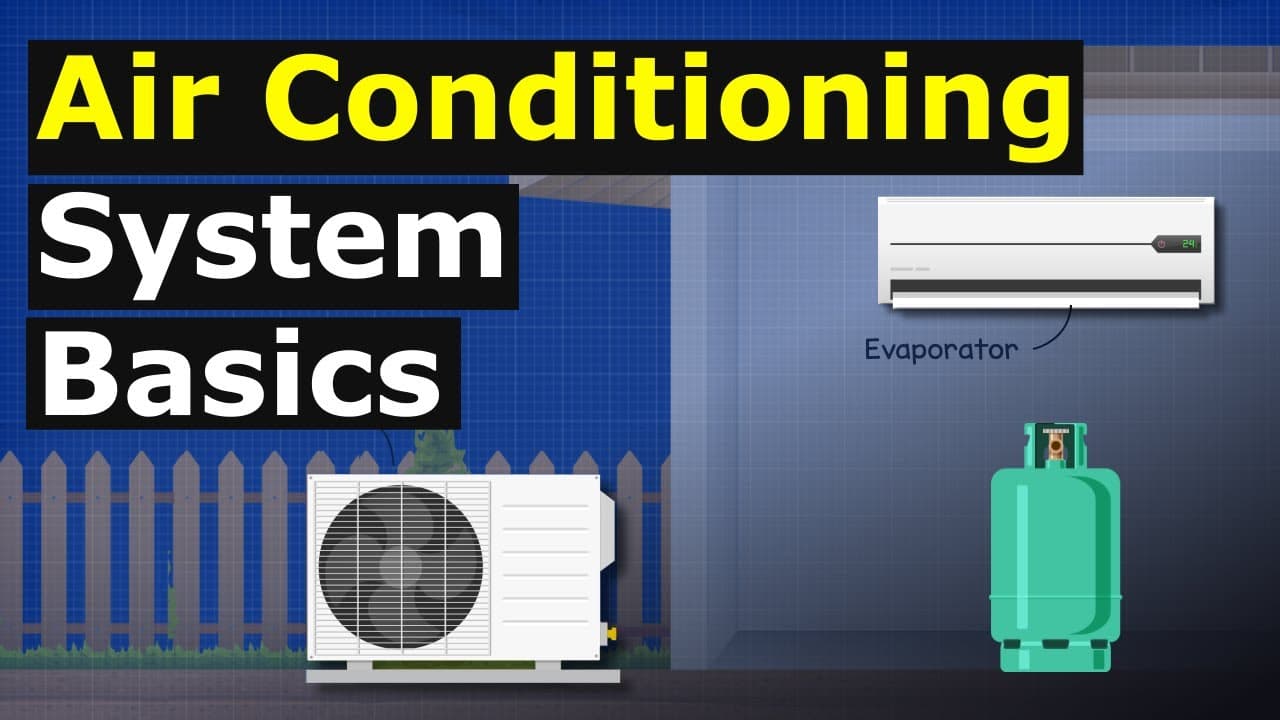
Air Conditioning System Basics hvacr how does it work
TL;DR
A refrigeration system consists of a compressor, condenser, expansion valve, and evaporator, with refrigerant circulating between these components to cool a room. Different types of expansion valves, such as fixed orifice and electronic, are used to regulate the flow of refrigerant and optimize system efficiency.
Transcript
sponsored by danfoss when we look at a typical refrigeration system we have the compressor the condenser the expansion valve and the evaporator the condenser and the evaporator are both heat exchangers the condenser sits outside the property and the evaporator sits inside the room being cooled the compressor circulates a refrigerant in the pipework... Read More
Key Insights
- 😎 A refrigeration system comprises a compressor, condenser, expansion valve, and evaporator, with refrigerant circulating between these components to cool a room.
- 🎴 The expansion valve plays a crucial role in regulating the flow of refrigerant, preventing liquid refrigerant from reaching the compressor and optimizing cooling efficiency.
- 🎮 Different types of expansion valves, such as fixed orifice, thermostatic expansion valve, and electronic expansion valve, offer varying levels of control and efficiency.
- 💝 Electronic expansion valves are the latest evolution in expansion valve technology, providing real-time, automatic adjustment based on precise temperature and pressure measurements.
- 🎮 Electronic expansion valves offer advantages such as improved system efficiency, precise temperature control, and integration with advanced control systems.
- 🧑🦽 Fixed orifice devices and thermostatic expansion valves are still widely used but have limitations in terms of temperature control accuracy and manual adjustments.
- 😎 The choice of expansion valve depends on factors such as system requirements, cooling demands, and desired level of control.
Install to Summarize YouTube Videos and Get Transcripts
Explore YouTube Video Summarizer or Get YouTube Transcript Extractor
Questions & Answers
Q: How does a refrigeration system work?
A refrigeration system works by circulating a refrigerant, which changes from a liquid to a vapor in the evaporator while absorbing heat from the room. The compressor then squeezes the vapor, raising its temperature and pressure before sending it to the condenser, where it condenses back into a liquid and releases heat to the outside air.
Q: What is the purpose of the expansion valve?
The expansion valve regulates the flow of refrigerant into the evaporator, controlling the superheat and preventing liquid refrigerant from reaching the compressor. It ensures efficient cooling and prevents potential damage to the system.
Q: What are the different types of expansion valves?
There are three main types of expansion valves: fixed orifice, thermostatic expansion valve (TXV), and electronic expansion valve. Fixed orifice devices have a fixed hole size and turn the system on and off to meet cooling demand. TXVs sense superheat to adjust the valve position manually. Electronic expansion valves use a controller to measure temperature and pressure and adjust the valve position automatically in real time.
Q: What are the advantages of electronic expansion valves?
Electronic expansion valves offer several advantages over fixed orifice and TXVs. They provide precise temperature and pressure control, ensuring optimal system performance and efficiency. They can continuously adjust valve position in real time, eliminating the need for manual calculations and adjustments. They also allow for peak system performance and can be easily integrated into advanced control systems.
Key Insights:
- A refrigeration system comprises a compressor, condenser, expansion valve, and evaporator, with refrigerant circulating between these components to cool a room.
- The expansion valve plays a crucial role in regulating the flow of refrigerant, preventing liquid refrigerant from reaching the compressor and optimizing cooling efficiency.
- Different types of expansion valves, such as fixed orifice, thermostatic expansion valve, and electronic expansion valve, offer varying levels of control and efficiency.
- Electronic expansion valves are the latest evolution in expansion valve technology, providing real-time, automatic adjustment based on precise temperature and pressure measurements.
- Electronic expansion valves offer advantages such as improved system efficiency, precise temperature control, and integration with advanced control systems.
- Fixed orifice devices and thermostatic expansion valves are still widely used but have limitations in terms of temperature control accuracy and manual adjustments.
- The choice of expansion valve depends on factors such as system requirements, cooling demands, and desired level of control.
- Continual advancements in refrigeration technology contribute to improved energy efficiency and overall system performance.
Summary & Key Takeaways
-
A typical refrigeration system is made up of a compressor, condenser, expansion valve, and evaporator.
-
The refrigerant, a specially designed fluid with a low boiling point, circulates between these components to cool the room.
-
The expansion valve controls the flow of refrigerant, ensuring it does not damage the compressor and optimizing cooling efficiency.
Read in Other Languages (beta)
Share This Summary 📚
Summarize YouTube Videos and Get Video Transcripts with 1-Click
Try YouTube Summary with ChatGPT & Claude or YouTube Transcript Generator
Explore More Summaries from The Engineering Mindset 📚


Summarize YouTube Videos and Get Video Transcripts with 1-Click
Try YouTube Summary with ChatGPT & Claude or YouTube Transcript Generator